
Last checked: August 2026 · Written by the player-led team at Badminton House
Quick answer
No fixed timeout: BWF badminton injury rules do not provide a tennis-style fixed medical timeout.
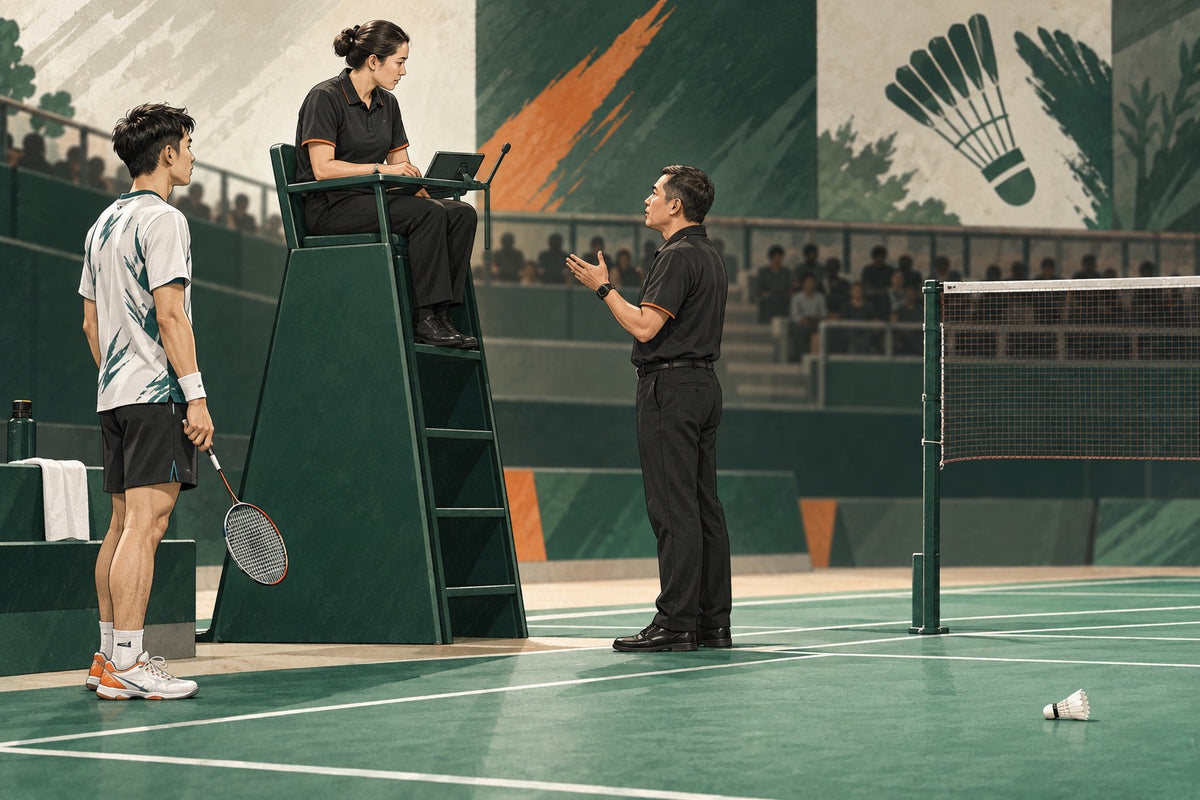
Ordinary process: if an injury requires the Referee, the umpire calls the Referee and times the delay. The Referee controls access, the Tournament Doctor advises, and the player quickly chooses whether to continue or retire.
Emergency exception: severe emergencies use the immediate-care exceptions.
This guide explains the official procedure used under the BWF Laws and Instructions to Technical Officials in force on the checked date. It does not diagnose an injury or tell a player whether treatment is medically appropriate. Local events may have fewer officials in club-level competition, but they should not invent extra entitlements and call them BWF rules.
The central distinction is between managing an unexpected injury and delaying to recover. The current Laws of Badminton require continuous play outside the stated intervals and suspensions, forbid delay to recover strength or wind, and make the umpire the sole judge of delay.
Related reading: compare an in-match retirement with a pre-match absence in our walkover, retirement and default guide.
What happens when a player is injured on court?
If an injury or illness requires the Referee, the umpire uses the raised-right-hand signal. The Referee first gets the facts, decides whether the Tournament Doctor or anyone else is needed, and reminds the umpire to time the delay. The doctor advises; in ordinary cases, the player quickly decides whether to continue.
The sequence comes from the current BWF Instructions to Technical Officials. A player asking for the doctor does not automatically bring the doctor onto court. The Referee receives the umpire's facts and decides whether medical attendance is needed under the procedure.
| Person | Current procedural role | What that role does not mean |
|---|---|---|
| Umpire | Stops play as needed, signals for the Referee and supplies facts. | The umpire does not diagnose the problem or award a fixed timeout. |
| Referee | Manages access, timing, fairness and the prompt resolution of the situation. | The Referee does not make the ordinary player decision to continue. |
| Tournament Doctor | Advises whether continuing is medically advisable and may give permitted quick relief. | Doctor attendance is not an open-ended treatment session. |
| Player | Makes the ordinary continue-or-stop decision after advice. | The decision cannot be stretched into extra recovery time. |
The doctor may give quick relief, with bandaging flowing blood named as an example. Time-consuming treatment is restricted to the regular intervals and only when the doctor expects it can be completed, or nearly completed, before that interval finishes. Ordinary injury handling must not become a second interval created for treatment.
The Referee may allow no more than two people on court to assist, advise or translate, and must give the opponent equal consideration. This is discretionary. It does not create an automatic right to two coaches, two medical staff or an entourage around the injured player.
A clean practical sequence begins with facts, not treatment requests. The umpire can state the score, what was observed, how long play has been stopped and what the player has said. The Referee can then decide whether medical input is required and who may enter. This keeps the medical decision separate from the player's wish for rest.
The opponent must receive the same consideration under the two-person assistance provision. The source does not require identical actions for both sides; the Referee must apply the provision fairly.
Timing is an official record, not a countdown entitlement. The umpire times the delay so the Referee can see whether the process remains within the expected prompt boundary. A player cannot point to the phrase “a few minutes” and demand the balance of a self-created allowance after the decision is already clear.
There is no fixed medical-timeout number
The ITTO tells the Referee to resolve the matter quickly and well within a few minutes so play resumes or is abandoned. “Well within a few minutes” is procedural guidance, not a guaranteed stopwatch allowance that a player can use in full.

Can a player use cold spray or adjust taping?
During regular intervals, a player may use personal spray and a coach or medical person may administer it. Between rallies without a Time Clock, the umpire may permit self-applied spray without undue delay. With a Time Clock, self-applied cold spray and taping or strapping adjustment must finish before the 25-second clock expires.
This point changed. An official BWF technical-official newsletter reporting medical policy changes describes changes dated 15 November 2024 that removed the former Tournament Doctor allowance to administer one cold spray per player per match. It separately says players may use their own spray during regular intervals and that a coach or medical person may administer it then.
The later ITTO adds the between-rally detail. Without a Time Clock, the umpire may permit a player to self-apply spray when play is not unduly delayed. With the Time Clock, the player may self-apply courtside before the 25 seconds expire. These clauses do not restore doctor-administered on-court spraying.
| Situation | What the current documents support | Boundary |
|---|---|---|
| Regular interval | Player's own spray; coach or medical person may administer it. | The interval length does not expand. |
| Between rallies, no Time Clock | Umpire may permit self-application. | Play must not be unduly delayed. |
| Between rallies, Time Clock | Player may self-apply courtside before 25 seconds expires. | No extra time and no doctor administration. |
| Taping or strapping, Time Clock | Player may make an adjustment before the clock expires. | Not a separate therapeutic-taping break. |
Rules answer whether an action fits the match procedure; they do not say the action is medically useful or appropriate for a particular injury. A player should not read the spray allowance as treatment advice, and an official should not turn a product decision into a diagnosis.
The 25 seconds is the ordinary between-rally clock, not an injury timeout. Without a Time Clock, the listed allowance is self-applied spray. Taping or strapping adjustment appears only in the Time Clock list.
Without the Time Clock, self-applied spray depends on umpire permission and no undue delay. With the Time Clock, the instruction supplies a visible deadline but does not remove other control. The action happens courtside and ends before the clock expires.
During a regular interval, assistance is broader only within the interval's normal framework. A coach or medical person may administer the player's own spray then, but the interval still ends on schedule. If more treatment is required, the doctor and officials apply the separate treatment boundary rather than silently extending the break.
What about bleeding, cramp and footwear?
Flowing blood has a specific procedure: play should wait until bleeding stops and the wound is dressed, unless the Referee directs otherwise, and blood on court should be cleaned promptly. Current documents do not grant a special cramp timeout or an injury-specific right to remove or change footwear during extra treatment time.
The bleeding instruction is about making the court and wound ready for play, not awarding a fixed number of minutes. Quick bandaging can be part of permitted relief. If the situation becomes severe, ordinary pacing gives way to medical and emergency priorities.
Cramp still falls under the general injury and delay framework. No separate current cramp entitlement was located in the operative BWF documents reviewed. A player cannot assume that a familiar symptom creates guaranteed treatment time; the Referee still manages the situation and the player still reaches a prompt continue-or-retire decision.
The reviewed injury provisions do not create an injury-specific footwear-removal or footwear-change timeout. Any separate equipment issue must be handled under the applicable event rules; footwear adjustment should not be presented as an injury entitlement.
These absences matter because familiar tournament habits can harden into invented rules. A local official may have seen a player retape an ankle, remove a shoe or receive spray at another event. That observation does not establish a universal entitlement. The operative event documents and the Referee's instruction control the present match.
Players can prepare without trying to predict every injury. Arrive with permitted personal supplies organized, understand whether the event uses the Time Clock and ask officials where regular-interval assistance occurs. Preparation shortens confusion; it does not guarantee that a requested action will be allowed outside its documented condition.
- Do not invent a duration: neither bleeding nor cramp converts “well within a few minutes” into a guaranteed minimum or maximum.
- Do not confuse clothing tape with treatment: rules about marks on clothing answer a different question from athletic taping or strapping adjustment.
- Do not promise doctor entry: routine attendance remains under the Referee's procedure.
- Do not use a rule guide as medical clearance: being procedurally allowed to resume does not establish that resuming is safe.
For club events without a Tournament Doctor, organizers should publish their emergency and retirement procedure before play and identify who has Referee authority. They should not imitate only the visible part of an elite procedure, such as allowing spray, while omitting emergency access, timing, blood cleanup and the authority to stop play.
How does a player retire, and when can the doctor enter immediately?
When the player confirms retirement, the umpire announces the retirement, winner and score, then records the retirement notation. Later consequences depend on the event format and regulations. In suspected cardiac arrest or suspected concussion with blackout, the Tournament Doctor may attend immediately without waiting for Referee direction.
Retirement is an in-match outcome, not a pause while the player decides indefinitely. The umpire confirms the decision and completes the formal announcement. The score at that point is part of the record, while the opponent becomes the match winner.
What happens next is not identical across every competition. The BWF General Competition Regulations distinguish consequences for other individual events, team ties and group formats, with specified exceptions. Tournament players should check the prospectus and event rules rather than assume one retirement consequence.
Under the current GCR, retirement or withdrawal from one event means the player must be withdrawn from other entered events, with an exception for the BWF World Senior Championships. In a team tie, the player cannot play later matches in that tie but can participate in future ties. Those are different consequences arising from different competition structures.
In group play, retirement during a match counts as not completing all group matches, so all that player's or pair's group results are deleted. This is why the match announcement and later draw consequence should be explained separately. The umpire records what happened in the match; the applicable event regulation determines what happens to the wider competition record.
The retirement notation is Ret, without a period, under the current BWF Vocabulary. That precise notation distinguishes the formal result from casual descriptions of a player stopping an underway match.
Emergency exception
The current ITTO expressly allows immediate Tournament Doctor attendance without Referee direction for suspected cardiac arrest or suspected concussion with blackout. This narrow exception exists to accelerate emergency care. It must not be used to argue that routine aches, cramp or equipment adjustments trigger automatic doctor entry.
An unmistakably severe injury overrides the ordinary decision process: the doctor provides first aid pending hospital transport. Officials should protect the player and court, apply the emergency procedure and avoid treating competitive continuity as more important than immediate care. The ordinary continue-or-retire process is disregarded for a player covered by the severe-injury exception.
For players, the practical preparation is administrative: know who the Referee is, where event medical help is located, what the prospectus says about withdrawal and how your other events may be affected. These checks do not prevent injury, but they remove guesswork when a decision must be made quickly.
Remember the current sequence
- Umpire assesses the incident and calls the Referee if necessary.
- Referee gets the facts and controls access; the umpire times the delay.
- Tournament Doctor advises when summoned; quick relief stays within the rules.
- Player promptly continues or retires, except where emergency action takes priority.
- Officials record the result and apply the specific event regulations.


Leave a comment
This site is protected by hCaptcha and the hCaptcha Privacy Policy and Terms of Service apply.