
Last checked: August 2026 · Written by the player-led team at Badminton House
Quick answer: conditioned badminton games
Change one rule so the game repeatedly asks for the skill you want to practise. Keep the court normal enough to recognize, score the intended behaviour, and stop the round when players begin reaching, landing, or swinging without control.
Solo pair
Use zone rules: make one area unavailable so both players must choose a different shot.
Score
Give points for the behaviour you want, not only for winning the rally.
Reset
Play short blocks, then remove the condition and check whether the new choice survives.
Drop-in players often get plenty of matches and almost no deliberate practice. These games turn one ordinary match into a small experiment: change one rule, notice which shots appear, and keep the condition only long enough to make the weakness visible.
The BWF Shuttle Time manual describes games as motivating while also warning that correct technique still needs attention. Read the BWF Shuttle Time manual. The rules below are Badminton House practice designs, not official competition formats.
Use first to 5 or first to 7 for a short block. If a game makes players dive, collide, or repeat a painful movement, stop and return to cooperative feeds. For broader session structure, see our badminton practice games guide.
1. Rear court out: reduce panic lifts
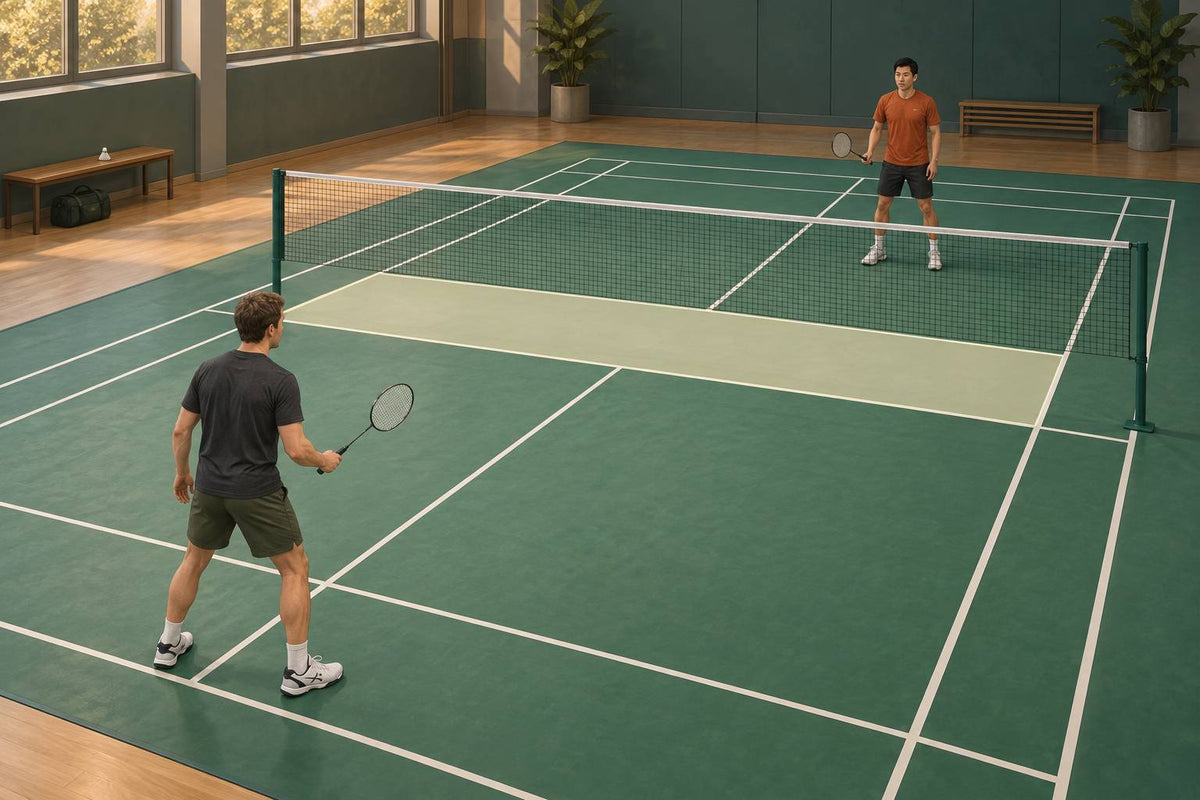
This two-player singles game makes the rear court unavailable for scoring, so a player under pressure must find a controlled net shot, block, drive, or short lift instead of automatically sending the shuttle long.

- Setup: use half or full singles court, with normal service and a first-to-7 score.
- Rule: after the receiver has returned the serve, a shuttle landing beyond the opponent’s short service line loses the rally for the hitter. The rally may travel through the rear court; only the landing zone is restricted.
- Self-check: after each rally, name the safer option you could have used instead of the lift.
- Pass: play 7 points with fewer than two rushed lifts and no dive or unstable reach.
2. Front court out: train clear length
This reverse zone game removes the front court as a scoring target, making a short defensive clear immediately visible. It gives players a simple reason to contact the shuttle cleanly and send it beyond the short service line.
- Setup: play singles with the normal rear boundary and first to 7.
- Rule: a shuttle landing before the opponent’s short service line loses the rally for the hitter. Drives and net shots are therefore tactical risks, not default choices.
- Self-check: call “short,” “mid,” or “long” after your clear before looking at the result.
- Pass: achieve five clears that land past the short service line without shortening your preparation or falling away.
3. Middle lane out: make shot selection visible
A narrow centre lane becomes out of bounds, forcing players to choose the body, a sideline, or a deliberate corner instead of repeatedly sending safe shuttles through the middle.
- Setup: use singles or doubles and mark an imaginary lane about one racket length wide along the centre.
- Rule: a shuttle that lands in the lane loses the rally for the hitter. In doubles, keep the lane narrow enough that it does not erase ordinary middle exchanges.
- Self-check: before serving, each player names one safe target and one change-up target.
- Pass: complete a short game without using the same target three times in a row.
4. Two versus one: rebuild recovery to base
The one-player side faces continuous feeds from a pair, which exposes late recovery and poor base positioning quickly. Short rounds and frequent swaps keep the challenge useful rather than turning it into a fatigue contest.
- Setup: use three players, one full singles court, and 45–60-second rounds. The single player serves every rally; the pair stays on its half.
- Rule: the pair must alternate which partner returns the single player’s serve. The pair may score only after the single player has returned that first shot; if the pair wins before that reply, replay the rally. The single player scores by winning the rally.
- Self-check: after every shot, freeze briefly at the base position rather than watching the shuttle.
- Pass: complete two rounds with controlled stops and no repeated late lunges.
5. Double points for a clean net kill
This scoring change gives slow net hands a reason to prepare the racket early. It rewards a controlled downward interception, while ordinary rally points remain available so players do not swing recklessly at every loose shuttle.
- Setup: play singles or doubles to 7 points with normal boundaries.
- Rule: a clean net kill is worth 2 points; every other rally win is worth 1. The shot must be controlled and legal, with no dive or contact with the net.
- Self-check: start with the racket head above the hand and move forward only when the shuttle is available.
- Pass: score two net kills without missing because of a rushed swing or late preparation.
6. King of the court: remove predictable patterns
A rotating king-of-the-court format gives a larger group repeated short turns. Add a no-lift scoring condition for one block so players must vary between net, drive, block, and attack rather than choosing the same escape every rally.
- Setup: use four or more players, with two on court and the next two waiting at the entry side.
- Rule: the winning side stays for one rally only. During the conditioned block, a rally containing a deliberate lift earns no point for either side; replay it once and continue.
- Self-check: say the shot family you are choosing before the serve: net, drive, block, or attack.
- Pass: identify three different successful shot families before the block ends.
How do you know the game helped?
Remove the condition for five normal rallies and look for the same decision without the special score. If the player immediately returns to the old fault, repeat a shorter block, then reduce the bonus or zone restriction before returning to normal play.
- Write down the weakness before starting.
- Play one short conditioned block.
- Record one technical sign, not only the score.
- Remove the condition and test five ordinary rallies.
The best conditioned badminton game makes one choice easier to notice. Keep it short, keep the movement clean, and return to ordinary scoring often enough to see whether the new habit belongs in your real game.

Leave a comment
This site is protected by hCaptcha and the hCaptcha Privacy Policy and Terms of Service apply.