Shoes & Gear

Yonex MAVIS 250 Nylon Shuttlecock Speeds: Green, Blue and Red

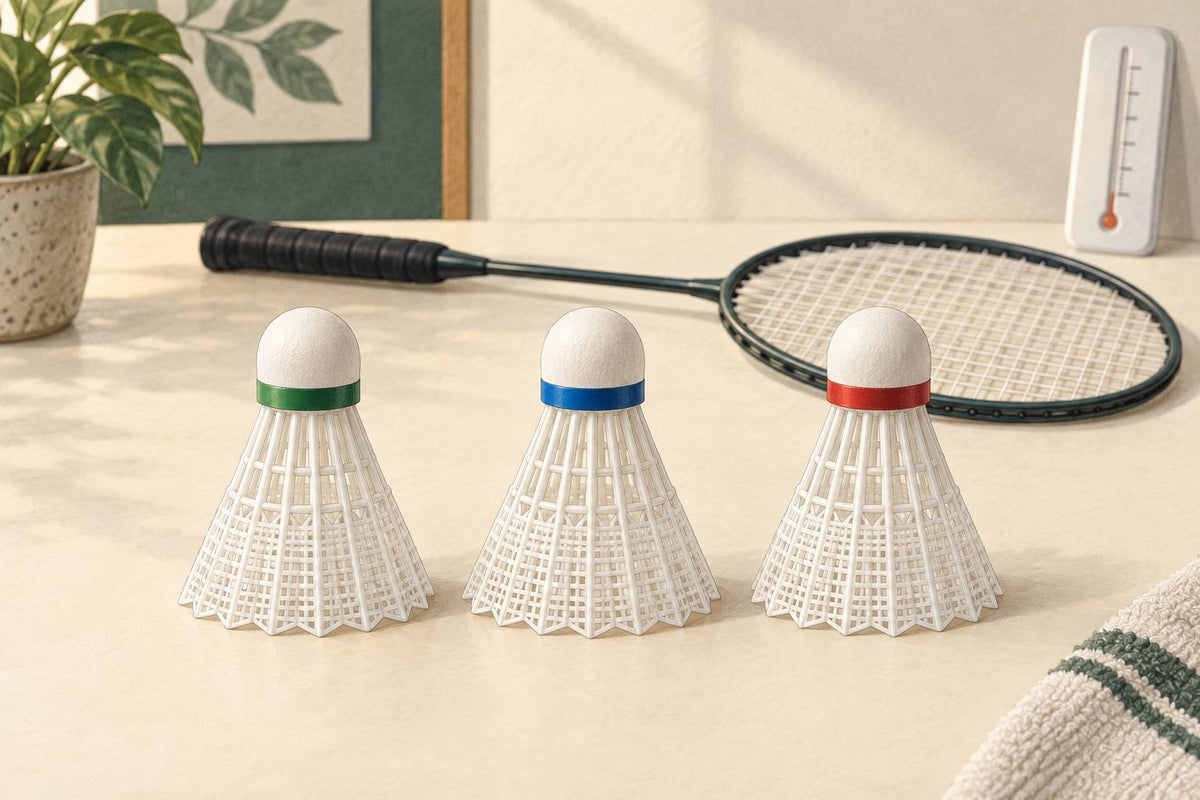
Three unbranded nylon shuttlecocks with green, blue, and red cap bands are paired with indoor condition cues.

Last checked: August 2026 · Written by the player-led team at Badminton House

Quick answer

For Yonex MAVIS 250, green is slow for 22–33°C, blue is medium for 12–23°C, and red is fast for 0–13°C. The cited MAVIS sources do not establish a cross-brand or cross-model cap-colour standard.

Start with MAVIS 250 cap colours and temperatures

Use the cap colour only after identifying Yonex MAVIS 250. Its published green, blue, and red temperature pairings are model-specific information; the cited source does not establish that every nylon shuttle brand or model uses the same colour system.

  1. Check that the tube is MAVIS 250 before applying a cap-colour meaning.
  2. Match green, blue, or red only to the published MAVIS 250 temperature range.
  3. If the model or brand differs, look for that product’s own information instead of borrowing the MAVIS colour code.
  4. Keep cap selection separate from a claim that one colour exactly reproduces another hall or shuttle model.

MAVIS 250 cap colours and temperatures

For Yonex MAVIS 250, green cap denotes slow for 22–33°C, blue medium for 12–23°C, and red fast for 0–13°C. The official MAVIS 250 page gives the cap, speed, and temperature pairings. It does not establish an exact player setup or personal fit. Yonex MAVIS 250

Three unbranded nylon shuttlecock cap bases in green, blue, and red paired with warm, neutral, and cool indoor cues; exact temperatures remain in the article text, with no rendered words or numbers.
MAVIS 250 cap colours and temperatures: Three unbranded nylon shuttlecock cap bases paired with warm, neutral, and cool indoor cues.

The useful answer is exact: MAVIS 250 green is listed as slow for 22–33°C, blue as medium for 12–23°C, and red as fast for 0–13°C. Those ranges are a product-page reference for that model, not a general definition of every green, blue, or red nylon cap.

Read the three pairings as one product record. The cap colour, descriptive speed, and temperature range belong together on the MAVIS 250 page. Separating the colour from the model would make the source look broader than it is. The page does not say that a green cap from another brand, or even another nylon model, carries the same selection meaning in a different hall.


Why nylon-skirt temperature matters

Yonex says nylon-shuttle skirt hardness varies with temperature, which is why its MAVIS speed options are temperature-specific. The product description links temperature to the continuous nylon skirt; it does not supply a cross-brand colour ranking or a personal flight prediction. Yonex MAVIS 250

One unbranded nylon shuttle with a continuous skirt, warm and cool indoor cues, and a non-directional pointer to the skirt; no cap chart or speed ranking.
Why nylon-skirt temperature matters: Temperature cues point to the continuous nylon skirt without creating a cap chart or speed ranking.

Temperature matters to the model-specific selection information, which is why a reader should identify the tube before guessing from colour. If another brand or MAVIS model is in hand, do not apply this MAVIS 250 cap key; consult that exact product’s own published information.

The source’s explanation is about the nylon skirt on MAVIS 250: Yonex says its hardness varies with temperature, and presents speed options for that reason. It is not an instruction to infer a player’s ideal shuttle from colour alone. The product page does not test a personal preference, an exact flight match between halls, or a cross-brand colour hierarchy, so those decisions need their own model-specific information.


Where the MAVIS colour system stops

Yonex MAVIS 200 also links shuttle selection to air density and lists blue as medium for 12–23°C. The MAVIS 200 page provides that model-specific product information. A named product record is not a universal equipment verdict. Yonex MAVIS 200

Two distinct unbranded nylon-shuttle tubes, each cap linked only to its own tube, with a crossed transfer arrow between the two records.
Where the MAVIS colour system stops: Keep each cap reference with its own exact product record.

The cited product pages do not establish a cross-brand colour standard or a perfect hall-equivalence rule. Use the MAVIS 250 pairing accurately, then keep any further choice tied to the exact product and session rather than a universal colour story.

MAVIS 200 is useful here as a second model record, not as proof that the two models are interchangeable. Its page also lists blue as medium for 12–23°C and refers to air density, while the MAVIS 250 page explains its temperature-specific skirt behaviour. The overlap in one listed blue range does not establish an exact equivalence across models, halls, or conditions outside the information each maker publishes.

Compare product records, not colours alone

MAVIS 250 and MAVIS 200 show why a colour needs its product name. The MAVIS 250 record lists green as slow for 22–33°C, blue as medium for 12–23°C, and red as fast for 0–13°C. The MAVIS 200 record also lists blue as medium for 12–23°C and links selection to air density. Read each page as information about the named model, not as a combined cross-model colour legend.

For a local session note, record the exact tube, the maker’s stated cap reference, and the indoor conditions being considered. If the tube changes, restart the product check rather than carrying a colour conclusion across models.

Choose by model and hall

  1. Confirm the exact nylon shuttle model before reading a cap colour.
  2. Check the maker’s model-specific temperature or speed guidance.
  3. Match the choice to the hall and the session or event requirement.
  4. Do not transfer one model’s cap-colour rule to another model without checking its maker.

Questions the cited sources do not settle

  • That green, blue, and red mean the same speed for every nylon-shuttle brand.
  • Exact equivalence across models, halls, or altitudes.

Browse nylon shuttlecocks

Player-first advice for your next indoor session

Reading next

Indoor badminton player holding one unbranded racket, with a clinician and neutral three-marker screening card.
An indoor badminton player checks a neutral local air-quality observation before deciding whether to practise.

Leave a comment

This site is protected by hCaptcha and the hCaptcha Privacy Policy and Terms of Service apply.