
Last checked: August 2026 · Written by the player-led team at Badminton House
Quick answer
No cited source establishes a standard 2v1 setup, timing, rotation, or work-to-rest ratio. BWF supports progressing toward more complex, restricted-choice, opponent-cue practice, so 2v1 is best described as a local constraint design.
Start with Treat 2v1 as a local constraint, not a standardized drill
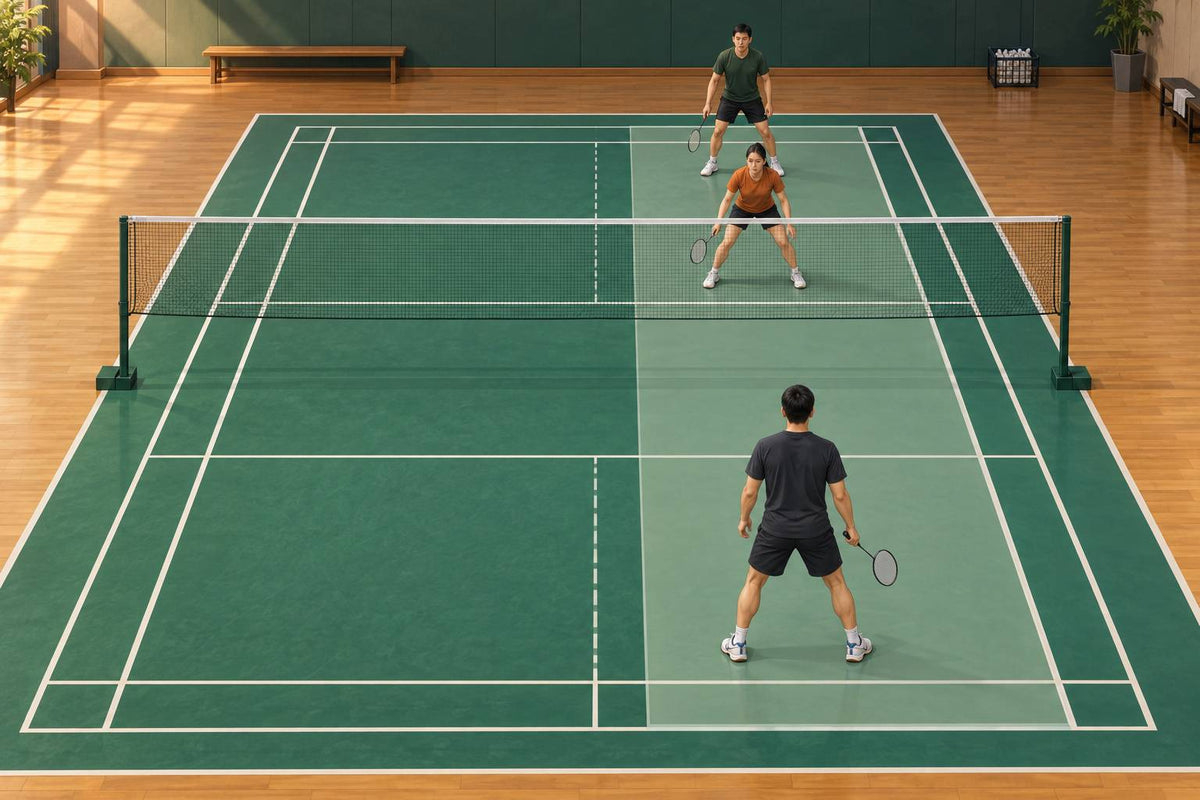
Treat 2v1 as a coach-designed constraint, not a standard BWF drill. A useful local version names the solo player, the pair, the usable court area, the cue, rotation, and one changed rule; it does not claim a prescribed timing, work-to-rest ratio, or transfer result.
- Use one solo player against a pair in a clearly agreed half court, with one visible cue such as recovering to a named central area.
- Run a first local variant where the pair sends predictable shots and the solo player names the cue before returning.
- Rotate the solo role after the agreed block, then use a second variant that changes one constraint such as the pair’s second-shot option or usable target area.
- Review whether the cue remained visible; if it did not, return to the predictable version rather than adding more pace or calling the activity a BWF format.
Related reading: 7 Badminton Conditioned Games to Challenge Club-Night Habits — for other coach-designed game constraints.
Treat 2v1 as a local constraint, not a standardized drill
BWF coaching guidance calls for stated session goals, evaluation, and progression from simple to complex, slow to fast, and predictable to unpredictable. The Level 1 coaching-process and progressive-practice sections state these principles. The manual provides a teaching principle, not a fixed protocol. BWF Level 1 Manual

Give the solo player one visible decision cue
BWF Level 3 supports restricted-choice, opponent-cue, and game-like practices for anticipation rather than practice disconnected from tactical context. The manual discusses opponent cues and functional, restricted-choice practice. Exact local practice choices remain outside the manual’s scope. BWF Level 3 Manual

A second variant can change exactly one local constraint. For example, keep the same players and court area while allowing the pair a different second-shot option, or keep the same shot choices while changing the solo player’s target. This is a coaching design, not a tested progression.
Simplify the local task when the cue is obscured
If the 2v1 arrangement obscures the intended cue, simplify it to a 1v1 task as a local design choice. BWF does not establish 2v1 scoring, rotation, work-to-rest ratio, or transfer effect; its sources offer practice principles rather than an evaluated 2v1 protocol. BWF Level 1 Manual and BWF Level 3 Manual

Set a three-player constraint before the first feed
- Name the solo player, the paired side, the usable court area, and the one visible cue the solo player is meant to read. A clear first version gives every participant a role without presenting the arrangement as a standard competition format.
- Write the pair’s permitted choices, the solo player’s allowable response, the reset after an error, and the rotation order. If a player waiting to rotate cannot explain the task, reduce the arrangement until the constraint is visible from the sideline.
- When adding difficulty, change one element only: the pair’s second option, the usable area, the starting feed, or the solo player’s target. Keep the cue and other conditions stable so the new version has an identifiable purpose.
- Use a simplified one-versus-one version when the three-player arrangement obscures the question. Simplifying is a design choice that restores a readable task, not evidence that one format is better for every player.
Name who takes the solo role next, who moves to the paired side and when play pauses for the change. Keep the active layout at two against one, and write any waiting role or move to one against one on the next practice card.
Keep the first 2v1 constraint readable
| Observation | Record |
|---|---|
| Planned cue | The solo player reads one named opponent position |
| Permitted option | One clear reply remains available |
| Observed cue | Record whether the solo player could see it |
| Next change | Add one constraint only if the cue stayed visible |
- Name the solo player, the pair, the usable area, and one visible cue.
- Use a predictable first version before giving the pair another option.
- Rotate the solo role through the agreed local block.
- Change one constraint only after the solo player can describe the cue being read.
Questions the cited sources do not settle
- That 2v1 improves defence, attack, decision-making, court control, or match fitness.
- Exact player positions, rotations, timings, or safety rules as evidence-led prescriptions.
What to do next
If the solo player’s cue becomes invisible, return to the predictable version instead of adding pace or another constraint.

Leave a comment
This site is protected by hCaptcha and the hCaptcha Privacy Policy and Terms of Service apply.