
Last checked: August 2026 · Written by the player-led team at Badminton House
Badminton officiating runs on three tiers of authority: line judges and the service judge watch one specific thing each, the umpire runs the match itself, and the referee runs the whole tournament. An appeal has to climb that chain in order, and only certain kinds of disputes can climb it at all.
Related reading: what a misconduct warning actually costs you if a dispute goes wrong
Who is actually in charge: line judges, the umpire and the referee
Three tiers of officials can rule on a badminton match. A line judge or service judge watches one specific thing and reports to the umpire. The umpire runs the match, the court and its surrounds, and reports to the referee. The referee has overall charge of the tournament itself.
Splitting the job this way keeps each official's task narrow: line and service judges rule on their assigned duties, while the umpire manages the match as a whole.
| Official | Rules on | Reports to |
|---|---|---|
| Line judge / service judge | One assigned line, or service faults by that server | The umpire |
| Umpire | The match itself, plus any appeal on a point of dispute raised before the next serve | The referee |
| Referee | Unsatisfied appeals the umpire refers up, on questions of law only | Top of the chain for that tournament |
The Laws of Badminton put the first two tiers in plain terms: the umpire, where appointed, is in charge of the match, the court and its immediate surrounds, and reports to the referee, who is in overall charge of the tournament or championship, per the Laws of Badminton, Section 4.1. A service judge, where one is appointed, has a single narrow job on top of that: calling service faults made by the server. Everything else on the line-calling and match-running side sits with the umpire.
Plenty of matches, especially at club level, run without line judges or a service judge at all. When an appointed official is unsighted, the umpire either carries out that official's duties directly or plays a let. If an official was never appointed in the first place, the umpire arranges for those duties to be covered the same way. The chain does not shrink so much as collapse into one person: at a club night the umpire, or whoever is running the event, ends up wearing every hat at once, while at a national event with a full officiating panel the same two-step appeal (umpire first, referee only for an unresolved rule question) still applies underneath the extra layers.
Is your dispute a matter of fact or a matter of law
Every disputed call is either a matter of fact, decided by whoever saw it and final immediately, or a matter of law, which the umpire can send up to the referee. That single distinction decides whether raising your hand is worth the delay.
A shuttle landing in or out, whether it clipped a line, or whether it touched a player on the way past are matters of fact. The Laws state that an official's decision is final on all points of fact for which that official is responsible, with one narrow exception: the umpire must overrule a line judge when it is beyond reasonable doubt that the call was clearly wrong, per the Laws of Badminton. Outside that exception, arguing a fact call with the umpire wastes the one appeal window you actually have.
A dispute about how a rule was applied is a matter of law: the score is wrong, the wrong player served, or a let should have been called and was not. Only unsatisfied appeals on questions of law can go to the referee, and only if raised before the next serve is delivered or, at the end of the match, before the appealing side leaves the court, per the Laws' rule on officials and appeals. In plain terms, a referee can overrule the umpire only on a question of law, a rule interpretation, never on a question of fact, a judgment call, according to a badminton officiating guide.
Two examples make the split concrete. If the umpire calls a shuttle out and you are certain it clipped the line, that is a fact call already decided by whoever saw it, and pushing further only risks a warning for delay. If the scoreboard reads 14-all but your own count has it 15-14, that is a matter of law, a possible error in applying the scoring rules, and it belongs in front of the umpire immediately, before the next serve settles the point for good.

How to raise a dispute without earning a misconduct warning
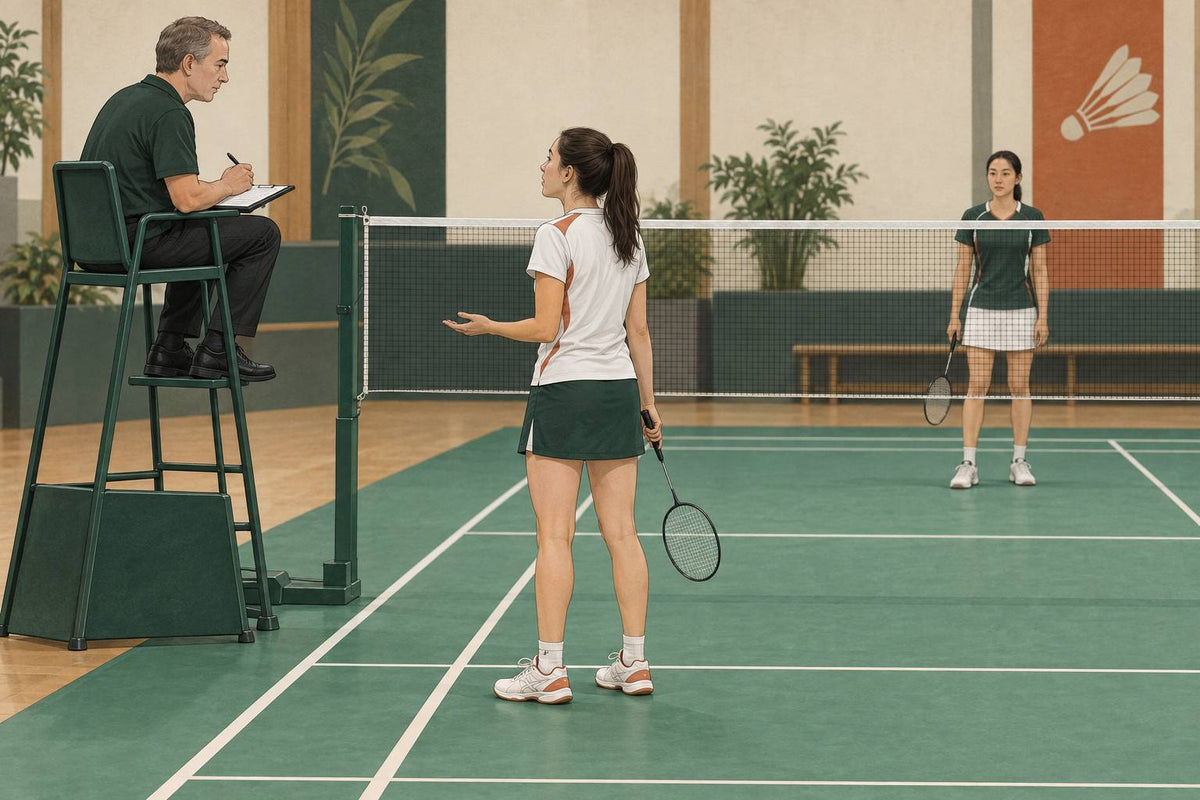
Address the umpire directly, stay at your position on court, and raise the issue before the next serve is struck. Badminton's continuous-play rule turns a legitimate appeal into a punishable delay the moment you leave the court or hold up play to argue your case.
The window is short by design. Once the next service is struck, the point it would have covered is over and the chance to appeal it is gone for good, so everything below has to happen in the gap between the disputed point ending and the next serve starting, not after a changeover or at the next interval.
- Stop before you play the next point. The umpire's duty to rule on a point of dispute only applies if you raise it before the next service is delivered.
- Speak to the umpire, not your opponent, their coach or the crowd. Say one sentence: what happened, and which rule you think it breaks. Only the umpire's chair carries any authority over the outcome, and venting anywhere else risks reading as the kind of conduct that earns its own warning.
- Let the umpire rule. If the answer does not resolve a genuine rule question, ask the umpire directly to refer it to the referee.
- Stay in position while you wait. No player may leave the court during a match without the umpire's permission, outside the scheduled intervals.
- Do not use the pause to catch your breath or take advice. Play must never be delayed to let a player recover or receive coaching.
The umpire administers a breach of those last two rules the same way every time: a warning first, then a fault against the offending side if it happens again, or an immediate fault for a flagrant breach, per the Laws of Badminton. A fault hands your opponent the point outright, which is a costly way to lose the argument you were trying to win.
What the referee can and cannot do once called over
The referee rules on how a law was applied and has overall charge of the tournament, including instructing the umpire when a review system produces an inconsistent or clearly wrong decision. What the referee cannot do is re-judge a call the umpire or a line judge actually witnessed.
The clearest example in the Laws covers video review: if an instant review system gives an inconsistent or obviously incorrect decision on a line call challenge, the referee instructs the umpire how to proceed. The same logic carries over to any other question of law referred up during a match: the referee rules on the law question, and the umpire carries out that ruling on court.
The referee's authority reaches past individual rulings, too. If the umpire faults a side for a second breach of the continuous-play or conduct rules covered earlier, the umpire must report it to the referee immediately, and the referee alone holds the power to disqualify that side from the match, per the Laws of Badminton. That power sits one level above the umpire on purpose: disqualification is serious enough that no single court official should be able to end a match unilaterally.
Before you raise your hand
- Decide fast: did an official actually see this (a matter of fact), or is it a rule question (a matter of law)? Only the second can reach the referee.
- Stay in position and speak only to the umpire, before the next serve is struck.
- If the umpire's ruling does not resolve a genuine rule dispute, ask them directly to call the referee.
- Once the referee has ruled, treat it as the end of the conversation. Save your energy for the next point instead of the last one.



Leave a comment
This site is protected by hCaptcha and the hCaptcha Privacy Policy and Terms of Service apply.