
Last checked: August 2026 · Written by the player-led team at Badminton House
Buy the exact racket model a tour player uses and it still will not feel like theirs. The model name on the box is only a starting point: what separates a tour setup from a retail frame is measured swingweight, tension chosen for the conditions, and legal customization the box never mentions.
Related reading: Badminton racket swingweight explained and how to tune racket balance with lead tape cover the physics and the how-to behind the differences below.
What a Racket's Printed Specs Actually Tell You
A retail racket's box lists weight class, grip size, balance category, flex and a recommended tension range. Those numbers describe one frame off the production line at one moment, strung by nobody, gripped by nobody, and swung by nobody. They are a starting point, not a finished setup.
The frame itself is bounded by law before it ever reaches a shelf. Under the Laws of Badminton, a racket frame cannot exceed 680mm in overall length and 230mm in overall width, and it must stay free of any device that lets a player change its shape during play. Inside that box, though, the same law leaves real room to work: it explicitly permits attaching material used "to limit or prevent wear and tear, or vibration, or to distribute weight," as long as it is reasonable in size and placement. That single clause is what makes grip build-up and counterweighting legal, and it is why two rackets that started out identical rarely stay that way.
Three things change a stock frame into a working setup: how its swingweight is actually measured and matched, how its string tension is chosen rather than fixed, and how legal add-ons shift its balance. Each is explained below, followed by what a club player can copy cheaply and what is not worth copying.
Matched by Measurement, Not by Model Name
Two rackets with the same printed weight and balance can still swing very differently, because swingweight (how heavy a racket feels while it is moving) depends on where mass sits along the frame, not just how much of it there is. Weighing a racket on a scale never catches that.
A 2023 Scientific Reports study on the badminton smash makes this concrete. Researchers took frames of equal static mass and deliberately built them to different swingweights by taping lead at the tip or at the handle bottom, producing test rackets spanning roughly 85 to 106 kg·cm², against a typical range of 90 to 97 kg·cm² for badminton frames generally. Identical weight on the scale, clearly different racket in the hand. The same study found that a single player's racket head speed could differ by up to 5 m/s between rackets of different swingweight, well beyond the roughly 0.7 m/s per 5 kg·cm² average trend measured across the whole group. In plain terms: the "right" swingweight is personal, and a printed number cannot tell you what it is for you.
This is the physical reason a serious setup treats measured swingweight, not the box's weight class, as the real spec. It also explains why a club player buying "the same racket" as a favourite pro can end up with a frame that feels nothing alike: unless the swingweight happens to match too, the model name was never the whole story. For the physics of why mass placement matters so much more than total mass, see our swingweight explainer.
What to copy, what to skip
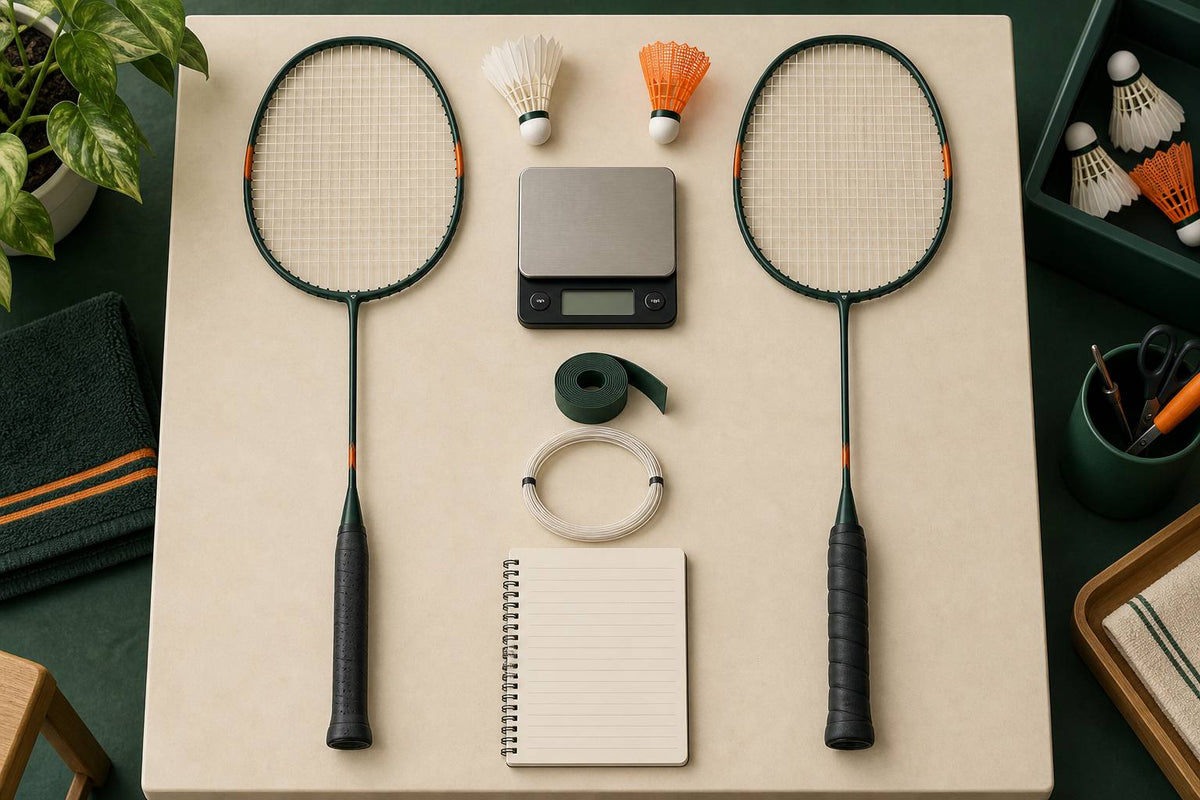
Copy cheaply: if you own two rackets of the same model, weigh them on a kitchen scale and swing them back to back. A gram or two of difference, or a noticeably different feel at identical weight, tells you they are not really the same racket, no matter what the box says.
Skip: buying a racket purely because a specific pro plays it. The model name is not the setup; without knowing the swingweight actually built into that specific frame, you are copying a label, not a spec.
Tension Set by the Hall and the Shuttle, Not the Season
String tension is not a number a serious player sets once and forgets. It is chosen for the shuttle being used and it drifts with the conditions in the hall, which means a tension that felt right on stringing day can feel slack two weeks later without a single point being played on it.
Heat and humidity are the main drivers of that drift. One badminton academy's stringing guide notes that strings lose tension faster in hot, humid conditions, so a racket strung tight can measurably loosen within about two weeks even in normal storage. Shuttle type matters just as much: a veteran UK stringer advises lowering tension for plastic shuttles compared with feather, for more repulsion off the string bed and less vibration, and notes that some players keep a separate racket strung 2 to 3 lbs lower specifically for plastic-shuttle sessions.
Playing level changes the useful range too. That same stringer's guide bands typical tensions from about 16 to 19 lbs for beginners up to 26 to 32 lbs for county and international players, and is explicit that higher tension stops paying off well before international numbers: a highly accomplished player might see power level off around 24 lbs, while for a lower-level player 20 to 21 lbs is already the practical ceiling. Push past a racket's rated range and the risk is not just wasted string; the frame can crack under the extra load, and higher tension also transmits more vibration into the arm.
| Player level | Typical tension range | Why it stops there |
|---|---|---|
| Beginner | 16-19 lbs | A bigger sweet spot forgives mistimed contact. |
| Intermediate | 18-23 lbs | Swing speed is consistent enough to want more feedback. |
| Advanced | 23-28 lbs | Power ceiling is close; the gain is now mostly control. |
| County / international | 26-32 lbs | Swing speed and technique can actually use the stiffer bed. |
What to copy, what to skip
Copy cheaply: treat tension as something to revisit, not set once. If you switch between feather and plastic shuttles, or your hall runs noticeably hot and humid, expect your string bed to feel different within a couple of weeks and restring or retest rather than assuming it is still what you paid for.
Skip: asking your stringer for a county or international number because a pro plays there. That tension range assumes a swing speed and technique most club players are not generating, and stringing above your racket's rated range risks a cracked frame for no real power gain.
Grip Build-Up and Butt-End Counterweight
Building up the handle with extra grip layers, or adding a small amount of weight at the butt end, is routine, legal customization that moves a racket's balance point well away from the figure printed on the box. Neither changes the frame's shape, so both stay inside the Laws of Badminton's allowance for weight-distribution add-ons.
The mechanics are straightforward once you isolate them: a thick replacement grip or extra overgrip layer adds mass near the butt end, which pulls the balance point back toward the handle and makes a racket feel quicker and less head-heavy in exchanges, even though the printed balance category on the box never changes. It is a small, reversible edit, but it is not trivial. A racket must be measured in the same strung-and-gripped state every time for a comparison to mean anything, since the grip itself is part of what you are measuring.
This is the same lever in reverse from adding tape at the head: one moves mass toward the hand, the other moves it away, and either one takes a box-standard frame further from its printed spec. Our lead tape balance-tuning guide walks through exact placements, gram amounts, and how to test a change safely before trusting it in a match.
What to copy, what to skip
Copy cheaply: add one extra overgrip layer, or a thin strip of tape under the grip, and play a full session before judging it. It is legal, reversible, and the standard first move for shifting a racket's feel without buying a new frame.
Skip: copying a specific pro's exact balance point wholesale. The same study found one player's racket head speed can swing by as much as 5 m/s between different swingweights, so a setup dialed in for someone else's swing is a guess at best for yours.
Building your own setup from a retail frame
- Weigh and compare any two rackets you own before trusting that "same model" means "same racket."
- Pick a tension for your level and your shuttle, and plan to revisit it as conditions or shuttle type change.
- Try one small, reversible change at a time (an overgrip layer or a strip of tape), and test it over a full session before deciding it worked.
- Use a pro's setup as a reason to experiment, not as a target number to match exactly.


Leave a comment
This site is protected by hCaptcha and the hCaptcha Privacy Policy and Terms of Service apply.