
Last checked: August 2026 · Written by the player-led team at Badminton House
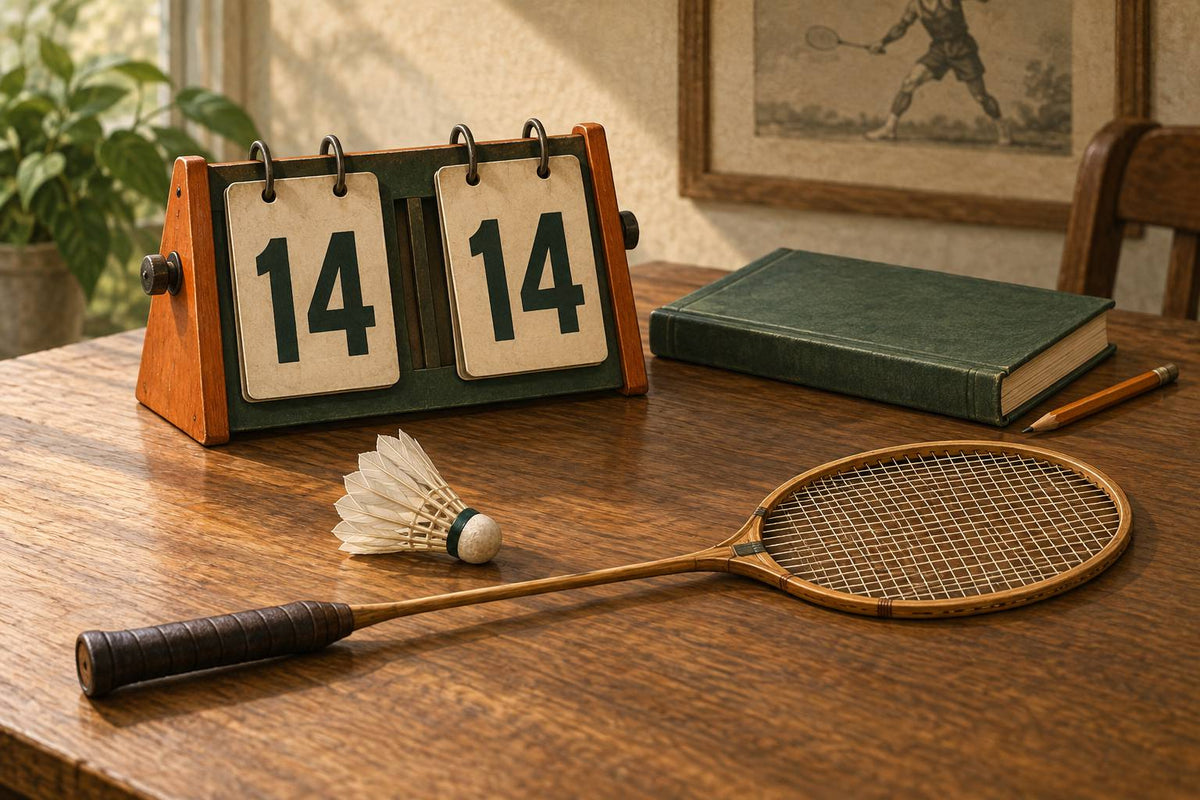
In late-era badminton 15 point scoring, only the serving side could score. Under the IBF rules in force from 1 August 2002, all doubles and men's singles went to 15, women's singles went to 11, and the side that first reached 14 or 10 could choose a fixed setting extension.
Old 15
Service scoring: only the serving side scored; setting at 14-all was a choice.
Current 21
Rally scoring: every rally scores; win by two after 20-all, capped at 30.
Future 15
Rally scoring: from 4 January 2027; automatic deuce after 14-all, capped at 21.
The shared number 15 hides different systems. Old setting was not the same as today's win-by-two rule, and the future BWF game to 15 is not a return to service scoring.
Start with a dated rulebook, not “the old rules”
Badminton's scoring rules changed before the move to rally points. To keep the walkthrough reproducible, this article uses the IBF Statutes and Laws marked “as from 1 August 2002”. That is a precise late service-scoring snapshot, not a claim that every earlier tournament used identical targets and setting choices.
The distinction matters most at 13-all. The historical Laws archive records that the 13-all setting option was dropped in 1998 while 14-all setting remained. The August 2002 law therefore waits until 14-all, or 10-all in women's singles. Importing a remembered 13-all choice would mix editions.
Scope of this walkthrough: August 2002 IBF service scoring. For the longer timeline, including experimental formats, read the history of badminton scoring from service to rally points.
How did service-only scoring work?
Under the August 2002 IBF Laws, a side added a point only when it won a rally while serving. When the receiving side won, it gained the right to serve but no point was added. It then had to win a rally as the serving side to move its score.
| Rally winner | Old scoreboard result | Next service |
|---|---|---|
| Serving side | Adds 1 point | Serving side continues under the applicable service-order rules. |
| Receiving side | No point for either side | Right to serve passes under the applicable singles or doubles rules. |
That is why an old score could remain 8–6 while more than one rally was played. A receiver might win, gain service, then lose the next rally without either side adding a point. The scoreline records scoring rallies, not the total number of rallies.
The same August 2002 Laws set a best-of-three match unless otherwise arranged. All doubles and men's singles played games to 15; women's singles played to 11. “Every discipline always played to 15” is therefore not an accurate description of this version.
What did setting at 14-all mean?
Under Law 7.5 in the August 2002 text, at 14-all in a 15-point game, the side that reached 14 first made one choice: continue to the original target of 15 or set the game to a new fixed target of 17. The rule did not ask which side had momentum, which side was serving, or who was favoured; it assigned the choice by order of reaching 14.

Worked example: Side A reached 14 first; Side B then made it 14-all
- If Side A does not set: the target stays 15. The next point scored by a serving side ends the game 15–14.
- If Side A sets: the target becomes 17. The first side to reach 17 wins, so 17–14, 17–15, or 17–16 can finish the game.
- Throughout: winning a rally while receiving changes service but still adds no point.
Setting was therefore a fixed extension, not a requirement to gain a two-point lead. A set game could end 17–16. An unset game could end 15–14.
Women's singles used the parallel choice at 10-all: the side first reaching 10 could continue to 11 or set the target to 13. Again, 13–12 could end a set game because the target, not a two-point margin, controlled the finish.
The rule created a real choice, but it did not prescribe a “correct” strategy. Choosing the shorter one-point finish or the longer fixed extension depended on the players and match; the law itself only defined who chose and where the game ended.
What changed when rally scoring replaced it?
The historical Laws archive records the IBF's adoption of 3 × 21 rally scoring in May 2006. The key mechanical change is visible in the score: the side winning every rally adds a point. A receiving winner no longer gains only service; it gains a point and becomes the serving side.
On 17 August 2026, the current authority is BWF Laws Version 5.0 (2), in force from 26 April 2025. A match is best of three games to 21 unless otherwise arranged; after 20-all a side must gain a two-point lead, and at 29-all the 30th point wins.
- At 0–0: the first rally changes the score, whichever side wins it.
- At leading score 11: the current Laws allow the 60-second in-game interval; the score does not reset.
- At 19–19: the next point creates 20–19, but a 20-all score starts the automatic two-point-lead ending.
None of those moments asks a side whether it wants to set. For the complete current procedure, use the badminton rules and scoring guide; for what the mid-game break allows, see the 60-second interval guide.
Why is the 2027 game to 15 not the old game?
The already-published BWF Laws Version 6.0 is marked in force from 4 January 2027. It changes the standard target to 15, but keeps rally scoring. It is future law in August 2026; Version 5.0 (2) remains current through 3 January 2027.
| Rule question | August 2002 old system | From 4 January 2027 |
|---|---|---|
| Who adds a point? | Serving side only | Winner of every rally |
| Normal target | 15; women's singles 11 | 15 for the standard match |
| At 14-all | First side to 14 chooses 15 or 17 | Automatic win-by-two extension |
| Hard finish | 15 if unset; 17 if set | 21st point at 20-all |
| In-game interval | Not supplied by this comparison | When the leading score reaches 8 |
The future rule has the old target number but the modern point mechanism. No side chooses whether to set, no receiving rally leaves the score unchanged, and no discipline keeps the old women's-singles target of 11 under the standard format.
How do you decode a club's “15-point” format?
Ask for the event sheet. The number alone does not tell you whether a local organizer is recreating service scoring, using a current rally-scored alternative, writing a time-saving house format, or preparing for Version 6.0.
- Who scores? Serving side only, or winner of every rally?
- How many games? One game, best of three, or another local structure?
- What happens at 14-all? Choice to set, automatic win by two, or a single deciding point?
- Is there a cap? Fixed 15 or 17, future cap at 21, or an organizer's own number?
- When are intervals and changes of ends? Do not borrow 11 or 8 from a different system.
If those answers come from a club notice, call them club rules. If they come from a dated BWF or IBF document, name the version and effective date. That one habit prevents three different meanings of “15 points” from becoming one muddled rule.



Leave a comment
This site is protected by hCaptcha and the hCaptcha Privacy Policy and Terms of Service apply.