
Last updated: July 2026 · Written by the team at Badminton House
Quick Answer: Badminton Rules and Scoring
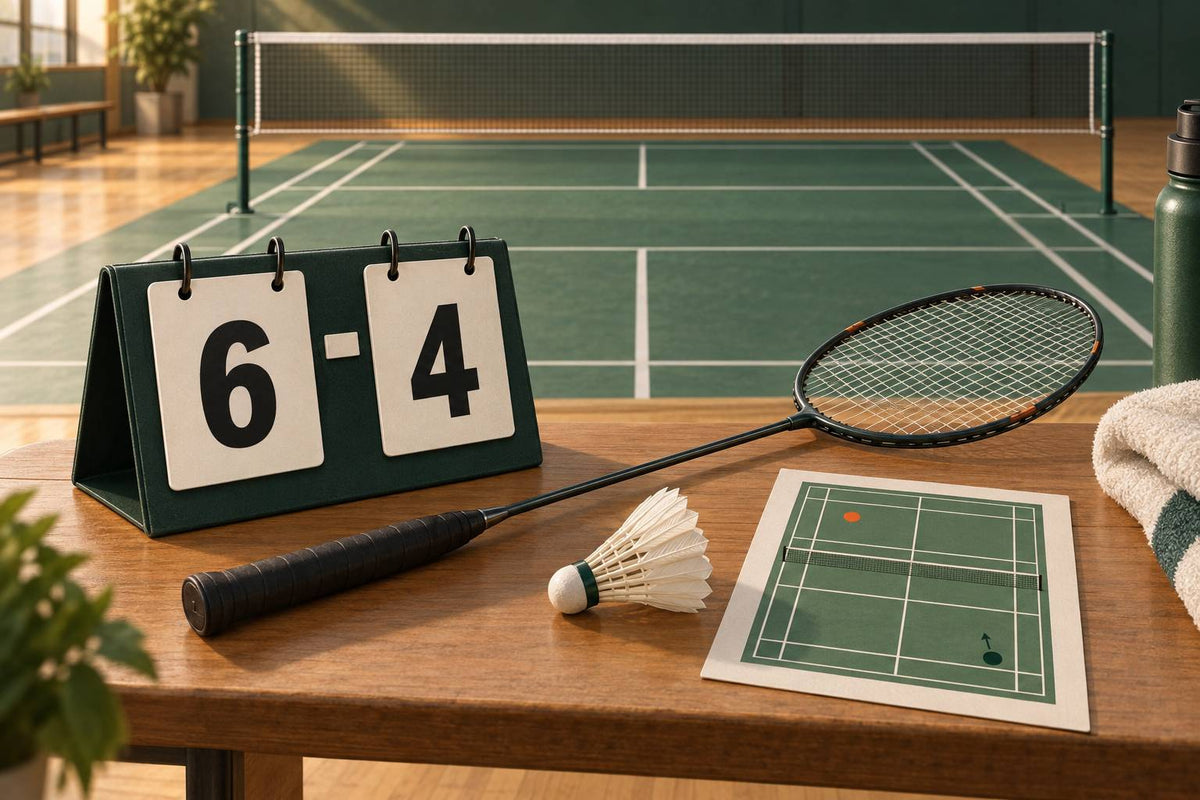
For Canadian recreational play, learn 21-point rally scoring first, then memorize the serving shortcut: even score serves from the right, odd score serves from the left.
21 pts
Best choice: use the current BWF-style club standard: best of 3 games to 21, with a point won on every rally and a 2-point lead needed at 20-all.
Serve
Call the server’s score first before each serve, serve cross-court, and switch service sides only when your side wins a point on serve.
2027
For future official play, know that BWF’s 3x15 format takes effect on 4 January 2027: best of 3 games to 15, with rally scoring still in place.
Badminton rules feel simple until your first real drop-in: someone calls “service over,” a doubles partner tells you not to switch sides, and suddenly you’re not sure whether the back line is in or out. If you’re trying to learn badminton rules and scoring for club play in Canada, the good news is that the core system is straightforward once you understand the pattern.
Canadian badminton follows the BWF Laws of Badminton through Badminton Canada, so the rules you learn here are the same foundation used by schools, clubs, leagues, and tournaments across the country. When you are ready to test them in a real draw, our guide to entering your first badminton tournament in Canada explains memberships, entry and which flight to choose. For now, that means best-of-three games to 21 points, rally scoring on every serve, and the familiar even-score-right-court / odd-score-left-court service logic.
This guide focuses on the rules Canadian players actually need at rec centres, club nights, school gyms, and local leagues — including the 21-point system, singles and doubles lines, service height, common faults, lets, and the upcoming 3x15 scoring change scheduled for 2027.
Getting ready for drop-in play? Rules are easier to learn when rallies last longer — check our shuttlecock collection for practice options; Badminton House ships Canada-wide.
In This Guide
- Which Badminton Rules Do Canadian Players Actually Use?
- How Does 21-Point Rally Scoring Work?
- Service Court Logic: Right When Even, Left When Odd
- Singles vs Doubles: The Lines That Confuse Beginners
- What Is the 1.15 m Service Height Rule?
- Common Faults and Lets to Know Before Drop-In Play
- What Changes in 2027: The New 3x15 Scoring Format
- Which Rules Should You Use First?
Which Badminton Rules Do Canadian Players Actually Use?
In Canada, the practical answer is simple: learn the BWF Laws of Badminton. Badminton Canada lists The Laws of Badminton as the rules of the game and points players to the Laws of Badminton and the Recommendations to Technical Officials. In other words, there is not a separate everyday “Canadian scoring system” you need to memorize before you show up at a club.
That same BWF-based structure shows up provincially too. Badminton Ontario directs officials to the Laws of Badminton in Chapter 4.1 of the BWF Statutes, while Badminton BC publishes the same simplified BWF 21-point rules: best of 3 games to 21, a point on every serve, and the 2-point-lead rule at 20-all.
| Canadian example | What it uses | What that means for you |
|---|---|---|
| Badminton Canada | The Laws of Badminton and Recommendations to Technical Officials | The national rules framework follows the BWF laws. |
| Badminton Ontario | BWF Statutes Chapter 4.1 | Officials are directed to the BWF Laws of Badminton. |
| Badminton BC | BWF simplified 21-point rules | The familiar 21-point rally-scoring system is the same one beginners see in club play. |
| UBC Badminton League | Rules laid out by Badminton Canada | Even recreational league play can be tied back to the national rules. |
If you understand that core BWF system, you can walk into most Canadian badminton settings and follow the match without needing a local rulebook.
If you are just getting started, pair the rules with a practical first-play plan. Our adult beginner badminton guide for Canada covers how to start playing, and the drop-in club night checklist helps you pack the basics before your first session.
For equipment, keep it simple: a comfortable racket, non-marking indoor court shoes, and consistent shuttles are enough to learn the scoring rhythm and service rotation. You can browse badminton rackets, badminton footwear, and shuttlecocks from a Canadian badminton specialty shop that ships Canada-wide.
So when someone says “we play normal badminton rules” in Canada, they usually mean this BWF-based system. Learn the core 21-point format first, then layer in the service-court details and fault calls as you play more matches.
How Does 21-Point Rally Scoring Work?
The current badminton scoring system used by Canadian clubs, schools, leagues, and tournaments is 21-point rally scoring. A match is played as the best of 3 games, each game normally goes to 21, and every rally produces a point — it does not matter which side served.
That “every rally counts” part is the biggest difference from older badminton scoring. Rally scoring has been used since 2006. Before that, only the serving side could score; if the receiving side won a rally, they won the serve but did not add a point.
| Situation | What Happens |
|---|---|
| Match format | Best of 3 games. |
| Normal game target | First side to 21 points wins the game, unless the score reaches 20-all. |
| Rally scoring | The side that wins the rally adds 1 point to its score. |
| At 20-all | A side must lead by 2 points to win. For example, 22-20 wins; 21-20 does not. |
| At 29-all | The 30th point wins the game. The final score can be 30-29. |
| Next game | The side that wins a game serves first in the next game. |
For club play, the easiest way to think about it is: win the rally, win a point. If you were serving and you win the rally, you keep serving. If you were receiving and you win the rally, you get the point and the next serve. The service-court side then depends on the server’s score, which is why the even-right, odd-left rule matters so much in the next section.
There are also built-in breaks. Players get a 60-second interval when the leading score reaches 11, a 2-minute interval between games, and in the third game players change ends when the leading score reaches 11.
Service Court Logic: Right When Even, Left When Odd

If you remember only one serving rule, make it this: badminton serves always go diagonally cross-court, and the server chooses the right or left service court based on the server’s own score.
The shortcut: server’s score even equals right court; server’s score odd equals left court. The server’s score is always called first.
| Server’s score | Serve from | Serve to | Example call |
|---|---|---|---|
| 0, 2, 4, 6, 8... | Right service court | Diagonally opposite right receiving court | “6–4” means serve from the right |
| 1, 3, 5, 7, 9... | Left service court | Diagonally opposite left receiving court | “7–4” means serve from the left |
Singles example: follow the server’s score
At 0–0, the server starts from the right court because zero is even. If the server wins the rally, the score becomes 1–0, so the same player serves next from the left court because one is odd.
If that server loses the next rally, the receiver wins a point and becomes the new server. The score is now called with the new server’s score first. If the new server’s score is odd, they serve from the left; if it is even, they serve from the right.
This is why calling the score out loud before each serve helps so much at drop-in play. The first number tells everyone two things at once: who is serving and which side they should serve from.
Doubles example: only the serving pair switches after winning a point
Doubles uses the same even-right, odd-left logic, but the movement pattern is where beginners usually get tangled.
- Serving pair wins the rally: they score a point, and the two partners switch left-right service courts. The same server serves again from the other side.
- Receiving pair wins the rally: they score a point and become the serving side, but they do not switch courts just because they won the serve.
A simple doubles pattern looks like this: Team A serves at 0–0 from the right. Team A wins the rally, so it becomes 1–0; Team A’s partners switch courts, and the same server now serves from the left. If Team A then loses the rally, Team B gets a point and the serve. Team B keeps its assigned service courts from the previous service sequence; the player assigned to the court matching Team B’s new score serves next, regardless of where the partners finished the rally.
Beginner check before you serve
- Say the score with the server’s score first.
- Look at the server’s first number: even goes right, odd goes left.
- Serve diagonally cross-court, not straight ahead.
- In doubles, switch with your partner only when your side was already serving and wins the rally.
- If your side just won the serve while receiving, stay where you are and use the score to identify the correct server.
Serving from the wrong service court is a service court error that has to be corrected once someone notices, so it is worth slowing down for a second before the serve instead of rushing into the next rally. Most club players will be patient if you are learning, especially when you call the score clearly and ask, “Right side?” or “Left side?” before serving.
If you are new to organized play, pair this scoring habit with basic club etiquette: bring your own shuttles, rotate fairly, and be ready when your court is called. Our adult starter guide covers that bigger picture here: How to Start Playing Badminton as an Adult in Canada.
For serve practice at home, school, or a community centre, durable nylon shuttles are usually the easiest starting point. You can browse current options in our shuttlecocks collection; Badminton House ships Canada-wide.
Singles vs Doubles: The Lines That Confuse Beginners

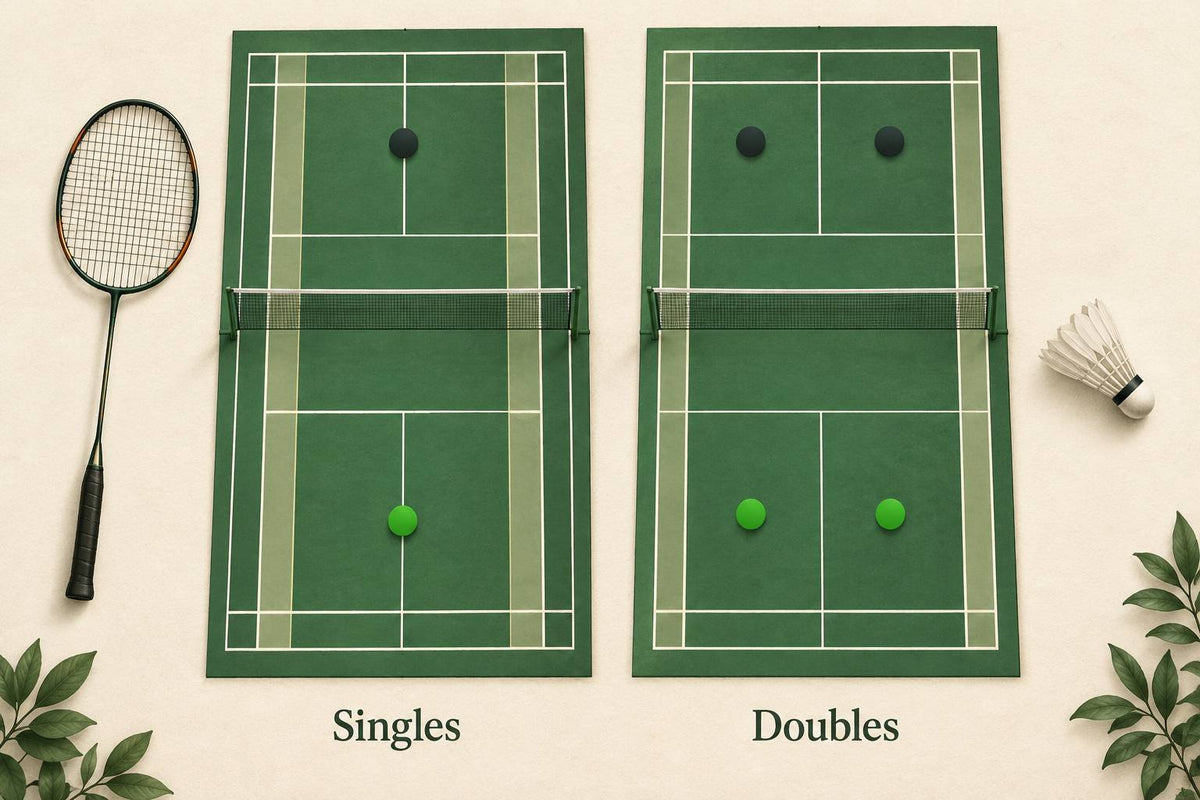
The easiest way to read the court is this: singles is narrower than doubles, but it is not shorter at the back. In singles, the side tramlines are out, while the full back baseline remains in play during both rallies and serving.
Doubles brings the wider side lines into play, but the service area is different because the doubles long service line restricts how deep the serve may land. That is why a serve that is good in singles can be long in doubles, even though the same back area may be playable later in a doubles rally.
| Situation | Side boundary | Back boundary | Beginner takeaway |
|---|---|---|---|
| Singles rally | Narrow court: inner singles sidelines | Full back baseline is in | A deep clear landing on the back line is still good. |
| Singles serve | Narrow singles service court | Full back baseline is in | A high serve can legally travel deep to the back boundary. |
| Doubles serve | Wider service court | Restricted by the doubles long service line | Do not aim your doubles serve as deep as a singles serve. |
Service court selection follows the same even-right, odd-left logic covered above. In singles, serving from the wrong service court is a service court error under the BWF laws — the error is corrected when it is discovered and the existing score stands — so treat your starting position as part of the serve, not an afterthought.
If you are moving from beginner drop-in to more regular singles or doubles play, your racket choice may start to feel different too: singles players often value length and control, while doubles players often notice speed and quick handling. For a broad starting point, browse our badminton rackets collection, or pair this rules guide with our drop-in play checklist before your next session.
Bottom line: remember the singles side lines, keep the full back baseline in mind, and use the earlier service-court logic before each serve.
What Is the 1.15 m Service Height Rule?

In formal badminton rules and scoring, the modern service-height rule is fixed: the whole shuttle must be below 1.15 metres from the court surface at the instant the server’s racket hits it. This is the standard you should expect in high-level tournament play, and it is part of the BWF laws that Canadian badminton rules follow through Badminton Canada.
This rule is still “new-ish” for many recreational players. Testing began in 2018 at the YONEX German Open on March 6, followed by the All England Open 2018. From December 2018, the fixed-height service rule became mandatory for high-level tournaments.
| Service standard | What it means | Where you’ll notice it |
|---|---|---|
| 1.15 m fixed height | The whole shuttle must be below 1.15 m from the court surface when the server contacts it. | High-level tournaments and matches using formal service judging. |
| Below the waist | The older rule required the shuttle to be below the server’s waist, with “waist” defined as an imaginary line level with the lowest part of the server’s bottom rib. | Many club nights, school gyms, and informal drop-ins still use this as the practical reference point. |
The 1.15 m rule was introduced to make service judging more consistent between players of different heights. Under the old waist-based wording, a tall player and a shorter player could have very different legal contact points. The fixed-height rule gives everyone the same measurement.
The experimental service laws also removed the older requirement that the racket must point downwards during the serve. That simplified the serve: the focus is on legal shuttle height, correct service court position, and a clean continuous service motion.
Practising serves? Use the same shuttle type for repeated drills so the feel stays consistent. Browse badminton shuttlecocks at Badminton House; we ship Canada-wide.
Best serving habit: before every serve, stand fully inside the correct service court, call the score, check that you are serving from the right side for an even score or the left side for an odd score, hold the shuttle comfortably below waist height for club play, and use one smooth continuous motion so your serve looks legal even when nobody is measuring 1.15 m.
Common Faults and Lets to Know Before Drop-In Play
Most beginner disagreements at drop-in are not about complicated tactics — they are about whether the shuttle was out, whether the serve was legal, or whether to replay the point. In Canada, the practical answer is the same ruleset used nationally: call the obvious faults, replay true lets, and keep the game moving.
| Situation | Call | What beginners should know |
|---|---|---|
| The shuttle lands outside the boundary lines | Fault | The side that hit it out loses the rally. If it touches the line, it is in. |
| The shuttle passes through or under the net | Fault | A legal shot must travel over the net, not through the mesh or under the tape. |
| The shuttle fails to pass over the net | Fault | If your drop, serve, clear, or smash does not cross to the opponent’s side, you lose that rally. |
| The shuttle touches the ceiling or side walls | Fault | In a standard call, hitting the ceiling or wall ends the rally against the player who hit it. |
| The shuttle touches a player or their clothing | Fault | If the shuttle hits your body, shirt, shorts, hair, or shoe, it is your fault — even if your racket is nearby. |
| The shuttle touches anything outside the court | Fault | This covers obstructions beyond the playable court area, not just the floor lines. |
| The shuttle is caught, held, and slung on the racket | Fault | A badminton shot must be a clean hit, not a carry or throw. |
| The same player hits the shuttle twice in succession | Fault | One continuous contact is different from two separate hits. Two hits by the same player loses the rally. |
Service faults that show up at club night
Serving has its own fault traps because both players have to be in the correct place before the shuttle is hit.
- Server and receiver must be diagonal. The server and receiver stand in diagonally opposite service courts. If the serve is not made cross-court to the correct service box, it is a fault.
- Do not touch the boundary lines. During service, the server and receiver must stand within their service courts without touching the boundary lines. A foot on the line is a service fault.
- The forward serving action must continue. After completing the backward racket movement, delaying the start is undue delay; once the racket starts forward, it must continue forward until the service is delivered.
Etiquette tip: Before serving, call the score clearly with the server’s score first, then make eye contact or check that the receiver looks ready. It prevents half the awkward “was I ready?” moments at drop-in.
When should you play a let?
A let means the rally is replayed. It is not a point for either side. The two most useful beginner examples are:
- The receiver was not ready. If the server serves before the receiver is ready, call a let and replay the point. If the receiver attempts to return the serve, they are usually treated as having been ready.
- A shuttle caught on or in the net can be a let after the serve is returned. In standard standing-player play, replay if it stays suspended on top of the net, or passes over and then becomes caught in the net. Those situations are faults on the serve; simply failing to clear the net is also a fault.
There is also a practical rec-gym caveat: many Canadian community gyms have low beams, basketball hoops, or other overhead structures. Many clubs agree before play that a beam contact is a let, but you generally cannot claim a let just because you hit the ceiling. If your venue has unusual overhead obstacles, ask the group’s house rule before the first game.
For smoother drop-in nights, pack enough shuttles and small essentials so rule discussions do not turn into long stoppages. You can browse badminton shuttlecocks for practice and club play, and use our badminton club night checklist before your next session. Badminton House ships Canada-wide.
What Changes in 2027: The New 3x15 Scoring Format
The big upcoming change is not a Canadian-only rule. The BWF approved a global scoring change at its 87th AGM in Horsens, Denmark, and the updated Laws of Badminton are listed as effective 4 January 2027.

The short version: matches are still best of three games, and rally scoring stays. What changes is the game target. Instead of playing to 21, each game will be played to 15.
For beginners in Canada: learn the 21-point system first. It remains the format most clubs, schools, drop-ins, and casual groups are using, so it is still the scoring system you need for everyday play.
| Rule area | Current 21-point format | 2027 3x15 format |
|---|---|---|
| Match length | Best of three games | Best of three games |
| Scoring method | Rally scoring: every rally produces a point | Rally scoring: every rally produces a point |
| Game target | 21 points | 15 points |
| Deuce rule | At 20-all, a side needs a 2-point lead | At 14-all, a side needs a 2-point lead |
| Hard cap | At 29-all, the 30th point wins | At 20-all, the 21st point wins |
| Third-game end change | Players change ends when the leading score reaches 11 | Players change ends at 8 points |
| Mid-game interval | 60-second interval when the leading score reaches 11 | 60-second interval at 8 points |
For Canadian players, the practical takeaway is simple. If you are playing drop-in, school badminton, club ladders, or casual matches, expect 21-point rally scoring unless the organizer clearly says otherwise. If you are entering sanctioned events after the new Laws take effect, check the event regulations so you know whether the 3x15 format is being used.
Practice Match Play — Browse Shuttlecocks
Ships across Canada · 14-day returns · Canadian badminton specialty shop
The change also does not rewrite the beginner service pattern covered earlier in this guide. In both formats, your score still determines the service court: even score from the right, odd score from the left, with the serve going diagonally cross-court. The service logic does not change.
Which Rules Should You Use First?
Learn 21-point rally scoring first. It is still the practical starting point for Canadian drop-ins, schools, and casual play; use the 3×15 update when you are following events that adopt the 2027 laws.
| If you are... | Choose this focus | Why it matters |
|---|---|---|
| Going to your first drop-in | 21-point rally scoring | Play best of 3 games to 21, with a point on every serve. At 20-all, a 2-point lead wins; at 29-all, the 30th point wins. |
| Keeping score while serving | Server’s score first | Call the score before each serve. Serve from the right when your score is zero or even, and from the left when your score is odd. |
| Playing doubles | Doubles service rotation | When the serving team wins a rally, the two partners switch service courts. When the receiving side wins, they score and take the serve, but the receivers do not switch courts. |
| Playing singles | Singles lines and service court | Use the narrower singles sidelines, and remember the baseline is in during both serves and rallies. A wrong-court serve is a service court error: it is corrected when discovered and the score stands. |
| Joining a Canadian league or event | The event’s BWF-based rules | Badminton Canada points players to the Laws of Badminton, and Canadian rec leagues can also state that play is subject to Badminton Canada rules. Check the event sheet, then apply the same core scoring and service logic. |
| Following 2027 competitions | 3×15 rally scoring | The BWF Laws of Badminton effective 4 January 2027 keep best-of-three rally scoring, but games go to 15. At 14-all, a 2-point lead wins, with a hard cap at 21; in a deciding third game, ends change at 8. |
Practicing serves and rallies? Durable nylon shuttlecocks are a practical beginner option. The Yonex Mavis 350 comes in tubes of 6 shuttlecocks in slow, medium, or fast speeds; check the shuttlecock collection for current availability. Badminton House ships Canada-wide.
If you are still getting comfortable with court etiquette and what to bring, start with How to Start Playing Badminton as an Adult in Canada in 2026, then use the Badminton Gear Maintenance Checklist before your next session.
Get 10% off your first order
Join the Badminton House list and we’ll email you a 10% welcome code — plus subscriber-only restock alerts, giveaways, and honest gear advice from players.
By subscribing, you agree to receive Badminton House emails and can unsubscribe anytime.
Rules make more sense once you play a few games and call the score out loud before every serve. We play badminton ourselves, so if you are unsure what to bring to drop-in, which shuttle to use, or how to choose beginner-friendly gear, contact us for advice and we will point you in the right direction.
Get set for your next Canadian club night with badminton-specific gear guidance.
Browse ShuttlecocksShips across Canada · 14-day returns · Canadian badminton specialty shop

Leave a comment
This site is protected by hCaptcha and the hCaptcha Privacy Policy and Terms of Service apply.