
Last checked: August 2026 · Written by the player-led team at Badminton House
Quick answer
On a court with an Instant Review System, a player or pair may challenge a line judge's call or an umpire's call or overrule, but only if the challenge is immediate. Each side can challenge as often as it likes until two challenges fail in one game; a second failure ends that game's challenges.
Start with What You Can (and Can't) Challenge
Then jump to the worked game below to see how the two-challenge budget plays out point by point.
Related reading: How to Run a Fair Badminton Round-Robin Tournament — for the formats, scoring and tie-breakers this review system operates inside, not how the reviews themselves work.
What You Can (and Can't) Challenge
On a court with an Instant Review System, a player or pair may challenge a line judge's call or a call or overrule made by the umpire. The umpire may also trigger a review alone, without any player challenge, when a line judge is unsighted and cannot decide. No other decision is reviewable this way.
This right does not exist at every umpired match. Both the regulation and the Laws of Badminton describe it as available only where an Instant Review System is in operation, so it depends entirely on the technology being installed on that specific court. At a club night, school match or any court without the system, a line judge's call can still be corrected, but only by the umpire's own overrule, never by a player's challenge (the umpire may overrule a line judge when a wrong call is beyond reasonable doubt).
Service faults, conduct faults and lets sit outside this system. See the BWF Instant Review System regulation for the full scope, and the BWF Laws of Badminton for the umpire's fallback overrule power on courts without it.
How to Make a Challenge
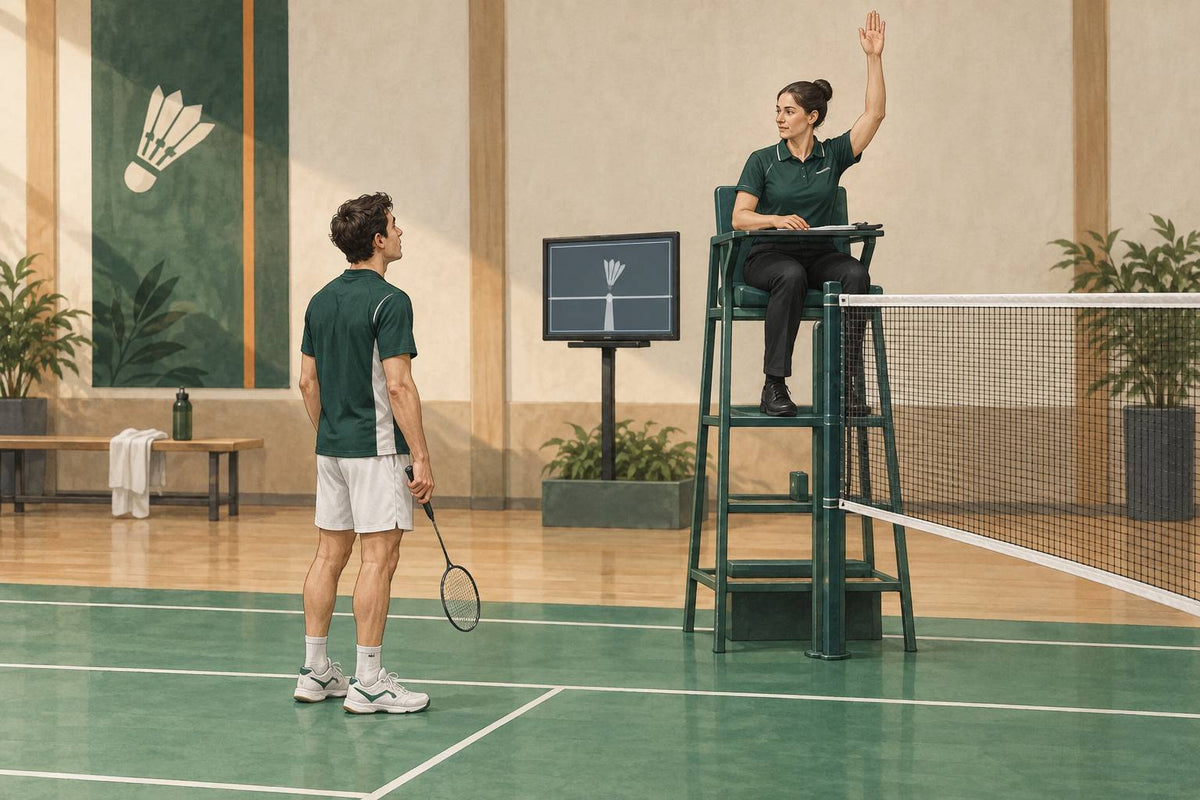
A challenge starts with the player, not the umpire. The player must say the word "Challenge" to the umpire, raise a hand, or both, and do it immediately after seeing the disputed call. A challenge attempted once play has moved on is refused; the umpire will say, "You did not challenge immediately."
The umpire relays the challenge to the Instant Review System operator, who checks the disputed landing spot and returns a decision; the umpire raises the left hand above the head to signal the request. A correct original call ends with "Challenge unsuccessful" plus the score; a reversed call ends with "Correction, IN" or "Correction, OUT" plus the score. If the system returns "No Decision," the point replays as a let only when the original call was "unsighted"; for any other original call, that original call simply stands. A result that looks inconsistent, such as mismatched text and graphic, or an obviously wrong decision, sends the umpire to the referee, who decides how play resumes, following BWF's instructions to technical officials.
The Two-Challenge Budget, With a Worked Game
A side can challenge as often as it likes until it has two failed line-call challenges in one game; the second failure removes the right to challenge for the rest of that game. A correct challenge never counts against that limit, and the two-failure budget applies during each individual game, resetting when the next game starts.
Picture a tight women's doubles game. At 8-8, Team A challenges a front-court line call; the review confirms the original call, so the umpire says "Challenge unsuccessful, one challenge remaining," and one of Team A's two chances is gone. At 15-14, Team A challenges a smash near the back boundary and wins the review; the umpire says "Correction, OUT," and Team A keeps its remaining challenge, because a successful challenge is never deducted. At 19-18, late in the game, Team A challenges again and loses; the umpire says "Challenge unsuccessful, no challenges remaining," and Team A cannot challenge again this game. Once Team A wins the game, its budget is back to two full challenges for game two.
None of that budget is touched when the umpire alone calls a review, or when the system returns "No Decision" or malfunctions.

Reading the Umpire's Calls (and When to Spend a Challenge)
An umpire's calls translate the review for anyone watching. "Correction, IN" or "Correction, OUT" means a challenge just overturned the original call; "Challenge unsuccessful" means it did not. "One challenge remaining" or "No challenges remaining" tells both sides exactly what is left to spend for the rest of that game.
| What you hear or see | What it means |
|---|---|
| "Challenge" (said by a player) | The player is formally invoking the right, not just reacting to the call out loud. |
| "Correction, IN" / "Correction, OUT" | The review reversed the original call; the score updates to match. |
| "Challenge unsuccessful" | The original call stands, and the side loses one of its two chances. |
| "One challenge remaining" / "No challenges remaining" | States exactly how much budget is left for the rest of that game. |
| Umpire's left hand raised above the head | The visible signal that an Instant Review System decision is being requested or announced. |
Every failed challenge uses one allowance: a successful review corrects the call, while the first failure leaves one challenge in hand. The calculation changes once a side is down to its last challenge, since a second failure ends the right to challenge for the rest of the game. Saving that final challenge for a moment that could decide the game, rather than a marginal call mid-rally, is the safer default under this rule.
The next time a player raises a hand and says "Challenge," the umpire's next words, "Correction" or "Challenge unsuccessful," tell you the result before the replay graphic does.


Leave a comment
This site is protected by hCaptcha and the hCaptcha Privacy Policy and Terms of Service apply.