
Last checked: August 2026 · Written by the player-led team at Badminton House
Quick answer
School gyms and community halls routinely put 20 or more players in front of one or two courts for a single booked period. Two queue-free warm-up games and five named session games below keep everyone moving: two use a real court, two need only floor space and a feeder, and one needs just a net.
Start with the warm-up
Run Mirror Chase and Happy Feet first; then rotate small groups through whichever games match the courts you actually have. Judge every game the same way: how many players are moving right now, not how clever the format looks on paper.
Start the period without a queue
Two partner games fill the first five minutes without a racket, a net, or a line to stand in: Mirror Chase trains reactive footwork, and Happy Feet trains a fast start off a signal. Both use pairs or small groups spread across open floor, so a hall of twenty players is moving from the first whistle.
Mirror Chase needs pairs and about two metres of clear floor each. One player is the leader and uses chasse steps (a sideways shuffle where one foot follows the other without crossing over) to move and change direction; the partner, the chaser, has to match every move. Swap the leader and chaser roles every 30 to 40 seconds, the cadence BWF's Shuttle Time schools lesson plans use for this drill, so nobody spends the whole game only reacting. A throwing version raises the difficulty: the leader holds a shuttle or a bean bag about three metres away and throws it instead of moving, and the chaser has to catch it and send it back.
Happy Feet works with the whole group at once and needs clearly separated movement lanes. Everyone faces away from the leader and jogs on the spot until a clap, a stamp, or a whistle sends each player toward their own marked target without crossing another player’s lane. Once the group has the idea, call two different signals for two different directions, which doubles the game as a listening drill for players who do not know each other yet.
Treat "how many players are moving right now" as the test for every game in this list, not just the openers. Even structured school PE lessons keep students in moderate-to-vigorous activity for only about 40 percent of class time on average, below the 50 percent benchmark public-health guidance recommends, so a session that adds standing-in-line time on top of that is spending an already scarce resource. If a group runs past about 24 players for these openers, do not stretch one circle thin: split into two groups using the whole floor, the same fix the lesson plans give for an oversized class.
Two games that keep a real court busy
Net King and the Half Court Team Game turn one marked court into a rotating contest instead of a queue. Net King is a fast head-to-head worth running back-to-back between challengers, and the Half Court Team Game lets three-a-side teams keep every player's shot on the scoreboard while players cycle on and off between points.
Net King needs only the forecourt, so it runs without full court markings: two players stand either side of the net and play net shots only. Hitting the shuttle into the net gives your opponent a point; catching the net cord (the top band) is worth 3; first to 12 wins. BWF's Shuttle Time schools lesson plans recommend timing the games once more than two or three pairs are waiting, rather than letting one match run long. Layer a queue on top for a full group (this part is Badminton House's own addition, not the original game): winner stays on, the next challenger comes in from the line, and the loser goes to the back. Adapt it by widening the playing area for stronger players or keeping it tight for beginners still learning to control the shuttle off a soft touch.
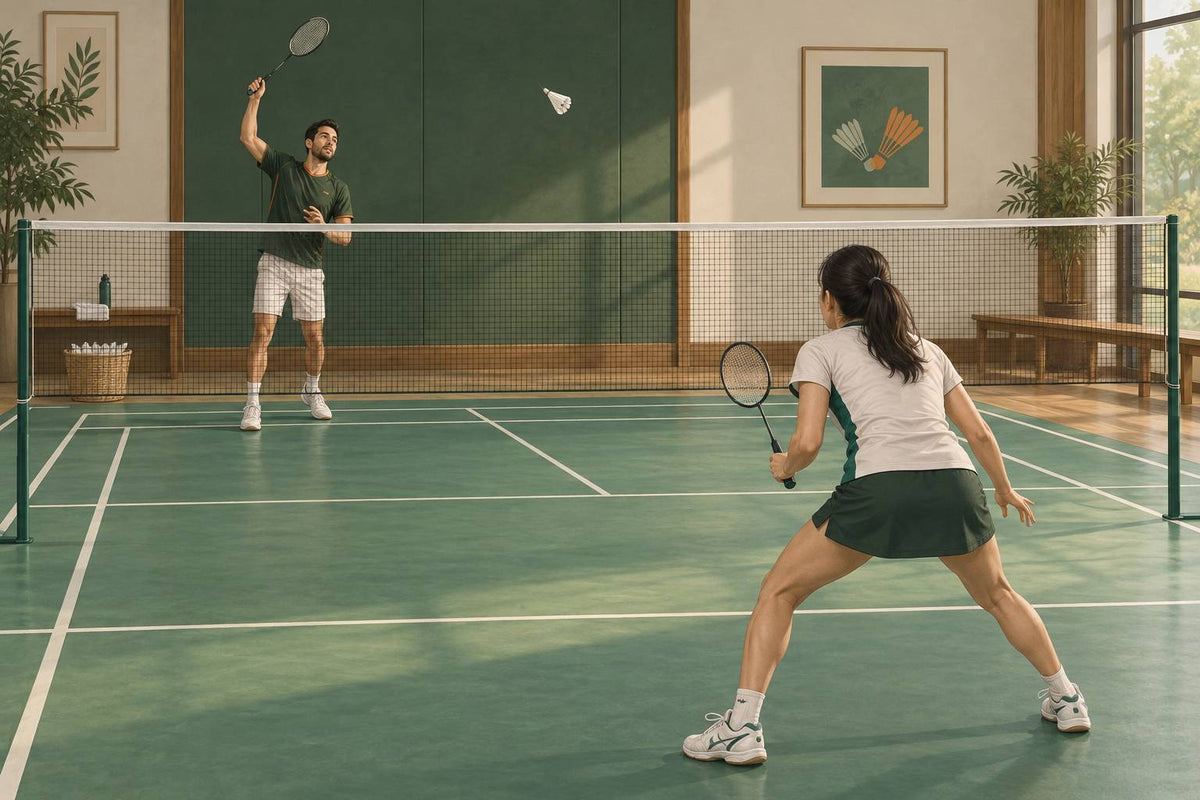
The Half Court Team Game needs one half of a full court and puts three players on each side. Player one starts the rally then steps off to the side; player two comes on for the next shot then steps off; player three takes the third shot, and the cycle repeats for as long as the rally lasts, with one active hitter per team while the next two wait behind the baseline. Enter only from the baseline and leave at the side, keeping the rotation outside other active courts. Every point any player wins counts toward their team's score, which keeps refereeing simple even with six players moving through one half-court. Score to a fixed point total or a fixed time, whichever fits your booking. Adapt it for a mixed group by giving the weaker team a small head start in points rather than changing the rotation, so the movement pattern stays identical for everyone.

Two drills that need no net at all
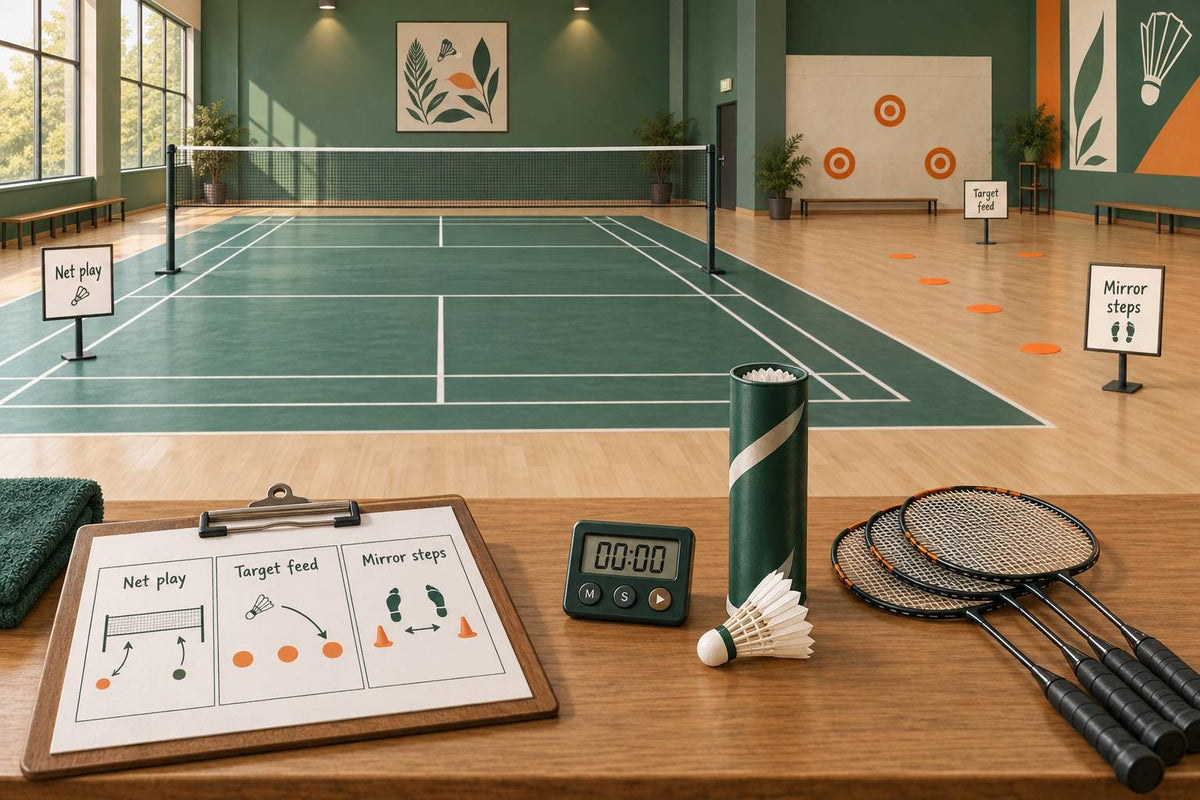
Merry-Go-Round and Group Feed to Targets are feeding drills for groups of four to six, run around a single feeder with no net, court, or racket-versus-racket rally required. That makes them the natural station for players who are not on one of your one or two real courts yet.
Merry-Go-Round puts four to six players in a loose group around a feeder, who can be a coach, a helper, or a player sitting out an injury. The feeder throws a shuttle to one player at a time; that player moves out with a chasse step and a lunge, hits it back, and returns to the group for their next turn. The lesson plans built the drill around lift practice, but the same rotation works for any stroke you want repeated, and for target practice: count a point only when the shuttle lands past a line on the rearcourt, and the group is now competing as well as rotating. Adapt it by shrinking the group to four when a court frees up, or splitting one group of ten into two Merry-Go-Rounds running side by side.
Group Feed to Targets puts players in a single line in front of a feeder who alternates throws left and right. The player at the front moves to the shuttle, hits it, and jogs to the back of the line while the next player starts; scoring a point for landing the shuttle inside a hoop or a taped square, instead of just keeping it in play, turns a repetition drill into a running competition. Adapt it by keeping each line to six or seven players and running two lines at once if the group is bigger, so nobody waits through more than half a dozen throws before their next turn.
A net-only doubles game for a spare net or half a court
Table Tennis Style Net Doubles restricts a doubles game to the strip between the net and the short service line, so two pairs can rally hard without the full court. That makes it the game to run on a half-used second court, or on a net set up without full markings.
Player one starts with a serve or a throw-in, and after that partners must alternate their team’s shots while the shuttle crosses the net on each return, using normal badminton scoring. The format comes from BWF's schools lesson plans, and its own harder variant sends each player running to touch the back doubles service line after every shot, which turns a gentle net exchange into a conditioning game once a group can rally consistently. Adapt it downward by playing three-a-side instead of two-a-side, which slows the pace without changing a single rule, a fix built into the same lesson plan for exactly this situation.
Put the five games into one period
Run the two openers first; then rotate small groups through whichever of the five games matches the courts and space available: two need a marked court or half-court, two need only floor space and a feeder, and one needs just a net. Fifteen to twenty minutes per station covers a typical booked hour with time left for a full-group finish.
This is a single-session format, built for one booked period with whatever courts you already have that day. If you are running a badminton unit across several weeks for a full class rather than one session, our guide to teaching badminton in schools covers the station-rotation version of the same space problem stretched across six lessons.
For a mixed-ability group, keep the games identical and change only the target: a smaller net-only strip for Net King, a small head start in points for the weaker Half Court Team, or a bigger hoop for Group Feed to Targets. Every player runs the same drill at a level that fits them, which is easier to referee on the night than running separate games for separate abilities.
Five games running at once burns through shuttles fast.
Browse Shuttlecocks

Leave a comment
This site is protected by hCaptcha and the hCaptcha Privacy Policy and Terms of Service apply.