
Last updated: July 2026 · Written by the team at Badminton House
Quick Answer: Badminton Club Court Rotation System
Use one visible queue, one posted court-entry rule, and one changeover trigger that applies to everyone at every session.
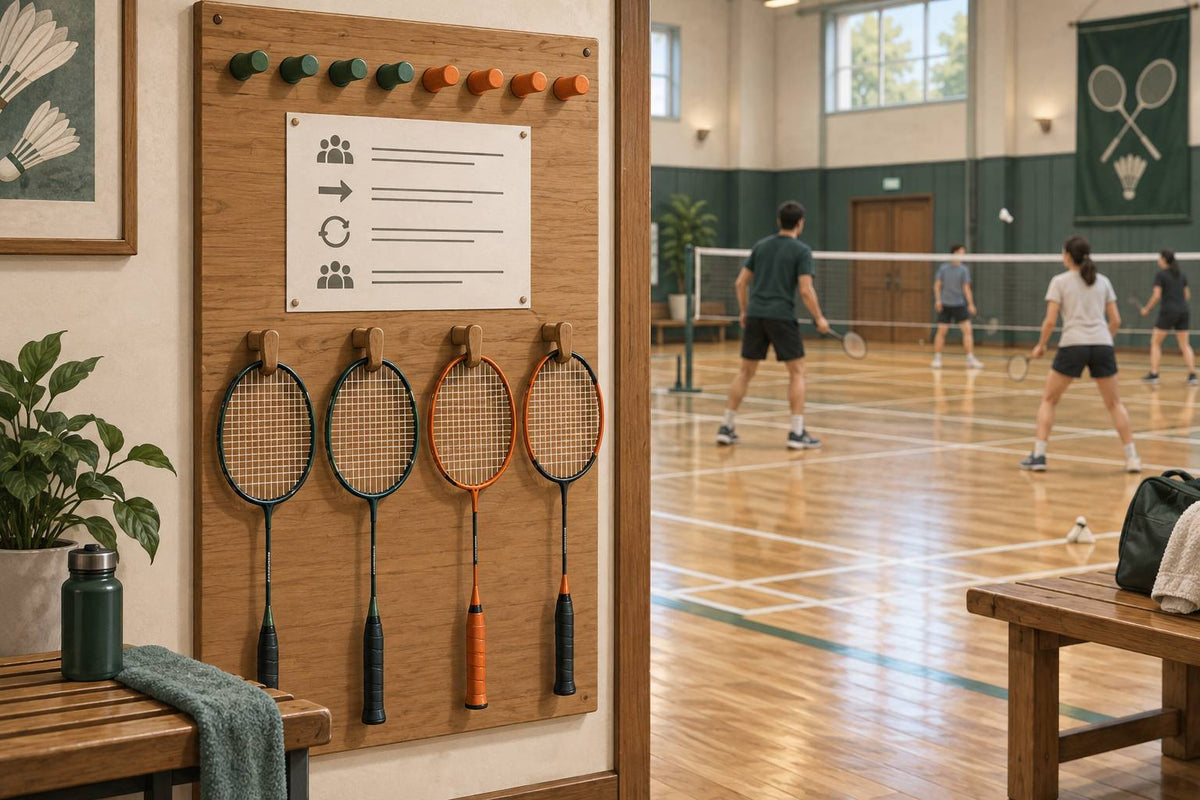
Join queue
Best default: add your name, peg, or racket at the back after each game.
Take court
Use the next four eligible players or the club’s posted picker rule.
Rotate off
Leave after the posted game, score, or timer limit and rejoin the queue.
At a busy club night, the awkward part usually isn’t the rally — it’s knowing when you’re next, who you’re with, and whether taking one more game is fair. A good badminton club court rotation system removes that guesswork before players start negotiating at the net.
The best setup is the one your group can follow quickly: clear queue order, a posted changeover trigger, and an obvious way to prevent repeated games while others keep waiting. This guide compares common systems used at drop-ins and social clubs, then shows the tie-break rules each one needs. Treat the system as club etiquette: explain it once, post it clearly, and enforce it calmly.
In This Guide
Badminton club court rotation system basics: house rules, not official rules
A badminton club court rotation system is a drop-in management tool, not an official badminton law. The Laws govern play on court; they do not prescribe whether a social club must use pegs, a sign-up list, level lanes, or a timer. The organizer chooses that layer to fit turnout and available courts.
Post four things where everyone can see them: how to join the queue, who may take the next court, what ends a turn, and how consecutive sit-outs are resolved. Read the format, ask the organizer if anything is unclear, and follow basic badminton court etiquette by stepping off promptly when your turn is over.

Racket or peg stack vs sign-up queue
Racket and peg systems suit clubs that want the queue visible beside the courts. One real club makes the top peg the picker, who chooses three players from the next six; another requires a complete singles or doubles group before rackets can reserve a court. After playing, everyone returns to the back. The posted tie-break should say that players who just vacated a court cannot immediately retake it while another complete group is waiting.
Sign-up queues put the same order onto a list, card set, or app. A strict list is easy to audit; a card system can limit how many people wait for one court; a digital tool can track attendance, games played, partners, and player levels. The posted tie-break should prioritize the player who has waited longest, then keep that player in the next eligible group rather than letting later arrivals pass repeatedly.
Winners-off and timed games on busy courts
When a queue forms, winners-off and timed games create predictable changeovers. In a winners-off format, the winning pair leaves after the game. The club must also say whether the losing pair stays together, splits, or leaves when four players are waiting. Winners-off prevents one dominant pair from holding a court, but it can still give the same losing players repeated turns unless the club adds a consecutive-game cap.
Timed formats solve a different problem. Every court changes at the same interval, regardless of score. Post what happens at the signal: finish the rally, record the current score only if results matter, then have all four players rotate off. Avoid displaying an arbitrary example time as if it were universal; the organizer chooses the interval for that session.
A one-game limit is a simpler alternative. Vancouver Racquets Club, for example, posts one game to 21 when players are waiting and limits warm-up to three minutes. That is a club policy, not a worldwide standard. Whatever limit you choose, state it before the first queue forms.
Level lanes and rotating partners for mixed groups
Level lanes are a sorting layer you can add to any queue. Use a small number of clearly described bands, let organizers move players when rallies are consistently mismatched, and keep at least one route for newcomers to join. The posted tie-break should say whether the longest-rested player stays first within a lane or may cross into another lane after a second consecutive sit-out.
Rotating partners solve a different problem: social mixing without fixed pairs. The organizer can pre-list each four-player group, or let the next player choose from a limited pick zone. Track recent partners so the same pair is not recreated every round. If balanced competition matters, use observed club play or an agreed rating rather than asking one label to define a player permanently.
Post the pairing rule, the sit-out tie-break, and the point at which lanes may merge. Without those details, “level-based” can become an excuse for a closed court rather than a fair rotation system.
Which Court Rotation System Should You Choose?
No badminton club court rotation system is universally best. Choose the three rules players must follow on every trip through the queue.
| Rule | Post this decision |
|---|---|
| Join queue | Choose one visible method: racket or peg stack, written list, cards, or an app. State how late arrivals and returning players enter. |
| Take court | Use the next four eligible players, or publish the picker and level-lane rule. Give priority to anyone facing a second consecutive sit-out. |
| Rotate off | Name the trigger: one game, winners-off, or a timer. State whether everyone leaves and where finishers rejoin. |
Fair court rotation works best when everyone understands the same rules before the first shuttle is served. Post the system at the queue, read it at the start of the session, and change it only between sessions.
A clearly marked racket is useful in clubs that run a physical racket queue.
See Badminton Rackets


Leave a comment
This site is protected by hCaptcha and the hCaptcha Privacy Policy and Terms of Service apply.