
Last updated: July 2026 · Written by the team at Badminton House
Quick Answer: Backhand Rear Corner Footwork
Choose the route by how early you see the shuttle and how high you can contact it.
Default
Round-the-head option: use when you can still get into position for a high forehand contact.
Rushed
Backhand approach: turn toward the corner, step and lunge when the forehand route is no longer available.
Late
Controlled reply: accept a lower contact when necessary and recover from the backhand lunge.
Getting pushed into the deep backhand corner is usually a footwork problem before it is a stroke problem. If your split step is late, you turn and run too early, or you arrive with your weight falling away from the court, even a solid backhand clear becomes a bailout. This guide treats the corner like a route decision: can you still get round-the-head, do you need a compact step-and-lunge backhand, or are you under enough pressure to accept a defensive contact? Each choice should start with a small split step and end with recovery that keeps your eyes on the shuttle.
In This Guide
Why This Corner Forces Backhands
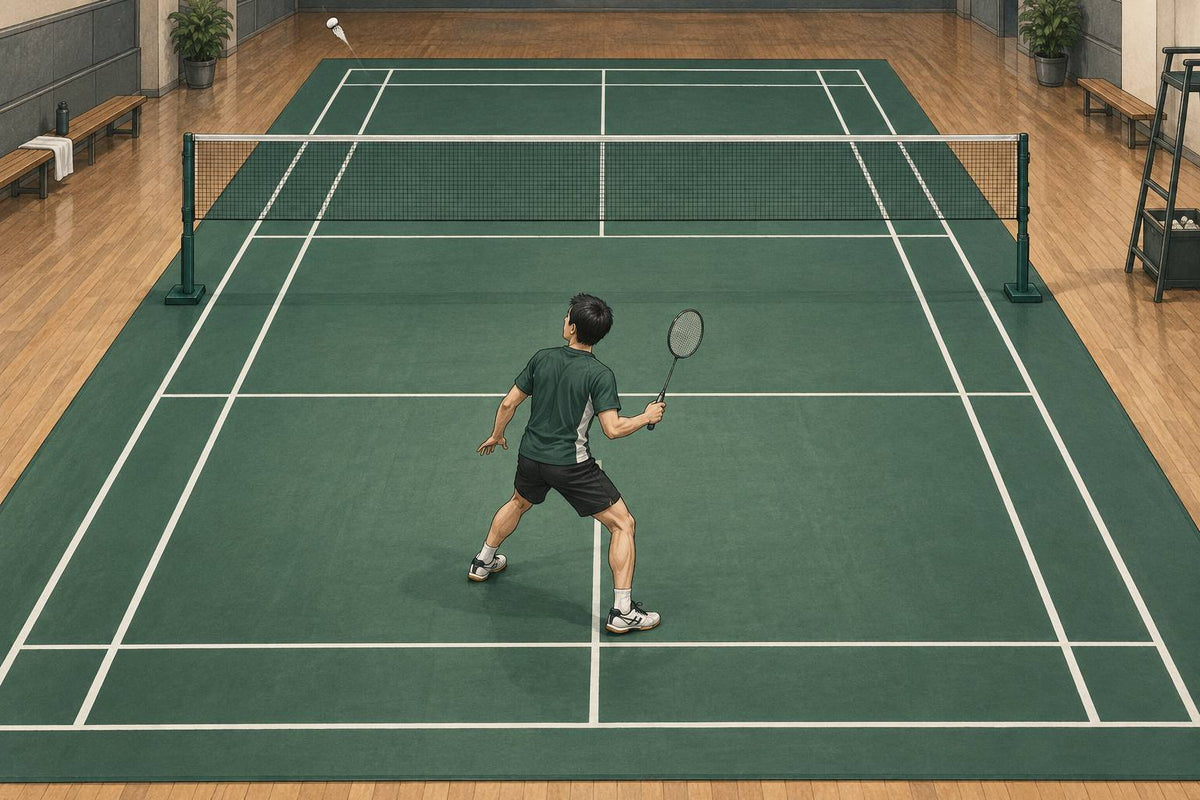
Badminton backhand rear corner footwork starts from a problem: the shuttle is behind you on your non-racket side, and you are deciding whether you can still turn it into a forehand. In the rear court, players generally try to play as many overheads as possible on the forehand, often using a round-the-head action because the forehand can produce more power and a more attacking reply from the deep corner.
The backhand overhead is the fallback when you cannot get into position for that forehand route. It is useful, but it carries pressure: you must turn your body toward the corner, often with your back partly to the net, which limits your view of the opponent and court. This guide focuses on the movement routes into and out of that corner, not the full hitting mechanics. For the stroke itself, use the backhand clear technique guide; for the preferred forehand alternative, see the round-the-head shot guide.
Split Step and First Turn
For a turned rear-court backhand, the basic route is split, step, lunge, with your body turning toward that corner rather than drifting there upright. The split step should be small and timed just before the opponent hits, so you are already loaded to push once the shuttle direction is clear. Treat it as a springy preparation, not a high jump.
If you can read the lift early, angle the split slightly toward the backhand rear corner. That directional split step improves your speed to the expected corner and reduces the size of the first recovery problem you create for yourself. A missing or late split step delays the first useful push toward the shuttle.
This timing matters mechanically too: split-step preparation is linked with a quicker force transition into the support foot and stronger push-off. For the timing details, see our badminton split step guide.
Route Options by Distance and Time Pressure
There is no single correct route into the backhand rear corner. Coaches commonly teach roughly a 2-step or 3-step pattern depending on how far the shuttle has travelled, how early you read it, and whether you can contact it high or only around mid-body. For a broader distance framework, see Badminton Rear Court Footwork: Choose the Right Travel Pattern.
- Early and high: get behind the shuttle for a round-the-head forehand when that route remains available.
- Less time or less jump: turn toward the corner and use the backhand step-and-lunge route, adding a chassé if distance requires it.
- Under pressure: use a controlled backhand lunge and accept a lower defensive contact when a high one is no longer available.
Add a small chassé before or after the pivot only if you cannot reach cleanly; extra steps should solve distance, not become a habit. For the separate round-the-head forehand leg switch, read Badminton Rear-Court Footwork: The Scissor Jump.

Recovery After the Hit
Recovery starts before the shuttle leaves your strings. In a deep backhand lunge, your centre of gravity has shifted hard into the rear corner, so turning your back and running to the middle is a trap: you lose sight of the shuttle, disturb your balance, and react late to the next shot.
At contact, push off the lunge foot immediately. Do not stand up first. Keep the knees slightly bent and recover with a chassé action, where one foot chases the other without crossing over. That lets you travel back toward base while keeping your shoulders more square to the net and your eyes available for the opponent’s reply.
Finish the recovery as a ready position, not a stop: land slightly wider than shoulder width, low through the hips, and springy enough to split-step again.
Which Route Should You Choose?
Use time pressure as the filter: choose the route that lets you arrive balanced, hit at the highest realistic contact point, and still recover with control.
| Situation | Use | Choose this if... | Recovery cue |
|---|---|---|---|
| Early and high | Default route above | You can intercept high and stay balanced enough for an offensive shot. | Land wide, then chassé back. |
| Early, lower risk | Rushed route above | You still have a high contact point but want a safer, grounded arrival. | Minimize extra steps. |
| Deep, late, or no time to attack | Late route above | You need a mid-body defensive contact instead of chasing a perfect high one. | Push from the lunge foot and regain useful court position. |
Get 10% off your first order
Join the Badminton House list and we’ll email you a 10% welcome code — plus training guides, technique advice, and badminton updates.
By subscribing, you agree to receive Badminton House emails and can unsubscribe anytime.
If this corner still feels messy, focus on one cue per session: early split, clean route, balanced recovery. We play badminton too, so if you are unsure whether the problem is timing, footwork, or setup, send us a note and we will help you think it through: contact Badminton House.
Footwork starts from the floor.
Court shoes that grip, stop, and recover cleanly make rear-corner practice safer and more repeatable.
Check Footwear AvailabilityBrowse options and check live availability before your next session.

Leave a comment
This site is protected by hCaptcha and the hCaptcha Privacy Policy and Terms of Service apply.