
Last checked: August 2026 · Written by the player-led team at Badminton House
Quick answer: badminton consistency drill
Choose one clear pattern, one visible landing area, and one simple record. A longest streak is a practice observation, not a validated test, technical diagnosis, or prediction of match performance.
Record
Best streak: note the task and conditions beside the number.
Compare
Compare like with like; changed conditions deserve a note, not a discarded result.
A useful badminton consistency drill gives you a repeatable practice snapshot: one shot, one landing rule, and one score you can revisit. The 50-clear format below is a Badminton House editorial option, not a standard or validated test. It can help you describe a session without claiming why a streak ended.
Related reading: Use drill variety versus repetition when you are deciding whether to keep one task stable or change it.
What does a 50-clear drill actually record?
This drill records the longest uninterrupted run that meets your own stated shot and landing rule on that day. It is useful as a practice log because the task is visible and countable. It does not measure match performance, identify a stroke fault, or tell you what to train next.
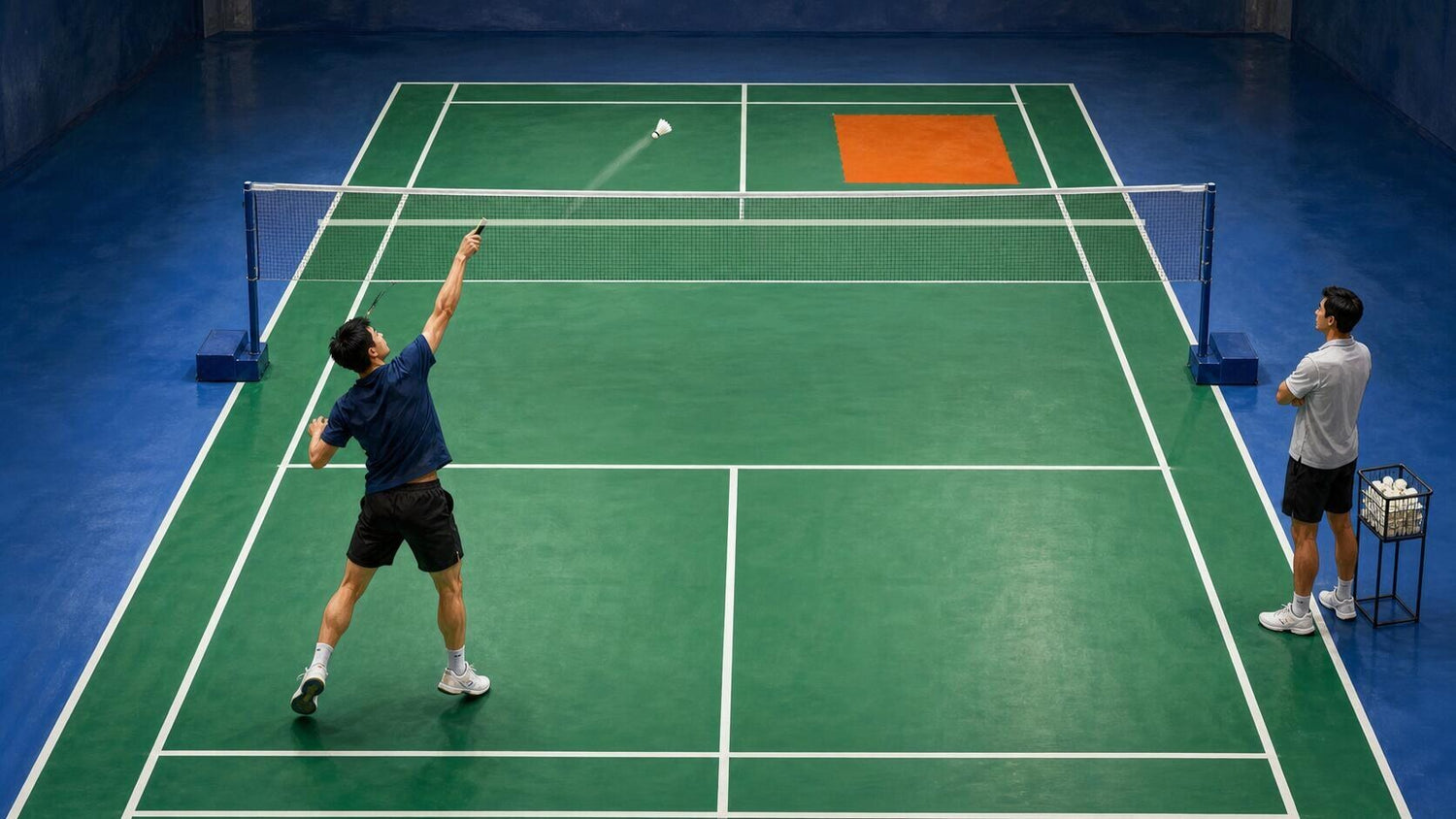
Mark a rear-court landing area with existing court lines, tape, or cones before you begin. Badminton’s laws say that a court line belongs to the area it defines, which makes a pre-agreed in-or-out rule easier to apply consistently. See the BWF Laws of Badminton for the court-line rule.
For this practice option, use a cooperative partner or feeder and count one point when the shuttle reaches the agreed area. A miss, a landing outside the area, or a feed you agreed not to accept ends that attempt. Restart at zero. Those are local rules for a clean record, not officiating rules.
How do you set up a repeatable attempt?
Keep the task small enough that both players can describe it before the first shuttle: straight clear or cross-court clear, a named target area, a feeding pattern, and a restart rule. Consistency comes from recording the same chosen task, not from making every session look identical.
- Name the attempt. For example: “straight clears to the rear target, cooperative return.”
- Agree the feed. Decide whether your partner returns a comfortable shuttle or hand-feeds, then use that choice throughout the attempt.
- Make the zone visible. Use a court area or removable markers; do not change its shape during the run.
- Stop and log. Write the best uninterrupted streak, plus anything that changed in the setup.
Clear, drop shot, net shot, and lift are familiar shot contexts in BWF coaching material, including a predictable two-player sequence that combines all four. That supports using their names clearly; it does not validate this article’s order, count, or target design. See the BWF Level 1 coaching manual.
A four-step practice ladder you can choose to use
If you want more than one practice record, add one task at a time and keep each score separate. The following ladder is a Badminton House option for organising a session, rather than a benchmark players must reach or a progression that proves readiness.
| Task | Record beside it |
|---|---|
| Straight clear | Best streak and target description |
| Cross-court clear | Best streak and feed choice |
| Drop or lift | Best streak and landing rule |
| Net-shot exchange | Best streak and agreed net area |
You may choose 50 as a session ceiling, or stop earlier if that keeps the practice useful. Do not convert a lower or higher streak into a player rating. A number simply describes that attempt under the conditions you wrote down.
How should you read the scorecard?
Read a scorecard as a record of practice conditions and a starting point for a coaching conversation. A broken streak does not reveal fatigue, forearm weakness, a technique problem, or a plateau. It also cannot tell you which drill or correction you need without further observation.
Log the hall, shuttle, partner or feed style, target rule, and best streak. If one of those changes, the number remains a useful session note, but it has a different comparability boundary. NIST describes repeatability as successive results obtained under the same conditions and distinguishes it from results under changed conditions; the principle is useful here without pretending your drill is laboratory measurement. Read NIST’s repeatability terminology.
Simple scorecard
- Date and named task.
- Target and feed rule.
- Hall, shuttle, and partner or feeder.
- Best streak, followed by one neutral note about what changed.
Review the score after several comparable sessions, not as a verdict after one run. Keep practice streaks separate from your match record: a controlled cooperative task and a competitive rally ask different questions. If you want a monthly comparison, use the same named task and write any deliberate change beside the new score. This keeps your records readable when you look back.



Leave a comment
This site is protected by hCaptcha and the hCaptcha Privacy Policy and Terms of Service apply.