
Last checked: August 2026 · Written by the player-led team at Badminton House
Quick answer
Doubles and singles are different physical jobs, not one badminton fitness plan at two speeds. Match data shows doubles players trade shots faster over shorter rallies while singles players sustain longer efforts and cover more ground. Train doubles for rotational speed, quick hands under load, and fast recovery between short bursts; train singles for sustained work capacity and repeated deep lunging. Copying a singles conditioning plan for doubles (or the reverse) trains the wrong qualities.
How Doubles and Singles Load the Body Differently
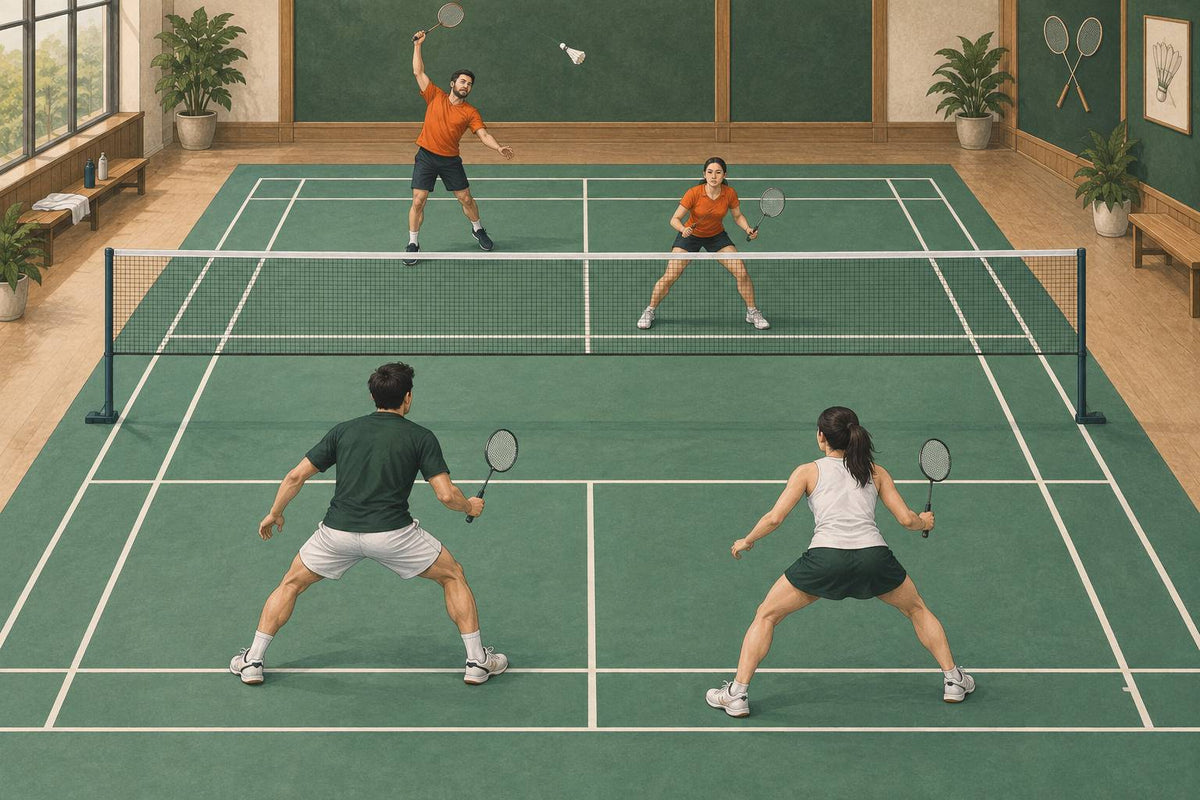
Doubles and singles put different demands on the body despite sharing a court, a racket and a scoring system. Junior and elite match data both show singles rallies run longer while doubles players exchange shots faster and rest for close to the same length of time between them, so each discipline rewards its own set of physical qualities.
A 2026 study of the 2019 Pan-American Junior Championships broke down 124 matches, 277 games and 9,847 rallies across all five events. Its finding: singles matches ran longer and had longer rallies, while doubles matches involved higher shot frequency, shorter rallies and more concentrated activity, with rest time between rallies staying almost identical across every event. The same study notes doubles events also ran shorter overall, likely because a doubles court gives each player less ground to cover, which enables faster, more offensive play than a singles player can sustain across a full rally. The table below lines up the junior rally numbers with elite-level shot-frequency data pooled from a separate systematic review, so you can see the same pattern show up at two different levels of the game.
| Metric | Singles | Doubles |
|---|---|---|
| Rally duration (junior championship data) | 6.9-7.3 seconds | 5.0-6.5 seconds |
| Shot frequency (elite pooled data) | 0.8-1.0 shots per second | 1.3-1.5 shots per second |
| Work density (active play share of total time, junior data) | 0.50 | 0.37-0.47 |
| Rest between rallies (junior data) | about 14 seconds | about 14 seconds |
Read the work-density row carefully: singles players spend a bigger share of total match time in active play than doubles players do, at every level this has been measured. That is the physiological signature of a sustained-effort sport. Doubles players get proportionally more rest, but they spend it recovering from sharper, faster bursts rather than pacing a long rally, and a separate systematic review pooling elite match data reports men's doubles shot frequency running around 1.5 shots per second against 1.0 in men's singles, with women's doubles and women's singles showing the same gap. The same review's singles-only data also puts real numbers on that sustained load: men's singles players cover roughly 1,763 metres of court per match and complete an average of 194 lunges per match. No comparable doubles figure exists in that dataset, which is itself a clue: doubles research measures pace and shot count, singles research measures distance and lunge count, because those are the qualities each discipline actually taxes.
Why Doubles and Singles Ask for Different Energy Systems
Badminton draws on the body's energy systems differently depending on which format you play. A systematic review of elite match data concludes each of the five playing categories places distinct demands on the player, and the practical split that matters for club players is doubles' short, frequent bursts against singles' longer, more sustained rallies.
The review that produced the rally and shot-frequency numbers above states its conclusion directly: each playing category places specific demands on the players, which matters for how training and testing are designed, and doubles' overall activity profile separates from singles' by a large margin. That is not a difference you can train away by running more; it is a difference in what the body is asked to do rally by rally.
Elite match-play measurements back this up at the metabolic level. During actual match play, badminton's energy cost is dominated by oxidative and phosphagen pathways, with blood lactate staying low, around 2.2 mmol/L on average, at a match heart rate near 152 beats per minute. That surprises players who assume a rally sport built on repeated sprints must run mostly on anaerobic glycolysis; in practice the aerobic and immediate-energy systems do most of the work, and a decent aerobic base still underpins how well either discipline recovers between points. Badminton House has found no badminton-specific study directly comparing doubles and singles at this metabolic level, so the rally-profile and shot-frequency contrast above, rather than this metabolic snapshot, is the evidence this article relies on for how the two disciplines differ.
What the same research group did test directly is how bout length changes internal load. Comparing 10, 30 and 50-second work bouts at an identical rest ratio, heart rate stayed statistically similar across all three lengths, while peak blood lactate rose sharply as the bouts got longer, roughly doubling from the 10-second bout to the 50-second one. Doubles' rally structure sits at the short end of that range; singles regularly sits at the longer end, which is one more reason a doubles-specific conditioning plan should build capacity for repeated short bursts rather than assume longer intervals automatically transfer down. If you want the actual set-and-rest design for building that short-burst capacity on court, our multifeed drill length guide covers it in seconds and sets; this article stays at the level of what to train and why.
Four Qualities a Singles-Style Plan Leaves Undertrained
A conditioning plan built around singles (long rallies, deep travel, sustained running) quietly skips four qualities doubles actually needs. Badminton House built this list by applying the rally-profile and shot-frequency data above to what a doubles court demands: fast racket-head speed, quick rotation with a partner, short recovery windows, and a low, ready defensive stance.
- Rotational speed. At 1.3 to 1.5 shots per second, doubles play does not leave time to plant and reset like a singles corner-to-corner exchange. Doubles partners rotate around each other almost every shot (front and back, or side by side), so reaction speed to a partner's movement matters as much as reaction speed to the shuttle.
- Hand and forearm speed under load. Shorter rallies at the net and mid-court reward a fast, compact racket-head reflex for blocks and net exchanges over the long, full backswing power a singles baseline rally rewards.
- Repeat-burst recovery. Doubles rest for close to the same length of time as singles between rallies, but that rest has to fully reset a sharper, higher-pace burst rather than pace a long one. Training that only builds sustained aerobic capacity misses this.
- Reactive strength from a low base. Defending and blocking at the net or mid-court happens from a low, split-step-ready stance, not the deep lunging recovery cycle singles court coverage builds. It is a shorter, quicker amplitude of movement.
None of this makes singles conditioning wrong. It makes it a mismatch for a doubles player who spends most of their court time on a doubles court, which describes most club and league players even when the conditioning advice they find online defaults to singles.
Two Weekly Structures: Doubles-Led and Singles-Led
Badminton House built these two structures from the demands above; no source prescribes weekly session counts for doubles or singles players, so treat both as a starting framework rather than a sourced regimen. Each week names three session priorities and, deliberately, what it leaves out.
Doubles-led week
- One session of rotation and reflex drills with a partner: front-back and side-side movement patterns, net exchanges, and blocking reps against fed smashes.
- One repeat-burst conditioning session built around short work bouts, each followed by full recovery before the next.
- One match-play or conditioned-game session against real doubles pairs.
- Deliberately left out: long continuous running or steady-state cardio blocks, which train an energy system doubles rarely uses for long.
Singles-led week
- One session of multi-corner footwork and repeated deep lunging, building the court-coverage capacity a full singles court demands.
- One sustained-effort conditioning session, longer continuous or long-interval work that matches singles' higher work density.
- One match-play session against real singles opponents.
- Deliberately left out: heavy rotational or partner-timing drilling, which trains a skill a singles court never asks for.
If you play both formats, run whichever week matches where most of your court time actually goes this month, and swap when your season does. A doubles specialist who only ever trains the singles week will show up fit for the wrong rally.
Put this into practice this week
- Count which format most of your recent court time actually went to, not which one you prefer, and pick the matching week above.
- Swap one generic conditioning session for a discipline-specific one: rotation and reflex drills for doubles, multi-corner lunging for singles.
- If you play both formats seriously, run the doubles week and the singles week in alternating blocks rather than blending them into one plan that trains neither well.


Leave a comment
This site is protected by hCaptcha and the hCaptcha Privacy Policy and Terms of Service apply.