
Last checked: August 2026 · Written by the player-led team at Badminton House
Quick answer
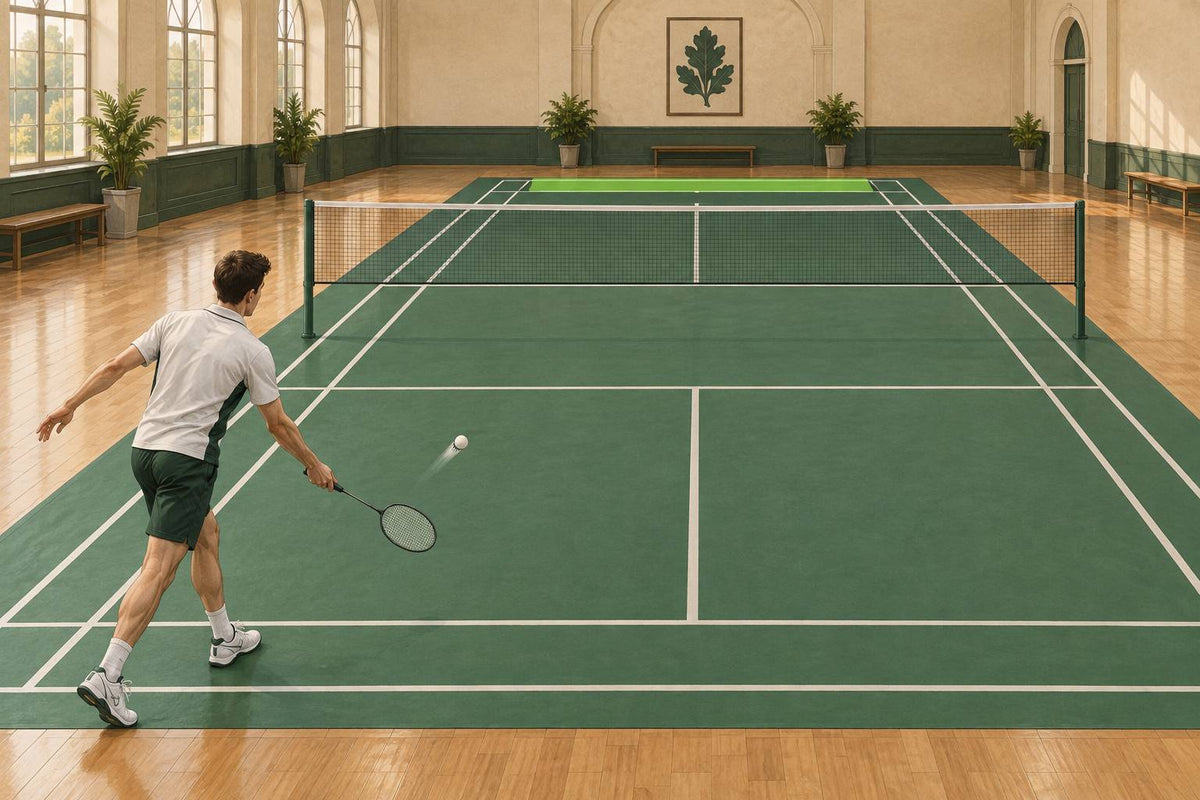
The official badminton shuttle speed test is one full underhand stroke hit from the back boundary line, upward and parallel to the sidelines. A correct-speed shuttle lands between 530 mm and 990 mm short of the far back boundary line: closer than that is too fast, farther is too slow. Run it three times with fresh shuttles before you trust the result, then fix a fail by reaching for a different speed number rather than touching anyone's feathers without agreement.
How to run the shuttle speed test
The official test is one full underhand stroke, hit from directly behind the back boundary line, contacting the shuttle at an upward angle in a line parallel to the sidelines, under BWF Law 3 on testing a shuttle for speed. Use fresh shuttles, hit at full effort, and repeat it three times before you trust a single result.
- Stand right at the back boundary line, the same line you use for a full-length clear.
- Hit one shuttle with a full underhand stroke: contact it above the line, angle it upward, and send it straight down the court, parallel to the sidelines rather than drifting toward a corner.
- Watch exactly where it lands relative to the far back boundary line. Ignore the sidelines, the doubles lines, and anything else on the floor.
- Repeat with two more fresh shuttles from the same tube. One stroke tells you about that stroke, not about the tube.
A mishit, a rushed swing, or a shuttle that has already taken a beating in a rally will throw off the result. Test with a clean, unhurried underhand stroke and a shuttle straight out of the tube, and let the third repeat settle any doubt the first two left.

How to read where it lands
A correct-speed shuttle lands not less than 530 mm and not more than 990 mm short of the far back boundary line. Landing closer than 530 mm short means the shuttle flew too far and is too fast for the hall; landing more than 990 mm short means it fell short of the zone and is too slow.
- Lands less than 530 mm short of the far line (close to it, on it, or past it): too fast for this hall.
- Lands more than 990 mm short of the far line: too slow for this hall.
- Lands between the two marks: correct speed. Stop testing and play.
You do not need to re-measure every session. Measure 530 mm and 990 mm in from the back boundary line once with a tape measure, mark both points with a short strip of court tape or chalk, and reuse those marks for every test in that hall. A worn or faded mark is worth five minutes to redo; guessing the band by eye is not.
What to do if the shuttle fails the test
Reach for a different speed-numbered tube first: feather shuttles are graded in whole-number steps, and moving one step up or down usually fixes a fail. Warm, humid halls tend to carry a shuttle farther, while cold, dry gyms and higher altitude change it too, which is why officials retest whenever conditions shift enough to matter.
If you are not sure which number to reach for, our shuttle speed buying guide covers when a lower or higher number is the sensible starting tube for a given hall, before you get to this on-court test at all. BWF's own testing guidance tells officials to retest shuttles on any day when temperature or humidity change substantially, and to test every available speed from both ends of the court rather than trusting one favourable strike.
Some players try to nudge a shuttle's speed by bending a few feather tips instead of swapping tubes. Skip it. The effect is inconsistent from bird to bird, it shortens the shuttle's life, and, as the next section covers, doing it without agreement is a rule breach, not a shortcut.
The rule on changing shuttles without agreement
Under BWF Law 16.6.2 on player conduct, deliberately modifying or damaging a shuttle to change its speed or flight is misconduct. Changing a shuttle's speed is a decision both sides make together, and in an officiated match, the Referee is the one who actually decides it.
The Instructions to Technical Officials spell out how this plays out on court: any change of shuttle must be fair and the umpire decides whether it happens, and a shuttle whose speed or feathers have been deliberately interfered with is thrown out. When both sides want a different speed, the Referee is called in and has the final say, and player testing at that point usually adds little the Referee did not already see.
Most club nights have no umpire, but the same courtesy holds. If a tube feels wrong, say so before you swap it, open a fresh one, or touch anyone's shuttles, including a spare from your own bag mid-match. Run the test together, agree on the read, and change speed by mutual choice rather than a quiet decision on your own side of the net.


Leave a comment
This site is protected by hCaptcha and the hCaptcha Privacy Policy and Terms of Service apply.