
Last checked: August 2026 · Written by the player-led team at Badminton House
Quick answer
NATA’s equation can describe one recorded session. NATA says fluid-replacement recommendations should use individual rather than population data because sweat rate varies by person and conditions; this guide’s comparable-session repeat is a local record-keeping choice, not a cited protocol or universal drinking, sodium, or litre-per-hour target.
Start with five recorded values
Estimate sweat loss from one recorded session. A later comparable-session repeat is a local record-keeping choice, not a universal drinking prescription.
- Record five values: body mass before and after exercise, fluid consumed, urine volume if any, and exercise duration.
- In the formula, the two body-mass readings form one body-mass-change term: (pre-session mass − post-session mass + fluid consumed − urine loss) ÷ duration.
- Local record-keeping choice: repeat the same five values in another indoor session you judge comparable before looking for a pattern.
- Do not use a single record as an electrolyte-product decision or a universal intake target.
Related reading: Badminton Nutrition Before a Match: Fueling Guide — for the separate fueling and recovery question.
The five recorded values in a sweat-rate estimate
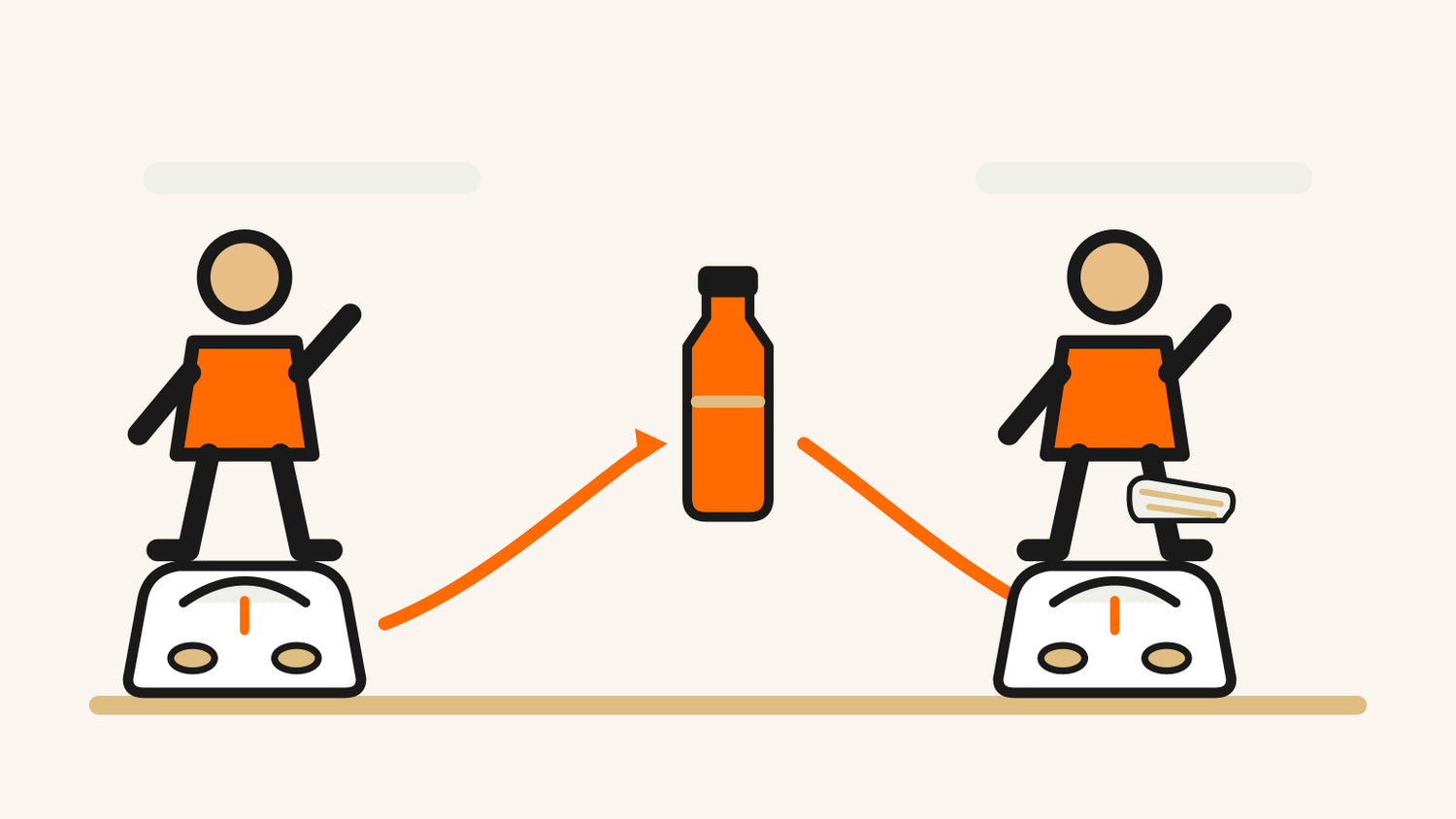
NATA’s sweat-rate equation uses the change between body mass before and after exercise, plus fluid consumed and minus urine volume, divided by exercise duration. That requires five recorded values, while the two mass readings form one calculation term. NATA fluid-replacement guidance

Read the equation as a balance of one completed session. The before-and-after body-mass terms show the net change across that session; fluid consumed is added because it entered during play, and urine loss is subtracted when it occurred. Dividing the resulting sweat loss by duration turns a session total into a rate. NATA’s table states that kilograms for mass, litres for fluid, and hours for duration produce litres per hour.
That unit describes the recorded session; it does not diagnose the player, identify every cause of the result, or set the next bottle. Its useful job is narrower: it keeps the five recorded values connected, so a later record can be compared without silently treating an estimate from one player as a target for another.
The NATA statement is general guidance for physically active people, not a badminton-specific sweat-rate study. Badminton supplies the session context here; the calculation does not establish a typical badminton sweat rate, a performance effect, or an indoor-hall intake rule. NATA fluid-replacement guidance
A useful way to read the setup is in two stages. First, complete the calculation only from the five recorded values. Then interpret it only as a description of that session. If fluid consumed or urine loss was not recorded, the equation has a missing term; a local editorial choice to mark that entry incomplete is clearer than supplying an invented value.
Keeping calculation and interpretation separate also makes the next question more precise. A complete estimate can be compared with another complete estimate, while an incomplete entry tells the player exactly what was not captured. Neither outcome creates a universal rate; the point is to retain the source-supported inputs before drawing a conclusion about an individual pattern.
What one session can—and cannot—tell you
One calculated session describes that session; it is not a universal intake target. NATA says fluid-replacement recommendations should use individual data because sweat rate varies with body size, environment, intensity and acclimatization, and its overview calls for sweat-rate measurement in various environments. It does not prescribe a fixed repeat count or a standard comparable-session protocol. NATA fluid-replacement guidance

One record is only one condition. NATA identifies body size, environmental conditions, exercise intensity, acclimatization status, and other factors as possible sources of sweat-rate variation, and says individual recommendations should use individual data rather than population estimates. That is why a rate from one session should not be recast as a general badminton target. NATA fluid-replacement guidance
Local record-keeping choice: repeat the same five values in another indoor session you judge comparable before looking for a pattern. The aim is not to turn every difference into a cause-and-effect claim. It is to preserve enough context that a player can see which session is being compared with which, and avoid copying another athlete’s intake as if it were their own evidence.
Avoiding overdrinking while individualising
During exercise, NATA advises people not to consume fluid that exceeds exercise-related body-mass losses and says body-mass gain is not recommended except in specific medically overseen circumstances. AIS says sodium replacement does not address the major risk created by excessive fluid intake. These are general fluid-balance boundaries, not a personal clinical decision. NATA fluid-replacement guidance and AIS electrolyte guidance

The body-mass boundary matters because a product label does not turn a session record into a personal prescription. NATA warns against fluid intake that exceeds exercise-related body-mass losses, and AIS notes that electrolyte replacement does not prevent the fluid-balance problem created by excessive drinking. Those points explain why the calculation, the record, and any product decision should remain separate questions.
AIS says the need for, and optimal plan for, sodium intake remains unclear in endurance and ultra-endurance contexts, and says a personalised fluid plan should be made with a sports dietitian when targeted replacement of large sodium losses is being considered. A sweat-rate estimate is therefore not a sodium prescription for an indoor badminton session. AIS electrolyte guidance
The cited sources do not provide a universal sodium target, a medical diagnosis, or a one-session plan for every badminton player. This guide therefore keeps its conclusion modest: calculate what was recorded, compare like with like, and do not use a single rate as a promise about performance, safety, or the right product.
A body-mass record does not diagnose hydration status or distinguish overlapping symptoms. NATA notes that early signs of hypohydration and exercise-associated hyponatremia can overlap and that blood-sodium assessment is needed to differentiate them before treatment. A player who feels unwell should not use this calculation to self-diagnose or self-treat. NATA fluid-replacement guidance
Make the record comparable
Local editorial record-keeping choice: keep five values together: before-session mass, after-session mass, fluid consumed, urine loss if any, and duration. The two mass readings form one change term in the formula. Add a brief note that identifies the indoor session being described, then mark the entry incomplete instead of filling a missing value with a guess.
On the next comparable session, use the same fields again. Put the two complete records side by side before trying to interpret a difference. This does not turn the note into a hydration plan; it simply makes the evidence trail visible and keeps a later conversation from relying on a remembered estimate.
The cited guidance supports the calculation and the need to individualise; it does not provide a universal drinking rate, sodium target, diagnosis, or product decision. The goal is a clearer comparison, not a target copied from another player.
Questions the cited sources do not settle
- A universal millilitre-per-hour or sodium target.
- A medical diagnosis or a one-session calculation that applies to every hall condition.

Leave a comment
This site is protected by hCaptcha and the hCaptcha Privacy Policy and Terms of Service apply.