
Last checked: August 2026 · Written by the Badminton House player-led team.
Quick answer: the first 48 hours
Stop playing, check emergency and urgent warning signs, then protect a likely minor soft-tissue injury from aggravating movement. PEACE is a useful guide for roughly the first 1–3 days; LOVE begins after the first days as symptoms and a diagnosis allow. Forty-eight hours is a practical checkpoint, not a biological switch.
First
Screen before self-care: deformity, circulation or nerve changes, major loss of function and head-injury danger signs override every acronym.
1–3 days
Use PEACE: Protect, Elevate, Avoid anti-inflammatory modalities, Compress and Educate.
After
Use LOVE: Load, Optimism, Vascularisation and Exercise, scaled to the actual injury and clinical advice.
Important: This is general first-aid education, not a diagnosis, medication plan or return-to-play clearance. PEACE and LOVE do not rule out a fracture, dislocation, tendon rupture, serious ligament injury or concussion.
A “first 48 hours” title is useful because club injuries often happen after clinics close and the player must decide what to do next. The clock does not identify the tissue or grade the damage. Use it to organize decisions: safety first, short protection next, then a gradual move toward active recovery only when the injury allows.
What should happen in the first ten minutes?
End the rally and protect the player from another collision or forced movement. Before reaching for a wrap, decide whether this looks like a minor limb injury at all. A serious head injury, visible deformity, circulation change or major loss of function needs a medical pathway rather than courtside experimentation.
- Stop play: do not ask the player to prove the injury with hops, lunges, stretches or another rally.
- Make the area safe: move rackets, shuttles and bags away while the injured player stays in a comfortable position.
- Check the warning signs: compare the emergency and urgent lists below before choosing self-care.
- Record the event: note the time, movement or contact, any sound, immediate swelling, ability to bear weight, head contact and changes in sensation.
A possible concussion follows a separate rule. If a player has signs or symptoms after a bump, blow or jolt to the head or body, remove them immediately. The CDC sports-concussion response says no return that day and no return to sport until a healthcare provider clears it.
When should you stop self-managing?
Use emergency care for fracture, circulation, neurological or serious head-injury patterns. Use urgent same-day assessment for severe symptoms, major swelling or loss of normal function. These categories are more useful than guessing whether the injury is a sprain or strain from the place it hurts.
| Level | Warning signs | Action |
|---|---|---|
| Emergency | A crack with the injury; a body part changed in shape or pointing at an odd angle; numbness, tingling, blue or grey skin, or a cold limb. After head contact: seizure, repeated vomiting, increasing confusion, inability to wake or stay awake, slurred speech, weakness or numbness, worsening persistent headache, unequal pupils or double vision. | Use your local emergency number or emergency department. Do not resume play. |
| Urgent today | Very severe or worsening pain; large or worsening swelling or bruising; inability to bear weight or walk more than a few steps; marked stiffness or movement difficulty; a pop or snap with rapid swelling, blocked movement or major function loss; a knee that locks, gives way or painfully clicks. | Seek same-day clinical advice or urgent care. Do not use LOVE as a test. |
| Assessment | The problem is not improving with self-care or normal use remains limited. | Arrange assessment with a qualified clinician rather than assigning a home diagnosis. |
The limb warning signs come from current NHS sprain and strain guidance, NHS Dorset's early knee-injury guidance, and the NHS urgent knee guidance. The head-injury list follows the CDC concussion danger signs.
How does PEACE guide roughly the first 1–3 days?
Once urgent problems have been excluded, PEACE shifts the goal from “fix it tonight” to short protection, swelling management and a realistic plan. The framework uses about 1–3 days for protection, but prolonged total rest is not the target. The exact duration depends on the injury and clinical advice.
| Letter | Meaning | Practical boundary |
|---|---|---|
| P | Protect | Restrict movements and activities that aggravate the injury for a short period. Protection is not repeated pain-testing or complete immobilisation without advice. |
| E | Elevate | For a minor limb injury, raise it comfortably when practical. The foundational editorial calls the evidence weak, so elevation is supportive rather than a healing guarantee. |
| A | Avoid anti-inflammatory modalities | This is the framework's exact label. This article gives no medication or cooling instruction; personal choices belong with a clinician or pharmacist. |
| C | Compress | Use a wrap only if trained. It should be firm, not tight, with colour, warmth and sensation beyond it rechecked. |
| E | Educate | Understand the likely course, what to protect, which changes need review and what the next loading decision will be. |
The letters and evidence caveats come from the BJSM PEACE and LOVE editorial. Dorset County Hospital's patient guide uses the same framework for the first 72 hours. For compression, St John Ambulance says to check circulation immediately and every 10 minutes and to reapply more loosely if colour does not return promptly.
When does LOVE begin?
LOVE starts after the first days when serious injury has been excluded and symptoms permit an active plan. It may overlap with the end of protection; it is not automatic permission to load a painful joint or return to badminton. If the diagnosis or safe load is unclear, assessment comes before progression.
| Letter | Meaning | What it does not mean |
|---|---|---|
| L | Load gradually as symptoms and the diagnosis allow. | Do not use hops, deep lunges or a match as a clearance test. |
| O | Use realistic optimism and clear expectations. | Optimism does not mean ignoring swelling, instability or fear that needs clinical support. |
| V | Add appropriate pain-free cardiovascular activity after a few days. | Do not improvise around an injury that still cannot bear weight or has not been assessed. |
| E | Use diagnosis-specific exercise to restore mobility, strength and position sense. | A generic article cannot prescribe the exercise, dose or return date for an unknown injury. |
At the 48-hour mark, ask whether symptoms and function are settling, unchanged or worsening, and whether you know what was injured well enough to choose the next load. If not, the useful next action is assessment. “Day two” alone does not make LOVE safe.
Did PEACE and LOVE replace RICE?
PEACE and LOVE changed the emphasis from short-term symptom control alone to a continuum: brief protection, education and then active recovery. It also pushed back against prolonged total rest. That is a useful teaching shift, but it is not proof that one acronym is the universal treatment for every acute injury.
The foundational BJSM paper is an editorial. It reports weak elevation evidence, conflicting compression studies and no high-quality evidence that ice improves soft-tissue injury outcomes. Current NHS national guidance still recommends PRICE, including a wrapped cold pack, during the first 2–3 days. Authoritative sources therefore still differ on routine cooling.
This guide does not tell you to use, avoid or time cooling, and it does not advise on medication. It does say what the evidence can support safely: do not rely on long total rest, do not treat symptom relief as proof of healing, and do not let an acronym replace assessment when function or warning signs are concerning.
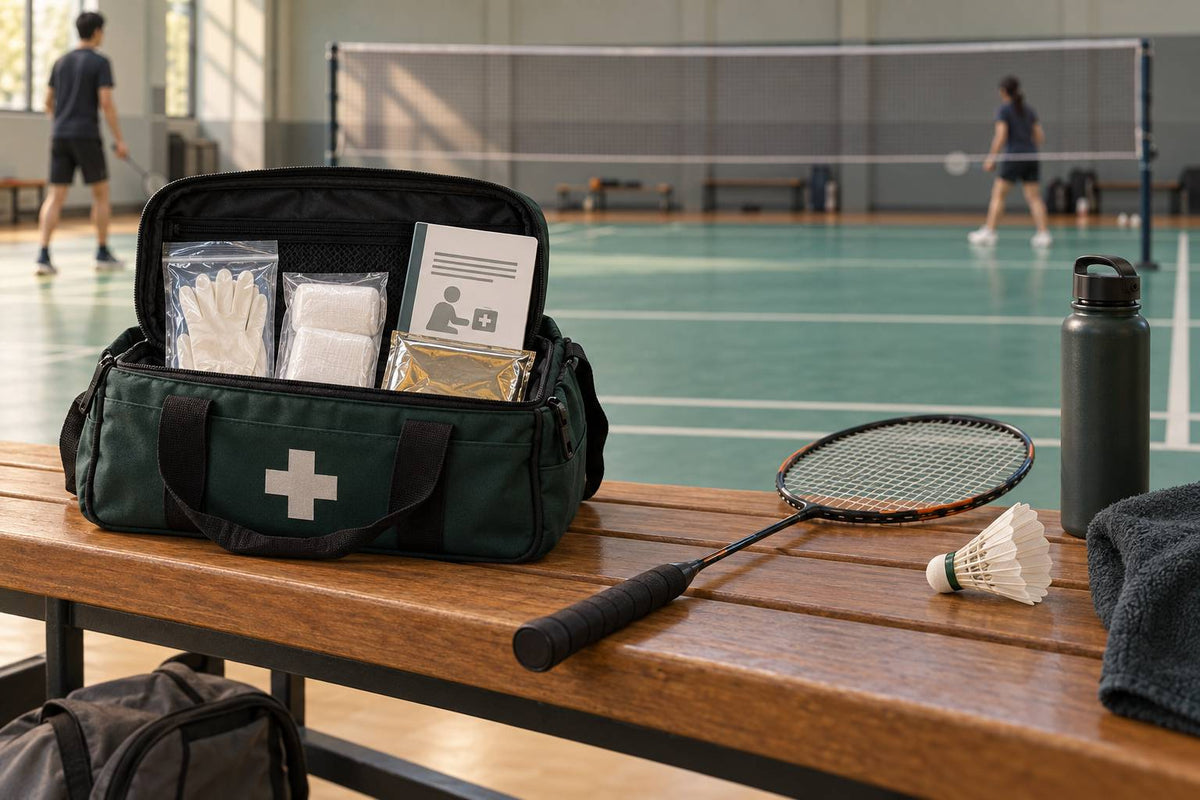
What should a club first-aid bag contain?
A small club bag should support safe first response and a clean handoff, not turn a teammate into a clinician. Keep non-medication basics together, label the bag clearly and make sure more than one regular player knows its location and the venue's emergency address.
- Non-latex disposable gloves.
- Absorbent dressings, adhesive bandages, sterile gauze and cloth medical tape.
- Roller and triangular bandages for trained use.
- A breathing barrier and emergency blanket.
- Printed first-aid instructions plus the venue address, local emergency number and AED location.
- A simple check card for replacing opened, used or expired items.
This non-medication list is drawn from the American Red Cross first-aid kit checklist. Supplies help only when someone can use them safely, so pair the bag with first-aid and AED training rather than adding improvised treatment tools.
Related reading: Once a clinician has narrowed the injury, use the specific guide that matches it: ankle sprain recovery, calf strain versus Achilles warning signs, or calf return-to-court questions.
The useful 48-hour rule
Use the time window to organize decisions, not to diagnose the tissue: screen first, protect briefly, reassess function and move toward LOVE only when the injury and clinical advice allow it.

Leave a comment
This site is protected by hCaptcha and the hCaptcha Privacy Policy and Terms of Service apply.