
Last checked: August 2026 · Written by the player-led team at Badminton House
This badminton lesson plan gives thirty beginners a useful job every minute of a six-week unit, even with only two nets. It uses short rotations, a repeatable setup and counted challenges so students practise movement, contact, serving and cooperation before they are asked to play a full game.
Related reading: Teaching badminton in schools
The plan is deliberately small. Each lesson has one observable objective, a warm-up, five stations and one exit task. That makes it practical for a teacher who is managing equipment, behaviour and mixed experience rather than delivering a club session to a few keen players.
Set up a big class so waiting never becomes the activity
With thirty students and two nets, run five groups of six and give every group a defined station. Two groups use the nets, while the other three practise a related movement, contact or target task. Rotate every six minutes after a short demonstration and reset cue.
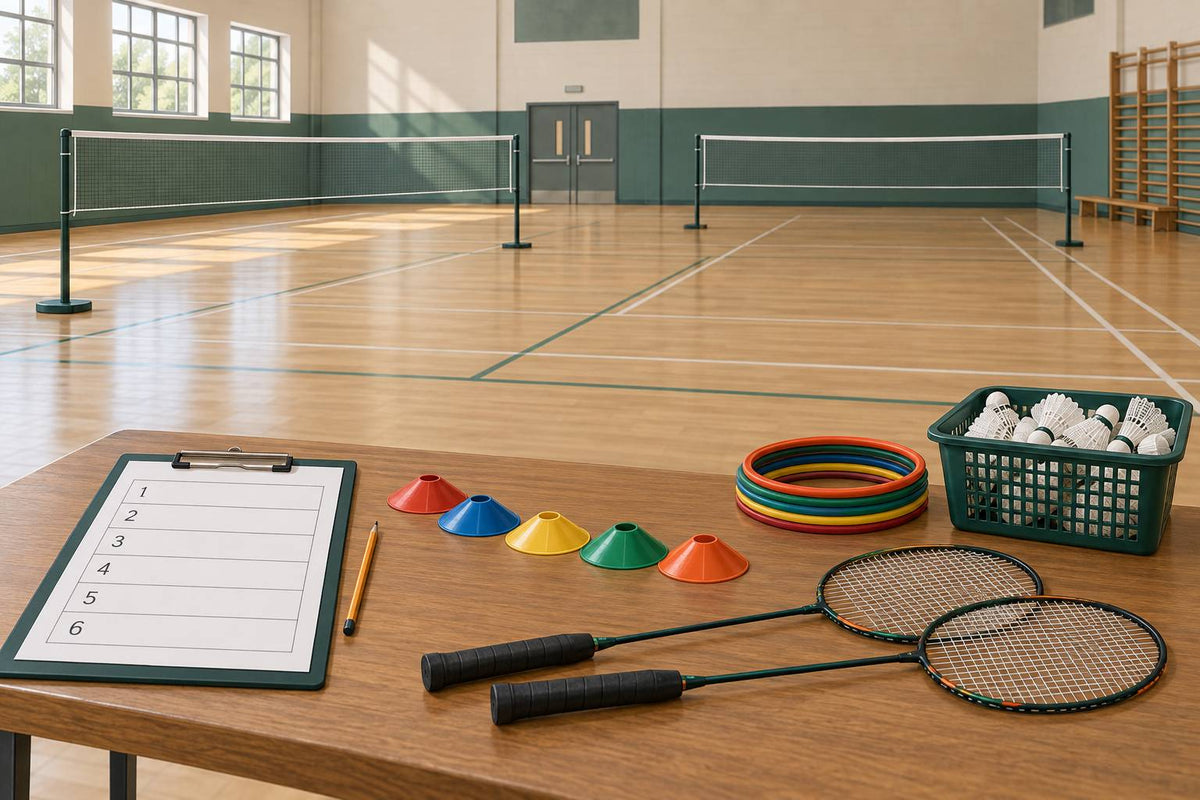
Put a coloured cone at each station, a shuttle tube or basket where students collect equipment, and a small card with the task in plain language. You do not need a polished poster. A cone colour, a verb and a number are enough: “orange: ten underarm feeds”; “green: five shadows”; “black: three target hits.” Keep spare shuttles off the playing lane so the first person who finishes can replenish a basket instead of inventing a new game.
Use six students per group in three pairs. At net stations, two pairs rally or serve while the third pair observes, counts or gathers. Change roles at the halfway point. At off-net stations, pairs work side by side rather than in a long single file. That is the practical interpretation of the BWF guidance to rotate partners and let learners use different practice levels within one group. The BWF Level 1 Coaches’ Manual also recommends moving work from simple and predictable tasks toward more complex, unpredictable ones.
For the whole unit, prepare: 15 short or standard rackets, 30 nylon shuttles, 20 cones, eight hoops or floor targets, two nets, two whiteboards or clipboards, and five pencils. If equipment is tighter, use hand-throwing at the contact stations and make the waiting pair a scorer. A useful station is one that gives repeated decisions or repeated contacts, not merely a place to stand.
| Station | Six-person layout | Teacher look-for |
|---|---|---|
| Net lane | Two pairs play, one pair counts or feeds. | Safe spacing and a clear role change. |
| Target lane | Three pairs each have a hoop or wall square. | Controlled contact rather than power. |
| Movement lane | Three marked paths, partners mirror then swap. | Stop under control and recover to base. |

Weeks one to three build contact, movement and an honest rally
Start with object control before competitive play. In the first three lessons, students learn the safety routine, basic underarm contact, a simple serve and recovery movement. Each lesson ends with a count that students can improve next week rather than a judgement about whether their technique looks elite.
Lesson 1: control the space and the shuttle. Objective: students can carry, collect and strike safely in their own lane. Warm up for six minutes with a shuttle balance relay: walk, stop, turn and place the shuttle in a hoop. At the two net stations, pairs hand-feed an underarm lift over the net and count clean catches by their partner. At the other stations, students tap a shuttle upward, throw-and-catch across a floor line, and shadow a ready position between three cones. Exit task: each pair records its best five-contact throw-and-catch sequence.
Lesson 2: make an underarm serve purposeful. Objective: students can send a shuttle upward and forward into a marked receiving space. Warm up with pairs rolling a shuttle tube-sized soft ball along a line, then progress to underarm throws. Net stations use low-pressure serves to a hoop placed beyond the short service area; the observer calls “ready” and records attempts. Off-net stations are hand feeds to a wall target, gentle racket taps in a lane, and a step-forward, step-back pattern. Exit task: five serves, with students counting how many land in the chosen area.
Lesson 3: move, hit, recover. Objective: students can return to a marked base after one controlled shot. Warm up with mirror footwork: one student leads two side steps and a stop, the other copies. At a net, pairs play one lift followed by a recovery to the cone behind them. Off-net groups shadow a split-step and lunge, hand-feed a shuttle after a two-step approach, and make a three-shuttle target sequence. The BWF manual uses a similar learning path, beginning with shadowing and building toward fed shuttles and rallies. Its progression examples are useful because they keep the task achievable while adding one demand at a time.
Do not correct every detail during these lessons. Pick one cue for the whole class, such as “recover behind your cone,” then offer one individual cue when needed. The BWF manual advises limiting external feedback to one or two simple, specific points. That keeps a rotation moving and gives students time to notice what happened on their own attempt.
Weeks four to six turn the separate skills into playable decisions
The final three lessons keep the station structure but add choice, cooperation and simple scoring. Students first make a rally predictable, then work with a partner to sustain it, then play short games with a narrow success condition instead of being judged by a full rulebook.
Lesson 4: serve, receive, then rally. Objective: students can begin a point and keep the next shot in play. At each net, one pair serves while the other returns to a large target zone; after the return, both sides try for three contacts. Off-net stations are overarm throwing into a back-court target, cooperative forehand taps across a floor line, and a scorekeeper station that practises calling “in”, “out” and “replay” calmly. Exit task: record the longest three-shot pattern your pair can repeat.
Lesson 5: use a partner as a helper. Objective: students can feed, observe and give one useful piece of feedback. Warm up with a partner chase: one student points to a cone, the other moves to it and returns. At net stations, the observer counts rallies and asks one question after each attempt: “Did you recover?” or “Was the serve high enough?” Off-net groups feed from the hand to a target, practise a four-corner shadow pattern, and run a cooperative clear-and-catch challenge. The target is not a hard smash. It is a partner who can make the next repetition better.
Lesson 6: mini festival and evidence of learning. Objective: students can apply a serve, a recovery and respectful scoring in a short game. Keep the two courts for four-minute games to five rally points. Standard law awards a point to the side winning a rally, and a normal game is won at 21, but five-point games are a class-management format rather than a replacement for official scoring. The Laws of Badminton set the official 21-point framework. Off-net groups complete the same evidence task: serve five shuttles to a zone, sustain a four-contact cooperative rally, or complete a shadow-and-recovery route. Rotate until every group has played and completed one evidence task.
End the final lesson with a one-minute reflection. Ask students to name one task they can now repeat, one cue that helped, and one role that made a group work. This produces better planning information than a vague thumbs-up because it identifies whether the barrier was contact, movement, rules or cooperation.
Assess repeatable evidence and adapt the next rotation
Assess this unit with small, repeatable tasks rather than a full-stroke checklist. Count a result, record one observation and use the next lesson to change the task level. That approach is manageable for a teacher and fairer to beginners who are still learning where the shuttle will go.
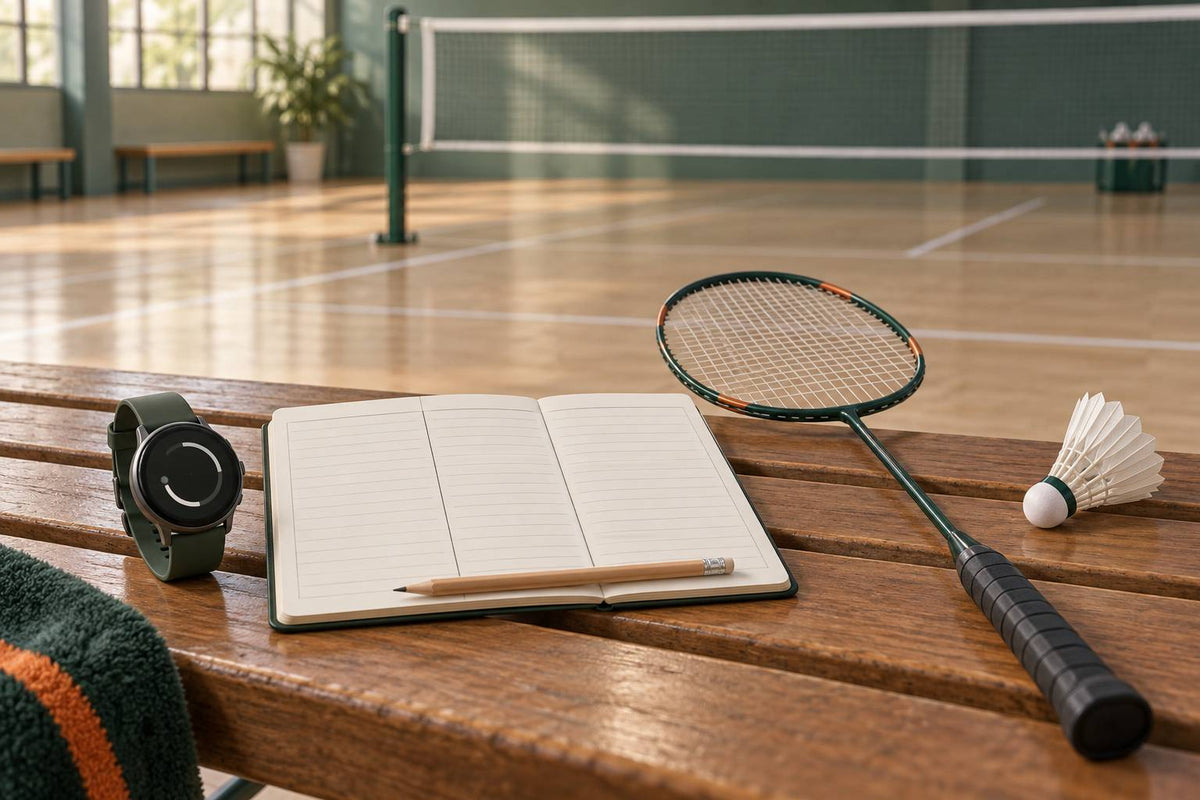
Use three evidence columns on a clipboard: “can start”, “can sustain”, and “can help a partner.” For example, a student can start when they complete two of five serves into a wide zone; can sustain when they complete four cooperative contacts; and can help when they feed safely or count honestly. These are teacher-made success criteria, so explain them before the station begins and allow a second attempt after a short cue.
Differentiate without separating the class into permanent ability labels. Make the standard task wide enough for most learners, then offer an easier and a harder version on the same station. A beginner may throw then catch across a line. A confident player may use a racket and aim beyond a cone. Both still practise timing, direction and recovery. The important management question is whether every pair is active, safe and able to explain its next attempt.
When a station fails, simplify it before adding more explanation. If shuttles are everywhere, shrink the lane and reduce the number in play. If students queue, create a second target or give the waiting pair a scoring role. If a rally is impossible, use throw-and-catch for two minutes, then return to racket contact. That is a progression decision, not a retreat.
A simple weekly record keeps the unit coherent. After each class, write down which station had the longest queue, which instruction needed repeating and which pairs completed the exit task without help. At the start of the next lesson, change only one of those conditions. You might widen a target, add another shuttle basket, move a cone farther from the net or shorten a rotation by one minute. This is more useful than rewriting the entire lesson because it preserves the routine students have learned. It also gives you a practical record for the next class or the next time you teach the unit.
Plan the room before students arrive. Put net groups far enough apart that a loose shuttle cannot enter the next lane. Keep wall-target groups facing the same direction and away from doors. Make the running path short and return students around the outside, not through a hitting lane. Explain that a racket stays below shoulder height unless the station specifically practises an overhead action. Stop the entire class for unsafe movement, then restart the station with fewer shuttles or more space. A quiet, repeatable reset is better than trying to coach over noise.
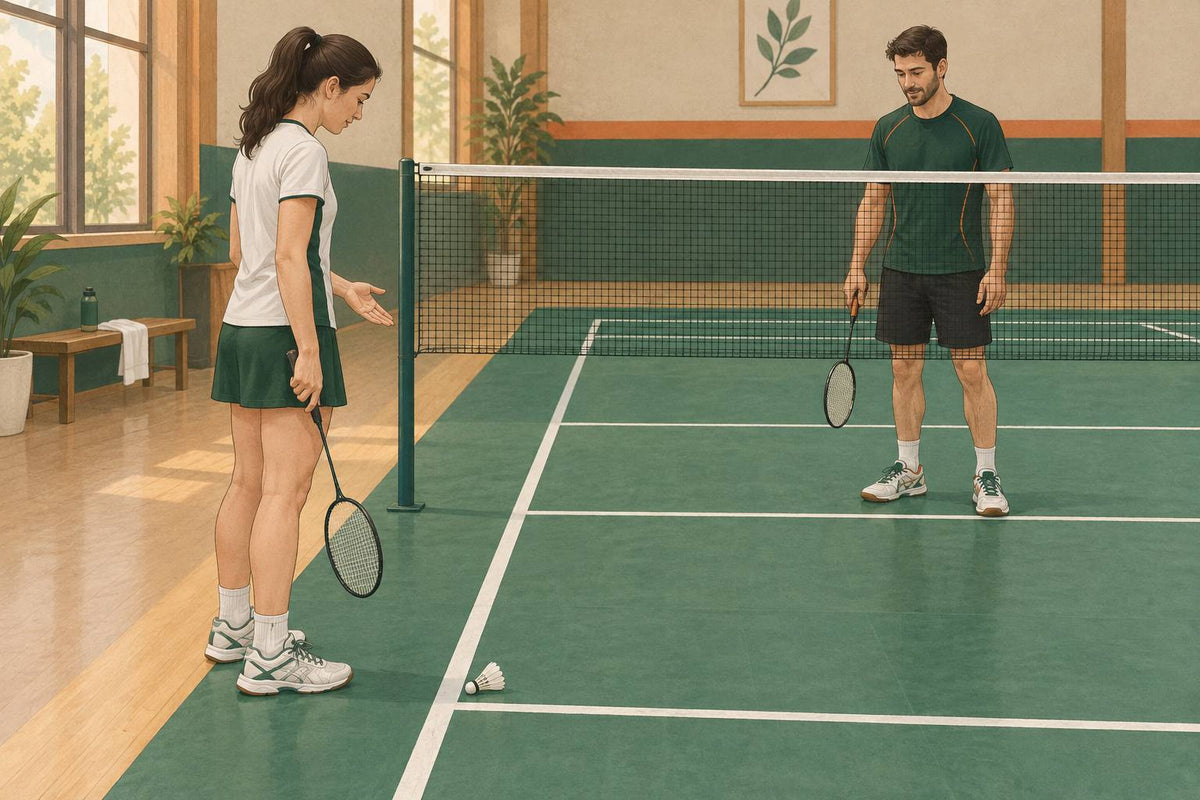
Use groups deliberately. Pair students who can work safely together, then rotate partners between lessons rather than every minute. Give each group three roles: player, partner and recorder. The recorder watches a concrete item, such as whether the player returned behind the cone or whether a serve crossed the net. The role is not permission to judge a classmate's style. It is a way to make observation active and to give the teacher a second source of information. When a pair moves to the next station, the recorder becomes a player and the role travels with the group.
If students arrive with varied experience, do not create a separate advanced court from week one. Give every station a base version and one extension. For example, the base serve task is a high underarm send into a wide zone. The extension is to choose a left or right target after the observer calls a colour. The base rally task is throw-and-catch across a line. The extension is a racket rally with a recovery cone. Students can move up after success, then return to the base task if control disappears. This protects confidence while keeping the class in the same lesson story.
Finally, make the final festival feel like evidence rather than a tournament trial. Keep games short, rotate often and let groups earn a point for respectful scoring or a completed rally as well as a winner. Students who are not on a court should still be collecting a score, completing a target task or preparing the next group. The aim of six weeks is a class that can set up, practise and play safely with increasing independence. A student who can serve, recover, cooperate and count honestly has a platform for the next badminton unit.
Before lesson one
- Mark five station colours and place the equipment before students enter.
- Teach the rotation signal, racket-safe distance and shuttle collection routine.
- Choose one count for the exit task and keep it for the next lesson.

Leave a comment
This site is protected by hCaptcha and the hCaptcha Privacy Policy and Terms of Service apply.