
Last reviewed: July 2026 · By Badminton House’s player-led team
Quick Answer: Teaching Badminton in Schools
Use a six-lesson, station-based unit: BWF’s free manual, 22 lesson plans and videos give non-specialists a ready starting point.
No marked court
Best choice: teach core skills and simple games indoors or outdoors.
30 pupils
Rotate small groups through skill, movement and target tasks so court queues do not dominate.
Limited kit
Use a rope or tape in place of a net, balloons and targets while rackets circulate.
Teaching badminton in schools can unravel when 30 pupils share a hall, a few rackets, and only one net: queues grow, rallies disappear, and confident players take over. A six-lesson unit works when each lesson has one clear movement or striking outcome and every pupil has an active role between turns.
This plan uses short progressions, simple games, and adaptable stations rather than trying to run full matches from day one. It gives teachers with limited badminton experience a practical way to build enjoyable, active lessons. For lesson one, choose the success cue, mark five station areas, and put the rackets at the two racket stations.
In This Guide
Why use a six-lesson badminton unit in PE?
A six-lesson unit should prioritise repeated successful contacts and active participation before formal matches. That makes badminton manageable for teachers without a specialist background and gives pupils with little or no experience enough time to build confidence through achievable movement, striking and partner tasks.

BWF’s Shuttle Time lesson plans are a free school resource with 22 plans that can be shortened, adapted, repeated and recombined. That makes six lessons a purposeful sequence rather than a rushed version of a full scheme.
For a teacher or volunteer who needs one simple starting session before planning the unit, see Badminton First Lesson: Teach a Friend to Rally in an Hour.
What should you teach in six badminton PE lessons?
Progress from controlling an object to sending to a partner, sustaining rallies, serving, and short self-managed games. Make lesson six a low-pressure class festival, not a test of full regulation matches; success and repeatable play matter more than complete technique.

| Lesson | Success cue | If pupils need more time | When they are ready for more |
|---|---|---|---|
| 1. Grip and striking | Tap upward three times. | Balloon. | Alternate sides. |
| 2. Send and receive | Partner catches a gentle send. | Shorter gap. | Target zone. |
| 3. Rally games | Keep five shots alive. | Catch then send. | Move after each hit. |
| 4. Serving | Keep both feet still; strike the shuttle’s base below 1.15 m so it travels upward and diagonally. | Serve to a hoop. | Name the receiving service court. |
| 5. Mini-matches | Serve from the right on an even score and the left on an odd score. | First to three. | Self-officiate. |
| 6. Class festival | Start, score, and rotate at the end of each game. | Cooperative rally. | Challenge ladder. |
Start with the middle task; move left for an earlier success, or right once pupils can meet the success cue.
For the serving and scoring cues, use the BWF Laws of Badminton as your rules reference.
How can you run badminton stations for 30 pupils with limited rackets?
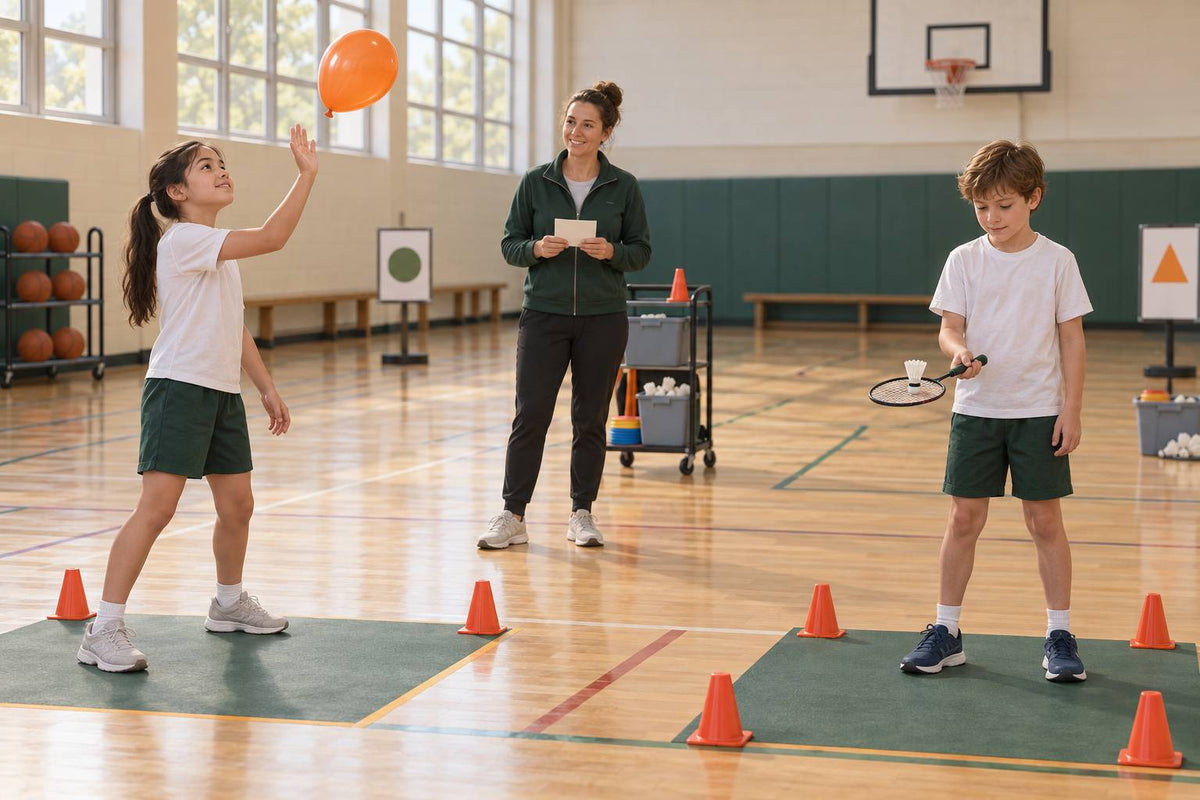
Divide 30 pupils into five groups of six and rotate them through five clearly marked, short stations. This practical adaptation keeps pupils moving, catching, throwing, shadowing or striking rather than queuing behind a court; BWF Shuttle Time’s FAQs confirm that group activities and creative use of space can support classes of more than 30.

Keep the available rackets at Cards 4–5; Cards 1–3 need none. For a 60-minute lesson, use: 5 minutes arrival task; 5 minutes demonstration and safety cue; five 8-minute rotations (40 minutes); 5 minutes reset/water; then 5 minutes exit reflection.
- Card 1 — Catch/throw: partner tosses to different heights; catch, call the target, swap.
- Card 2 — Shadow: move to four cones, stop balanced, then recover to base.
- Card 3 — Target/decision: choose the unoccupied hoop or cone target before throwing.
- Card 4 — Racket control: self-tap control.
- Card 5 — Partner racket: strike-over-line challenges.
On the signal, each group moves clockwise to the next numbered card. Across the circuit, pupils practise coordination, balance, agility, jumping/landing and decision-making—not just racket contact.
What equipment substitutions and rules make school badminton manageable?
A school unit can work without marked courts or regulation nets: use visible tape, a rope or tape in place of a net, improvised targets, and slower striking objects when pupils need more time to succeed. These adaptations keep the task recognisably badminton while making first contacts more achievable.

Use the BWF Shuttle Time equipment guidance to choose the simplest workable adaptation.
| Need | Practical swap |
|---|---|
| Boundaries | Tape clear boundary lines; a shuttle touching a line is in. |
| Net | Use rope or tape; lower or remove it only with clear safety spacing. |
| Contact | Use a balloon for slower contact; use coloured synthetic shuttles for visibility and durability; grip near the T-joint to shorten a standard racket. |
| Targets | Hoops, cones, boxes, baskets. |
Class-festival rules card
Play short games; award a point on every rally. State a local “basketball hoop = let” rule where needed. Watch for an incorrect serve, shuttle out of bounds, a shuttle that does not clear the net, ceiling/wall contact, shuttle touching a player, the same player hitting it twice, net touch, or reaching into the opponent’s court.
Which badminton lesson format should you choose?
Choose the Starter sequence for a full beginner programme, the recombined six-lesson unit when timetable space is tight, or the flexible station/outdoor format when facilities or equipment are the constraint. All three keep the emphasis on accessible, active first experiences rather than expecting teachers to coach formal matches.

| Choose | Best when | Teaching focus |
|---|---|---|
| Starter sequence | You can give beginners a longer progression. | Build skills lesson by lesson from the 10 beginner-focused plans. |
| Recombined six-lesson unit | You need a concise PE block. | Shorten, repeat, or combine activities to fit six lessons. |
| Flexible station/outdoor format | A shared gym, small space, or limited courts restrict play. | Use groups and creative space; the first 10 plans can be played outdoors. |
The BWF Shuttle Time lesson plans explicitly allow teachers to adapt duration and create new lessons from activities across plans.
Before lesson one
Choose one success cue, set out five numbered station cards, and make the one equipment swap your class needs most.
Get 10% off your first order
Join the Badminton House list and we’ll email you a 10% welcome code — plus training guides, technique advice, and badminton updates.
By subscribing, you agree to receive Badminton House emails and can unsubscribe anytime.
A strong school unit keeps pupils moving, makes early success visible, and leaves teachers with activities they can adapt and reuse. Station rotation, simple progressions, and durable plastic shuttles make that practical even when space and equipment are limited. We play badminton and can help you choose suitable shuttles or think through a school setup—contact us for advice.
Keep your next PE badminton unit ready for action.
Browse ShuttlecocksChoose durable shuttles for repeated school activities.

Leave a comment
This site is protected by hCaptcha and the hCaptcha Privacy Policy and Terms of Service apply.