
Last checked: August 2026 · Written by the player-led team at Badminton House
Quick answer
Cone and shaft markings are a model-specific specification sheet, not a universal badminton code. Read the model first, then confirm its weight, grip and stringing advice on that manufacturer’s official page. Keep any unit number as a record, but keep the receipt too.
First
Match the model: treat a code such as 4UG5 as useful only after matching it to the exact racket and manufacturer.
Then
Use the published tension range for that weight version, and save clear photos plus proof of purchase before the racket is restrung or damaged.
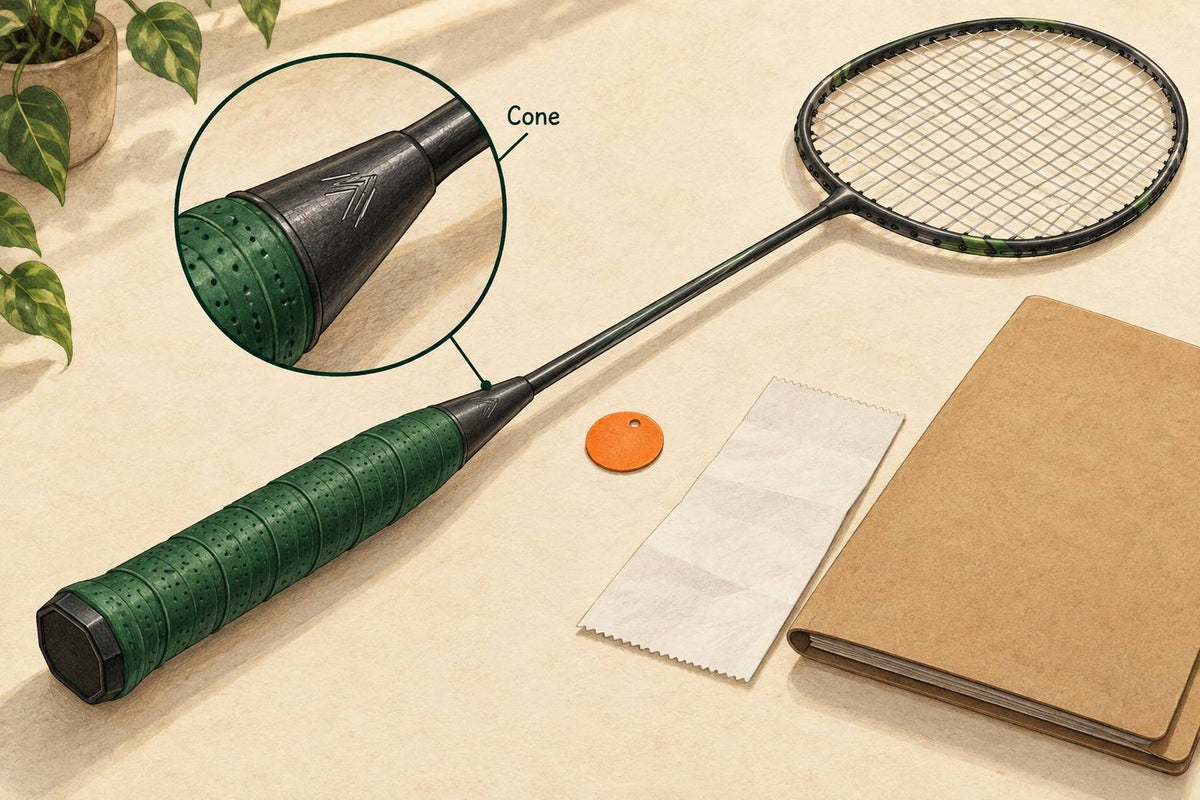
The cone is the short join between the handle and shaft. It is a convenient place for manufacturers to put a configuration code, a production or traceability mark, or other model information. The useful habit is not memorizing a universal decoder. It is reading every mark as part of one particular racket’s documentation.
That distinction matters because the BWF Laws of Badminton define racket construction and dimensions, but do not define retail weight classes such as 3U or 4U, grip labels such as G4 or G5, or a single string-tension scale. Those are manufacturer labels. Familiar letters across brands do not guarantee an identical meaning.
Not a fake-check guide: cone markings can be useful when you inspect a racket, but they do not prove authenticity by themselves. For the broader purchase check, read how to spot a fake badminton racket.
Read the model and configuration first
A compact code can combine a weight class and a grip designation. For example, one current Yonex product page lists a NANOFLARE NEXTAGE as 4UG5; on that specific page, 4U is listed as an average 83 g specification and G5 identifies the offered grip configuration. Yonex’s published specification is what gives that code its meaning.
The practical reading order is simple: find the model name or item code, identify the combined weight/grip mark, then compare both against the official page for that exact version. Do not assume that every colourway, production run, market version or model year is sold with the same choices.
| What you see | What it can tell you | What to do next |
|---|---|---|
| Model or item code | Which official specification page to use. | Search the manufacturer’s current or archived product listing before interpreting nearby codes. |
| 4UG5-style code | A weight-class and grip configuration on many models. | Confirm the manufacturer’s meaning rather than translating it into a universal weight or handle diameter. |
| lb or kg range | Manufacturer stringing advice for that model or weight version. | Give the range and the racket’s weight version to your stringer. |
| Serial or production mark | A useful identifier to photograph and retain with the racket’s records. | Keep it with the receipt; do not treat it as a standalone warranty certificate. |
Grip is a fit decision, not a bragging number. An overgrip adds material around the handle, so it can make an already comfortable handle feel too large. If you are choosing between two factory grip options, test the base handle before adding your preferred overgrip. If the racket is already yours, judge whether you can change finger pressure and rotate the handle cleanly rather than trying to convert G5 into another brand’s size.
Use stringing advice as a model limit
A tension marking is not a universal recommendation to string as tightly as possible. It is model-specific advice. The cited Yonex 4U example lists 20–28 lb. Treat that as the manufacturer's advice for that exact configuration, then confirm the official page before deciding what to request from a stringer.
Give a stringer four facts: model, weight/grip configuration, the printed or official tension range, and the string you want installed. The range protects the equipment decision; it does not tell you the best feel for your game. Choose within it based on your experience, the string and qualified stringer guidance.
If your cone does not show a readable tension label, do not guess from another racket in the bag. Look up the exact model. A current Yonex ASTROX 01 FEEL listing, for instance, identifies its 4U/G4,G5 configuration separately from its 20–28 lb stringing advice. The manufacturer page is more reliable than visual similarity.
Treat traceability and market marks carefully
A laser mark, serial-like number, sticker or country suffix is worth recording, especially before you change the factory grip, restring the racket or ship it for inspection. But it does not replace purchase documentation. Code formats change by brand, market and production period, and a number that looks official does not tell a buyer what a manufacturer will accept in a claim.
The warranty terms checked for this guide require an original purchaser, valid proof of purchase, a defect description, and photos or video. They also set market and seller conditions. Yonex USA’s warranty terms are one example of the principle: eligibility depends on more than an engraved mark.
Use a unit mark as a filing label. Photograph the cone, lower shaft, butt cap, receipt and order confirmation together. If you suspect a defect, stop using the racket, photograph its current condition and follow the seller or manufacturer’s instructions before modifying it further.
A 90-second racket-marking check
Use this routine when a racket arrives, before you ask for a restring, or when comparing two versions of the same frame. It keeps a useful specification check separate from an authenticity investigation.
- Read the model name and item code. This is the anchor for every other mark.
- Photograph the configuration code. Record the exact characters rather than relying on memory.
- Open the official specification page. Confirm weight, grip choices and tension advice for that version.
- Check the handle before adding an overgrip. Choose grip comfort first; added wrap changes the outside size.
- Save the receipt with the photos. This is the document that turns a marking into useful service or warranty evidence.
Once the markings are decoded, the next useful question is how the racket behaves in play. Use our on-court racket test routine to assess handling and control. You can also browse badminton rackets with the weight, grip and stringing details in hand or ask Badminton House about a specific configuration.



Leave a comment
This site is protected by hCaptcha and the hCaptcha Privacy Policy and Terms of Service apply.