
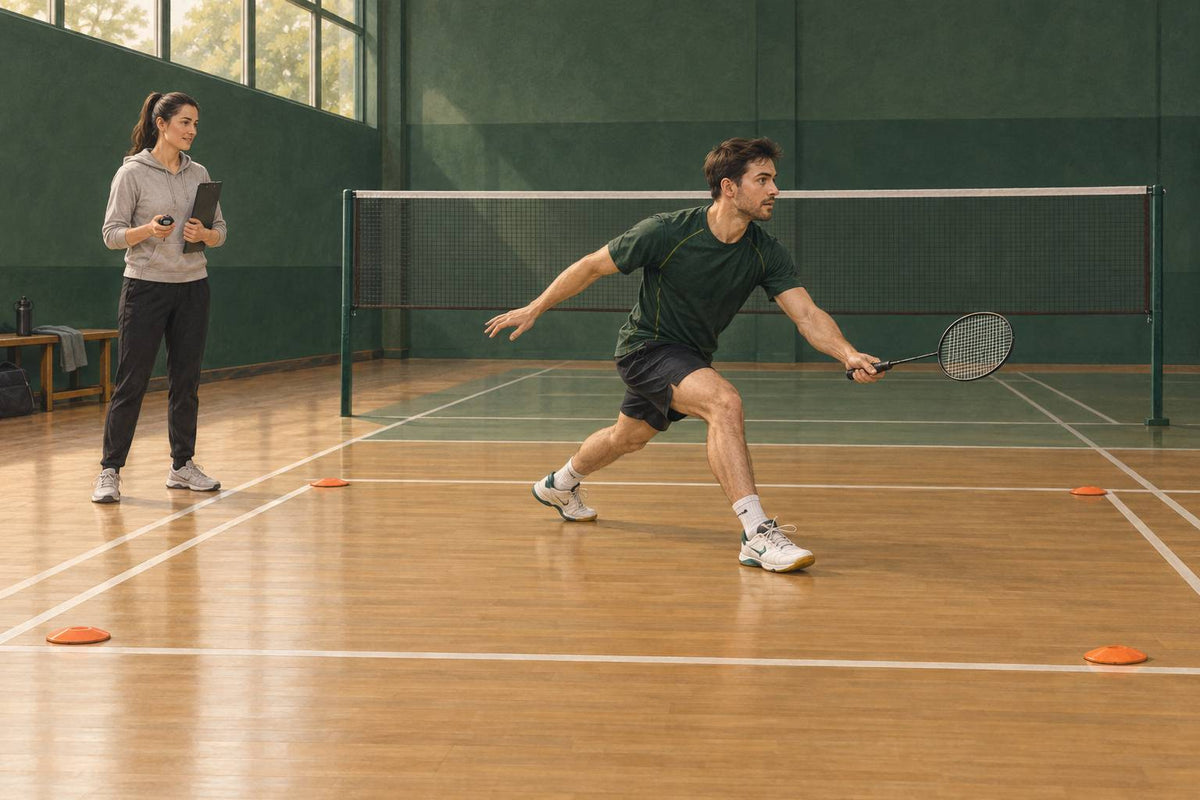
Reviewed August 2026 · By the player-led Badminton House team
Quick Answer: Repeated Sprint Training
Train repeat-effort capacity when you can still make one hard movement but your quality falls away across a demanding session. Start with controlled court movement, protect technique, and record what actually changes.
Default
Build gradually: repeat clean movement on a court, then add pace only when you can recover to a stable base.
Avoid
Do not turn a lab-style fatigue test into a personal score or force maximal work through pain, poor braking, or dizziness.
“I am fine in the first game, then everything gets late” is useful information, not a diagnosis. Badminton asks for short, high-intensity actions and recovery between them, drawing on both aerobic and anaerobic systems. That makes repeat-effort capacity worth training, yet it is only one part of late-match performance. Footwork, shot choice, pacing, technical efficiency, sleep, illness, and the day’s accumulated load can all change how a final game feels. A Sports Medicine review of badminton’s physical demands supports the intermittent picture, not a one-cause explanation for lost matches.
Use this guide when: your movement becomes slower, less balanced, or less repeatable after several demanding rallies. First make sure your footwork pattern is sound; then use a small dose of repeat-effort work to practise holding that pattern under fatigue.
What repeated sprint training can and cannot tell you
Repeated sprint training is practice at producing hard efforts with incomplete recovery. For badminton, the practical aim is to preserve posture, braking, first steps, and return-to-base quality across efforts. It cannot identify why you lose a third game or promise a match result, because the court problem may be technical, tactical, or recovery-related.
There is relevant badminton-specific evidence, with an important boundary. A 2026 randomized study gave 28 male collegiate badminton players regular skill practice plus twice-weekly 30 m all-out running for eight weeks. The repeated-sprint group used two or three sets of six 30 m sprints, with 30 seconds passive recovery between sprints and two minutes active recovery between sets. It improved more than its HIIT comparison on several fitness measures, including VO2max, Wingate power, agility, and spike-jump height. Read the study record and protocol.
That is encouraging evidence for that population and setup. It does not prove that every club player should copy the volume, that court shuttles equal 30 m running, or that a programme fixes a particular game score. Treat the study as a reason to use progression and consistency, not as permission to borrow a maximal protocol unchanged.
A useful distinction is between one good effort and repeatable quality. You may be able to chase one shuttle quickly, yet lose the next split step, arrive upright at the net, or take an extra recovery step after the fourth or fifth hard action. The target is not suffering for its own sake. It is seeing whether your movement remains recognizably badminton-shaped as you get tired.
Choose the right training problem first
Choose repeat-effort work only when your technique is acceptable early in a session and decays after repeated hard movements. If you are late from the first rally, cannot lunge and recover comfortably, or repeatedly choose the wrong shot, train that earlier problem first. A faster tired version of a faulty pattern rarely helps.
| What you notice | Better first response |
|---|---|
| You are late from the opening rallies. | Slow down and rebuild split step, first step, and recovery patterns before adding a conditioning block. |
| You move well early, then stop recovering to base or lose balance later. | Use the controlled repeat-effort progression below, with quality notes after each round. |
| One direction hurts, gives way, or feels unstable. | Stop the drill and seek an appropriate clinician or coach assessment rather than trying to condition around it. |
| You can move, but make poor choices when tired. | Add a simple shot-choice constraint after movement is stable, such as a controlled lift or straight clear on arrival. |
For the first two rows, pair the work with badminton footwork basics. That link matters because repeated work amplifies whatever you repeat. A clean, modest session beats a heroic session that teaches you to land heavily or reach with the upper body.
A cautious court-based progression
This four-stage progression is editorial coaching guidance, not a tested prescription. Its times, rests, and weekly placement are starting options to adjust with an appropriate coach or clinician when relevant. Advance only when the final round still has controlled deceleration, a clear split step, and a return toward base.
Stage 1: learn the route. From a comfortable base, move to one front corner and back, then one rear corner and back. Alternate sides. Work for about 15 seconds at a pace where you can stop under control, then walk and reset for 45 to 60 seconds. Complete four rounds. The goal is an even pattern, not a sprint.
Stage 2: connect corners. Use two corners in a planned sequence (front-right to rear-left, then front-left to rear-right). Work for about 20 seconds, rest for 60 seconds, and complete four to five rounds. End a round early if your last two recoveries are late or your landing becomes noisy and uncontrolled.
Stage 3: add badminton decisions. Ask a partner to call one of two planned corners after you return toward base, or use two coloured markers. Keep the same 20-second work capsule and 60-second reset for four to six rounds. The extra decision makes the drill more court-like without pretending it recreates a match.
Stage 4: use a short quality block. Once Stage 3 remains tidy, run two blocks of four 20-second rounds with 60 seconds between rounds and a generous three-minute walk, drink, and note-taking break between blocks. Do not add more volume merely because you completed it. First aim for the same posture and recovery route in the final round as in the first.
Choose one progression variable at a time: a slightly quicker route, one extra round, or a less predictable call. Do not shorten rest, add rounds, and increase speed together. That simple rule makes it easier to see what changed instead of mistaking a larger workload for a technical improvement.

Track training without building a lab test
Use a repeatable session note, not a percent-decline formula. A 2019 experiment found falling vertical-jump-derived peak power across five demanding court repetitions, with one-minute rests and rising lactate, heart rate, and perceived exertion. That observation does not validate a home test for club players. See the field-test study.
Instead, repeat the same Stage 2 or Stage 3 session after two or three weeks and write down four things: the stage, number of completed quality rounds, the first technical error you noticed, and whether the final round was easier, the same, or harder than the first. Keep the same court, route, work time, and rest time when comparing sessions.
Simple training-log example
Session: Stage 2, five 20-second rounds, 60-second resets. First error: late return from rear-left in round four. Final-round quality: same route, slightly heavier braking. Next choice: repeat this dose next week rather than progressing.
That note gives you a decision. If the final round stays controlled for two similar sessions, progress one variable. If quality falls sharply, repeat or reduce the dose. If pain, dizziness, unusual breathlessness, or a feeling of instability appears, stop rather than using a log to justify another round.
Fit it around real badminton
Place repeat-effort work where it supports court practice instead of competing with it. One short, high-quality block beside normal games and footwork practice is enough to learn from at first. Keep your hardest session away from a match or tournament day, and reduce the drill when your legs are already carrying unusual soreness.
A simple week might use one movement-quality session, one normal games session, and one repeat-effort block. The point is not to fill every spare day with intensity. It is to return to the next court session able to practise skill well. If games reveal that you are losing court position late, note the transition that fails: rear-court recovery, first step forward, braking at the net, or a rushed shot choice. Then make the next block specific to that observation.
Repeated sprint training is most useful when it remains humble: a way to practise repeatable movement under manageable fatigue. It is one option, not a diagnosis. Let your on-court quality, not a borrowed laboratory number, decide whether to progress.

Leave a comment
This site is protected by hCaptcha and the hCaptcha Privacy Policy and Terms of Service apply.