
Last checked: August 2026 · Written by the player-led team at Badminton House
Quick answer
For a diagnosed bunion or bunion-like prominence, prioritize a badminton shoe with a wide and deep toe box, a non-constricting upper and a heel that holds the foot back. Lacing can move pressure away from one spot, but it cannot make a narrow sole or shallow toe box larger.
Comfort, not correction: shoes, spacers, orthoses, splints and tape may manage symptoms. Do not expect them to realign or cure a bunion.
Assessment boundary: sudden hot swelling, illness, an injury that prevents weight-bearing or an open wound needs prompt care.
A bump and pain around the base of the big toe can fit hallux valgus, commonly called a bunion, but appearance alone does not establish the diagnosis or severity. This guide cannot diagnose the cause. It is a fit-and-load checklist for someone with a diagnosed bunion or a bunion-like prominence who wants to make safer shoe and session decisions.
The main distinction is simple: the laced upper can be adjusted, while the sole shape and toe-box volume cannot. Start with enough physical room. Then use lacing or a low-risk accessory trial only to fine-tune pressure. If pain remains, change the load or seek assessment rather than tightening the shoe around the problem.
Why badminton can provoke the big-toe area
Forward lunges and the push back to base place the forefoot against the floor and the shoe. Direction matters: one badminton study measured greater force and peak pressure under the great-toe region during right- and left-forward maximum lunges than during straight-ahead lunges in its healthy male participants.
The forward-lunge plantar-load study involved 15 university competitors without bunion pain. It measured pressure under a foot region, not force inside the big-toe joint. It therefore supports a careful statement that badminton can load the area. It does not prove why your toe hurts or which footwork change would treat it.
Symptoms can also come from direct upper pressure, the foot sliding into the front of the shoe, accumulated court time or a condition unrelated to hallux valgus. Note when the pain begins, where it is located, whether swelling is present and whether it settles after play. That record is more useful than assuming every painful lunge has one mechanical cause.
This may not be a routine bunion flare
Stop self-testing and seek urgent medical care for a hot, markedly swollen joint with fever or feeling unwell; serious pain or swelling after injury; inability to bear weight; or an open, draining, or infected-looking wound.
A five-minute badminton shoe fit screen
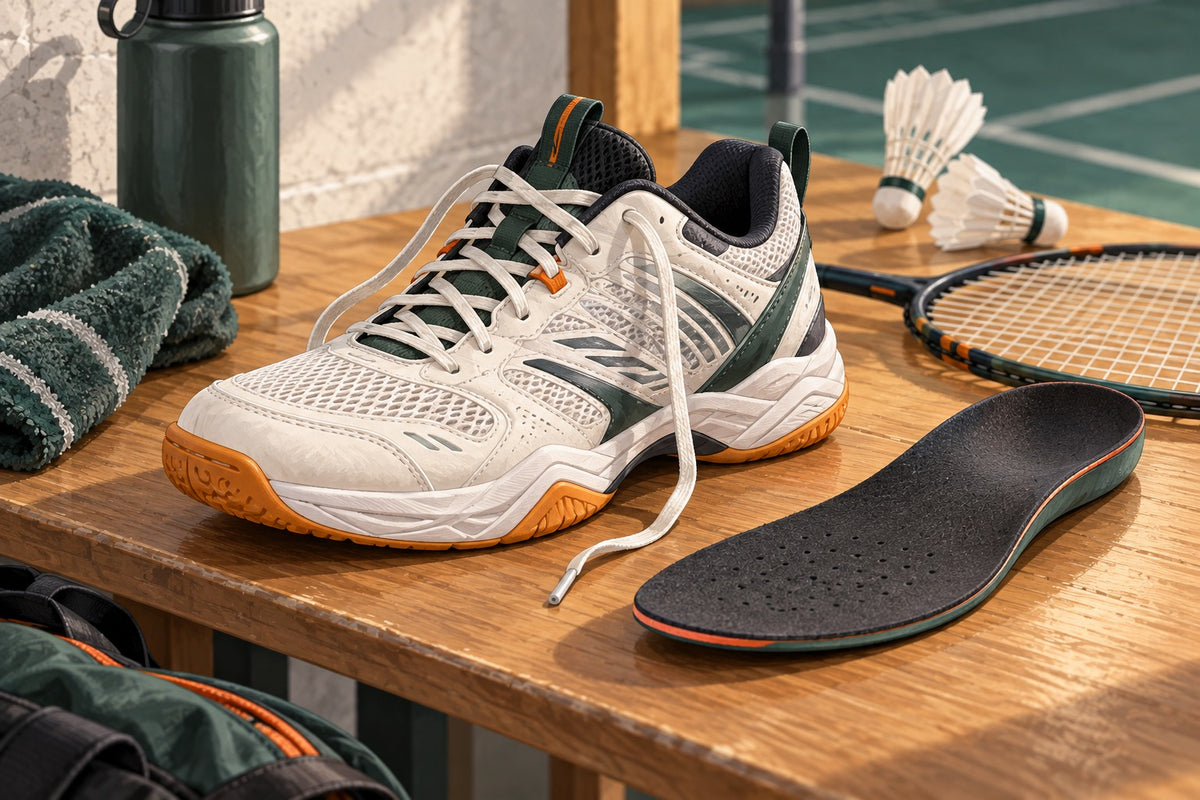
Test both shoes while standing, then add one controlled braking movement. The pass condition is enough room around the longest and widest parts of the forefoot with the heel held back. A size label, “wide” badge or soft first impression does not replace what happens under load.
- Check length: leave roughly a thumb's width ahead of the longest toe while standing. No toe should strike the front during an easy stop.
- Check loaded width: stand evenly, then shift weight onto the test foot. The forefoot should not hang over the sole edge or feel pinched from both sides.
- Check depth: the upper should clear the prominence without a hard seam or overlay pressing into it. Width without height can still compress the joint.
- Check the upper: favour material that bends around the prominence rather than a rigid panel positioned directly over it.
- Check heel hold: lace comfortably, walk, shuffle and make one shallow lunge. The heel should stay controlled without squeezing the forefoot.
Clinical footwear guidance supports enough width, depth and a non-constricting upper to accommodate the prominence. The multidisciplinary guideline makes the treatment limit clear: conservative care is symptom-oriented, not a causal correction.
| Fit finding | Reasonable next step | Do not do |
|---|---|---|
| One lace crossing presses the area | Create an eyelet window | Assume it unloads the joint internally |
| Upper presses even when loose | Choose a wider/deeper shoe or an upper with a softer panel over the prominence | Stretch a foot over a narrow sole |
| Heel slips when forefoot is comfortable | Try separate lower and upper tension | Tighten every crossing equally |
For construction details, compare the pressure points in our guide to badminton shoe uppers and fit. If you already own a near-fitting pair, use the companion badminton shoe lacing guide for the full pattern instructions.
What lacing, spacers and tape can actually do
These adjustments are symptom trials, not deformity treatments. Window lacing can remove one crossing from a pressure point, while a spacer, orthosis, splint or tape may change comfort for some people. None should crowd the shoe, numb the toes or justify playing through worsening pain.
Use a window only for upper pressure
- Mark the lace crossing directly over the sensitive area.
- Unlace to the eyelets below it.
- Run each lace end vertically to the next eyelet on the same side, leaving an uncrossed window.
- Resume crossing above the window and tie with comfortable upper-zone tension.
- Walk and make shallow lunges. Stop if the foot slides forward or a new pressure point appears.
The window changes contact from the laces and upper. It cannot widen the outsole, add depth or prove that less force reaches the joint. If removing one crossing makes the whole foot unstable, the shoe needs a better shape rather than a larger window.
Treat devices as one-variable comfort trials
A systematic review of nonsurgical hallux-valgus interventions found pain improvement more consistently than angle improvement, but the underlying studies were small and had important bias concerns. These studies did not test full-speed badminton. That supports cautious symptom trials, not a correction claim.
- Add only one spacer, tape setup, splint or orthosis at a time.
- Confirm that the device does not consume the toe-box room you just created.
- Test walking and shallow lunges first; do not progress if stability or pressure changes, and get clinician guidance before using a new device in full-speed play.
- Remove it for numbness, skin damage, a new pressure area or worse pain.
A clinician can help match an option to an actual diagnosis and inspect the skin and joint. Remove the setup if sensation, skin colour, skin integrity or pain changes.
Manage the court load without inventing a cure
When badminton repeatedly aggravates the area, reduce the provoking dose temporarily. Shorter sessions, fewer high-intensity singles rallies, or temporarily avoiding movements that reliably provoke symptoms can reduce exposure. These are symptom-guided load choices, not a footwork prescription.
Use a simple two-session audit:
- Record the baseline: note shoe, session length, game type, symptom level during play and over the next 24–48 hours.
- Change one factor: improve shoe fit, reduce total court time or lower the number of demanding singles rallies.
- Keep the rest stable: do not add a spacer, new tape and new footwork at the same time.
- Judge function: look for less symptom escalation without instability, compensation or new pain elsewhere.
If changing how you lunge seems necessary, involve a physiotherapist or foot-and-ankle clinician and a badminton coach. They can assess the joint and observe the whole movement. Generic instructions such as “always land heel first” or “bend the knee more” are not bunion treatment and may simply move load to another structure.
When to get the big toe assessed
Arrange routine assessment when pain persists for weeks, limits normal walking or badminton, keeps worsening, reduces joint motion or makes suitable footwear impossible to find. Seek prompt help for acute inflammatory, injury or wound signs. Earlier assessment is especially important when diabetes or reduced sensation changes foot risk.
Current NHS joint-pain guidance treats a hot, swollen joint with fever or feeling unwell as urgent. Inability to bear weight after an injury, an open or draining wound, rapidly changing colour, or severe sudden pain also belongs outside a shoe experiment.
For non-urgent symptoms, bring your court shoes and your two-session record to a podiatrist, physiotherapist or foot-and-ankle clinician. The best badminton shoe for a bunion is not a named model. It is the shoe whose real width, depth, upper and heel hold fit your foot, followed by a court load that the diagnosed condition can tolerate.

Leave a comment
This site is protected by hCaptcha and the hCaptcha Privacy Policy and Terms of Service apply.