
Last checked: August 2026 · Written by the Badminton House player-led team.
Quick answer: the fit matters more than the point-count label
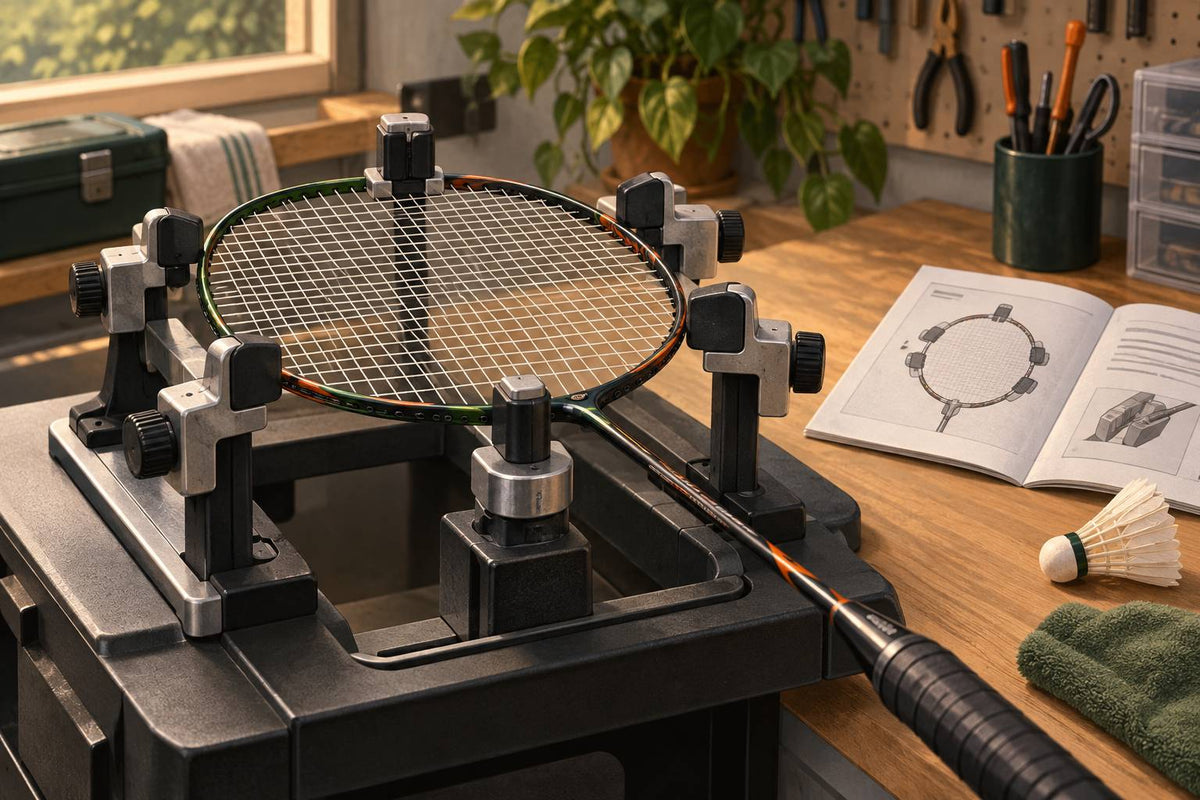
A badminton stringing-machine mount supports the racket hoop while changing string loads pull on it. Two-point and multi-point systems can both depend on correct centring, suitable badminton fittings, full intended contact, and controlled pressure. “Six point” alone is not proof of a safer job.
Before
Inspect first: a stringer should check the frame and grommets before applying tension.
Mounted
Supports should match the machine manual, sit squarely, and stay clear of the grommet holes.
After
Check the returned racket slowly; do not play with a crack, unusual frame change, or badly worn grommet.
The mount does not pull the string. Its job is to hold the frame in the intended position while the tensioner and clamps build the string bed. That is why a mounting system is better judged as a complete setup than as a marketing number.
This guide helps a customer understand the visible parts and ask useful questions. It is not a setup manual: only the trained stringer should adjust a mounted racket, and the machine's own instructions control the exact order and tightness.
What does a stringing-machine mount contact?
A two-point layout commonly supports the racket at the head and throat. On the specific GAMMA X-2 system, tapered plastic adapters contact both ends, while hold-down plates secure the frame vertically. Its manual requires the adapters to remain clear of grommet holes and warns against excessive hold-down pressure. See the X-2 mounting instructions.

A multi-point layout adds contacts around the sides of the hoop. On GAMMA's illustrated six-point system, the centre supports meet the racket around 6 and 12 o'clock and paired shoulder supports meet the sides. The manual tells the stringer to use badminton shoulder covers and make gentle, square contact. See the six-point mounting instructions.
| Part you see | Its job | Useful check |
|---|---|---|
| Head and throat supports | Locate and support the long axis of the hoop | Racket is centred; contact pieces fit the frame |
| Shoulder supports | Add lateral contact on a multi-point mount | Contacts sit squarely rather than on an edge |
| Covers or adapters | Match the support surface to the racket and machine | No intended string hole is blocked |
| Hold-down plate, where fitted | Controls vertical movement on that design | Used to the manual's criterion, not forced down |
Is six-point mounting automatically safer than two-point?
No universal answer follows from point count alone. A two-point system used with its correct adapters and pressure can follow its design; a multi-point system still needs centring, badminton fittings, square contact, and correct adjustment. A poorly placed extra support is not made safe by being the sixth point.
Movement is also system-specific. One GAMMA manual asks the stringer to confirm no movement when moving the mounted racket by the handle. The Global Racket Stringers Association guide says slight side-to-side movement may remain on some systems with six or more mounting points. The useful conclusion is not that one source is wrong; it is that a customer's visual guess cannot replace the model's instructions.
Do not adjust it yourself. If you are concerned while watching a restring, ask the stringer to explain the mount. Touching the frame or support can disturb a setup you do not control.
What does competent mounting include?
The exact sequence comes from the machine manual, but the shared checkpoints are easy to understand. The racket is inspected before tension, centred on the mount, fitted with suitable contact pieces, supported without blocking grommet access, and tightened only to the qualitative standard specified for that machine. The stringer then follows the racket maker's pattern rather than treating the mount as permission to improvise.
- Inspect the unstrung job. Look for frame damage and worn, split, or missing grommets before a pull begins.
- Select the proper fittings. Use the fittings specified for the racket and machine; the illustrated six-point manual calls for badminton shoulder covers, while the two-point manual uses tapered support adapters.
- Centre before tightening. The head and throat positions establish the frame, then the remaining contacts are set in the manual's order.
- Preserve access. A support should not cover a grommet hole needed by the string path.
- Use controlled contact. Loose enough to lose the intended support and tight enough to change the frame shape are both poor outcomes.
For the rest of the finished-job inspection—knots, weaving, shared holes, and tension consistency—use our badminton stringing quality check.
What can you ask before handing over a racket?
A good question is about the process, not an accusation based on the number of supports. You do not need to inspect the machine like an engineer. Ask enough to learn whether the stringer has a badminton-specific setup and a repeatable frame check.
- “What mounting layout do you use for badminton rackets?”
- “Does this machine use badminton covers, frame plates, or adapters?”
- “How do you keep the supports centred and clear of the grommet holes?”
- “Do you inspect the frame and grommets before pulling tension?”
- “Will you follow this model's stringing pattern and stated tension range?”
Those questions do not guarantee a result, but they reveal more than “Does your machine have six mounting points?” A stringer should be able to describe their own equipment without inventing a universal pressure number.
What should you inspect after pickup?
Before playing, make a slow visual pass around the hoop, grommets, shaft, cone, and grip. Compare the overall shape with what you know of the racket; do not try to diagnose a structural crack from paint alone. Yonex advises checking for cracks, other irregularities, and worn grommets before use. Read Yonex's racket safety guidance.
If you find a crack, a new pronounced shape change, a loose or damaged part, or a grommet that no longer protects the string from the frame edge, stop using the racket and take it back for professional inspection. Do not test a suspected defect with hard swings.
The point of learning the mount is not to fear every flex. It is to recognise that frame support is a fitted procedure: the right contacts, in the right places, adjusted by someone following the machine and racket instructions.


Leave a comment
This site is protected by hCaptcha and the hCaptcha Privacy Policy and Terms of Service apply.