

Last checked: August 2026 · Written by the Badminton House player-led team.
Quick answer: screen first, then change the overhead load
Stop overhead play if it reproduces neck pain. New trauma, persistent arm weakness or numbness, symptoms in both arms or legs, balance change, or bladder or bowel change need prompt medical assessment; sudden major neurologic change, fever with a stiff neck, or any FAST stroke sign needs emergency care. For localized non-traumatic discomfort without warning signs, keep comfortable daily movement and temporarily reduce the provoking overhead work.
Stop
Do not test through it: trauma, radiating neurologic symptoms, systemic illness, or sudden unusual signs change the decision.
Scale
Remove repeated smashes and high-volume overhead feeds that reproduce symptoms; keep only comfortable activity.
Review
A coach may check sequencing and unnecessary arm dominance, but cannot diagnose or medically clear the neck.
Neck pain during a clear or smash does not identify one damaged structure. Clinical guidelines note that a precise tissue source is rarely identifiable in much mechanical neck pain. “Tight trap,” “pinched nerve,” and “bad posture” are therefore not diagnoses a player or coach can safely make from one symptom. Read the neck-pain clinical guideline.
The useful first question is not which stretch fixes it. It is whether the presentation belongs in emergency care, prompt clinical assessment, or a cautious short-term change to a normal training load.
Get urgent help instead of trying an overhead fix
- Call 911 for stroke signs: any FAST sign (facial droop, arm weakness, or speech difficulty), sudden one-sided numbness, sudden vision change, sudden loss of balance or coordination, or a sudden severe and unusual headache.
- Go to emergency care: sudden major arm or leg weakness, rapidly worsening walking or balance, bladder or bowel change, or numbness around the inner thighs or genitals.
- Seek immediate assessment: fever, headache, and a stiff neck, especially with confusion, vomiting, or light sensitivity.
- Stop after significant trauma: a fall, collision, or direct blow with severe pain, inability to move, weakness, or numbness is not a self-test situation.
When should neck pain be assessed?
Arrange prompt clinical assessment for pain travelling into an arm with persistent tingling, numbness, weakness, sensory change, or a cold arm. Symptoms in both arms or legs, electric-shock sensations into limbs, clumsy hands, or gradually worsening walking and balance also belong outside a coaching plan.
The NHS cervical-myelopathy information sheet separates gradual symptoms that need clinician contact from sudden major weakness, gait decline, balance loss, and bladder, bowel, or genital sensory changes that need emergency care. It does not mean these signs prove one diagnosis; it means they are too important to train through.
Also arrange assessment when the problem is worsening, repeatedly returns as overhead volume rises, materially limits ordinary function, or has not settled after a few weeks. The NHS uses a few weeks as a care-seeking threshold, not a guaranteed recovery deadline. See NHS neck-pain guidance.
Why can overheads provoke neck symptoms?
An overhead stroke asks the neck and shoulder area to organize head position, trunk rotation, arm elevation, and force transfer at speed. A laboratory study of 24 healthy adults found greater cervical and upper-trapezius activation as force rose in standardized overhead pushing tasks. That was not badminton and did not study injured players, so the modest inference is simply that repeated hard overheads can add muscular demand—not that they reveal the injured tissue. Read the overhead-loading study.
Look for a recent change rather than a single universal cause: more multi-shuttle feeds, repeated jump smashes, longer club nights, a new gym block, or a return after time away. Desk setup may contribute to the day's total discomfort too. The Canadian Centre for Occupational Health and Safety advises tailoring monitor height, viewing angle, and distance to the individual rather than forcing one “perfect” position. Review CCOHS monitor guidance.
What is the first training adjustment?
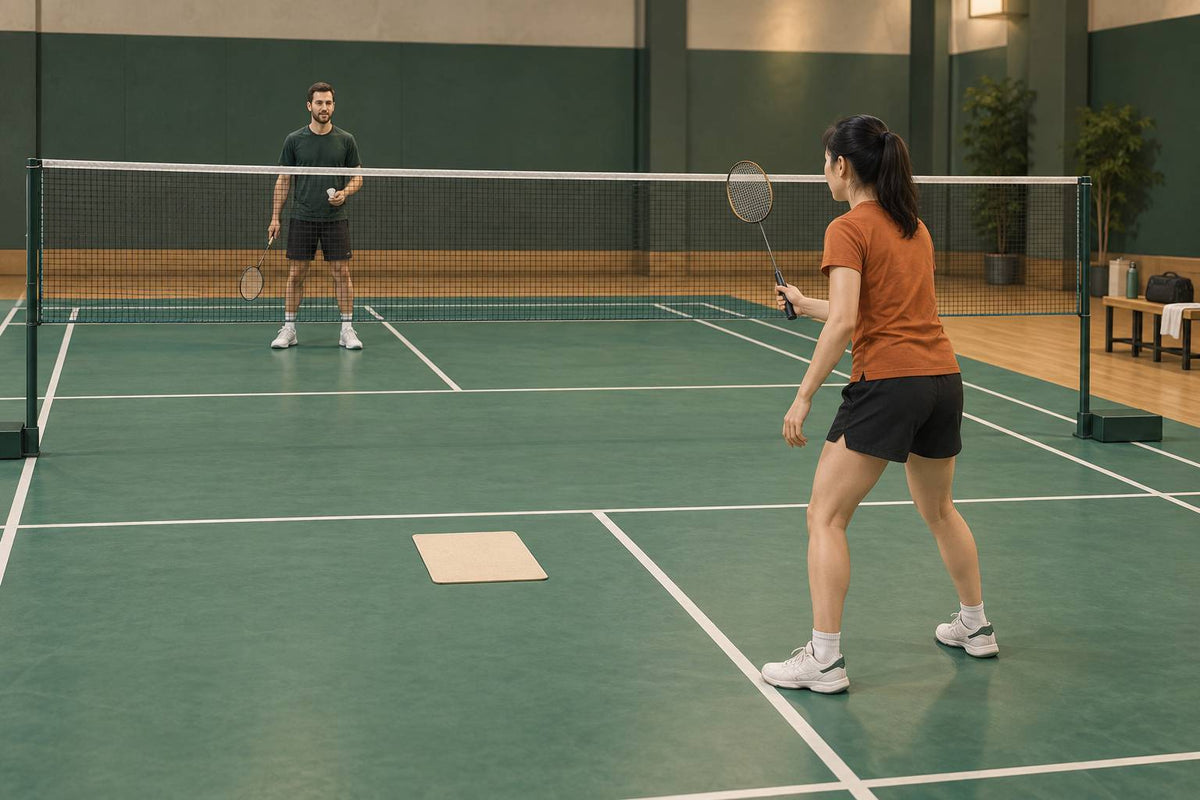
For localized, non-traumatic discomfort with none of the warning signs above, keep comfortable daily movement but remove the overhead dose that reproduces symptoms. That may mean pausing repeated smashes, jump smashes, and high-volume rear-court feeds while retaining easy walking, comfortable lower-body work, or non-provocative court tasks.
| What you notice | Coaching adjustment | Boundary |
|---|---|---|
| Pain appears only after repeated hard overheads | End that block; use comfortable non-overhead work | Not proof that load is the only cause |
| Easy overhead still reproduces pain | Do not keep testing it that session | Recurring symptoms justify assessment |
| Arm symptoms, dizziness, weakness, or balance change appear | Stop the session | Use the clinical or emergency pathway |
University Hospitals Sussex advises an early return to normal daily activity and gradual comfortable movement for ordinary acute neck pain. Translating that into fewer provocative badminton overheads is a coaching-load experiment, not treatment or medical clearance. Read the NHS Trust self-care guidance.
Can overhead technique fix neck pain?
Technique review can remove unnecessary effort, but it cannot diagnose or treat the neck. The BWF Level 3 coaching manual describes the forehand overhead as a whole-body throwing sequence and lists overly arm-dominant force generation as a common technical issue. A coach can therefore review whether the player is using legs and trunk, preparing in balance, and gripping only as firmly as the shot requires. See the BWF overhead material.
- Film a comfortable rehearsal only. Do not ask for a painful full-power demonstration.
- Check the sequence. Look for lower-body and trunk contribution rather than an isolated arm pull.
- Reduce the task. Shadow, throw, or use an easy feed only if each version stays comfortable.
- Stop chasing a correction. If symptoms remain or return as load rises, the next step is assessment, not another cue.
Our throw-to-hit overhead progression is a technical learning guide for comfortable players. It is not a rehabilitation plan and should not be used to clear symptoms.
How do you bring overhead work back?
There is no universal number of pain-free hours, repetitions, or days that clears a neck. When ordinary activity is comfortable, warning signs are absent, and a clinician has not given different restrictions, reintroduce one familiar overhead demand at a time: easy shadow movement, then easy contact, then a small number of controlled hits. Leave repeated hard smashing and fatigue-based feeds until later.
Stop the progression if symptoms return, spread into an arm, or change your movement. Repeated recurrence needs individual assessment. Do not crack or manipulate your neck to get through a session, and do not use the temporary disappearance of pain as proof that the underlying situation is safe.
The best “fix” is therefore a decision sequence: screen for important warning signs, remove the provoking overhead dose, keep tolerable normal movement, use coaching only for technique, and involve a qualified clinician when symptoms persist, spread, or escalate.

Leave a comment
This site is protected by hCaptcha and the hCaptcha Privacy Policy and Terms of Service apply.