
Last checked: August 2026 · Written by the player-led team at Badminton House
Quick answer
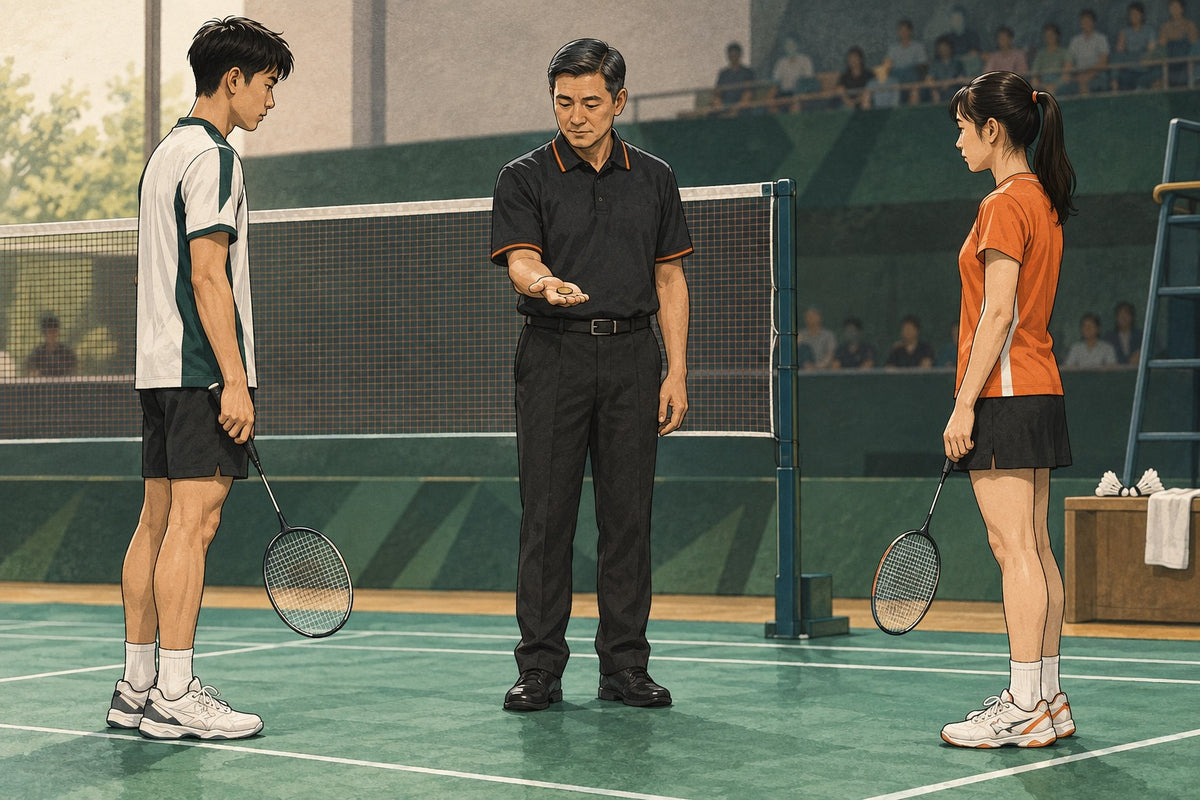
Before play, conduct a fair toss. Law 6 does not prescribe a coin, shuttle spin or racket spin.
Winner
Choose to serve or receive first, or choose the starting end.
Loser
Choose within the remaining category. The winner does not get both choices.
The rule uses the word “side,” so the same choice structure works in singles and doubles. In doubles, partners should decide who speaks before the toss and confirm the initial server or receiver after the service choice. In practice, a disagreement between partners is not a reason to rerun a fair toss.
What can the toss winner and loser choose?
The winner receives one category of choice: serve or receive first, or select the starting end. The loser then chooses within the remaining category. The winner cannot take both service and end, and the loser does not automatically receive. Once stated under the official procedure, the choices are final.
That sequence is set out in Law 6 of the current Laws of Badminton. Its complete text requires a toss but does not say how to conduct one. Using a coin toss, a shuttle spin or another fair local method is a matter of custom; Law 6 does not mandate a mechanism.
| Winner says | Loser then chooses |
|---|---|
| “We will serve first” | Which end to start at |
| “We will receive first” | Which end to start at |
| “We choose this end” | Serve or receive first |
The current Instructions to Technical Officials tell the umpire to carry out the toss fairly, note both sides' choices and treat them as final. That is the useful club habit too: conduct it openly and repeat the selections before warm-up.
For self-officiated play, agree on the fair method before using it in match play, conduct it in everyone's view and repeat each selection. If the method does not produce a clear result, resolve that before either side chooses. This is a practical club procedure, not an additional BWF rule.

Should you serve first or choose your end?
When the hall looks neutral, choosing serve first is a simple Badminton House default, not a BWF recommendation or a measured advantage. Choose an end instead only when you observe a meaningful difference in airflow, glare or shuttle visibility and prefer to control which direction you face at the start.
- Neutral hall: choose serve if you value a clear, familiar opening decision.
- Obvious draught: compare shuttle movement from both directions before deciding.
- Glare or pale background: stand at each end and check whether the shuttle remains easy to track.
- No clear difference: do not invent one from a single warm-up miss.
Related reading: if one side of the hall feels different, use our badminton airflow guide before treating a draught as an automatic reason to choose an end.
The Laws do not assign a point value or guaranteed advantage to first service or end choice. Doubles initiative, momentum and a preferred finishing end depend on the players, hall and match. Treat the toss as a small opening decision, not a forecast of the result.
The starting end still matters after the opening segment because every required swap follows from that assignment. It does not let a side keep one end permanently. Choose it for the conditions you can observe now, then expect the normal end-change sequence to redistribute those conditions during the match.
What happens after the toss?
At 0–0 on a standard court, the first server uses the right service court and serves diagonally. Players then change ends after game one, after game two when a third is needed, and when a side first reaches 11 in game three under the standard format. The toss selects only the starting end.
In doubles, the side serving first chooses its initial server, and the receiving side identifies the diagonally opposite receiver under the service-order rules. The full order then follows the Laws; the toss itself does not choose one partner for every later serve.
If an end change is missed, correct it as soon as the error is discovered and the shuttle is not in play. The existing score stands. Handicap matches and alternative scoring systems have separate variations, so do not carry the ordinary game-three-at-11 statement into every special format.
Some Para badminton classes use adapted playing and service areas. The standard-court explanation here does not replace those diagrams and class-specific provisions. Before a Para match, confirm the applicable court with the official instead of assuming that every class uses the same half-court adaptation.
Use this ten-second toss routine
- Conduct one fair, visible toss by the agreed method.
- Winner states serve, receive or the starting end.
- Loser chooses within the remaining category.
- Repeat both final choices, then begin the normal pre-match sequence.


Leave a comment
This site is protected by hCaptcha and the hCaptcha Privacy Policy and Terms of Service apply.