
Last updated: July 2026 · Written by the team at Badminton House
Quick Answer: Why Elite Badminton Turns Off Aircon
If airflow affects shuttle flight, elite events prioritize still air; ordinary club play only needs obvious drafts reduced.
BWF
Best answer: BWF facility rules require draught-free play and airflow not exceeding 0.2 m/s over the field of play.
Aircon
Air conditioning is not banned, but venues must be able to switch it off without delay if airflow becomes a problem.
Club
Your club does not need this elite tournament standard; gentle airflow is usually playable outside top-level precision.
If you’ve ever watched an elite match pause while staff adjust the air conditioning, it is not theatre or player fussiness. A shuttle is built to slow down fast: its open skirt creates huge drag, so once it loses speed near the end of flight, a faint draft can push a lift long, hold a net shot up, or bend a high serve off line. That is why tournament halls treat air like part of the court. The goal is not to make the arena uncomfortable; it is to keep both sides playing the same shuttle path.
Player note. The shuttles you use at club night react to the same physics; if flight feels inconsistent, start by checking the hall airflow and your shuttle condition. Browse shuttlecocks.
In This Guide
Why Shuttlecocks Notice Tiny Drafts


The reason starts with the shuttle itself. A shuttlecock is not a small ball. It is a low-mass, high-drag projectile with an open conical skirt made from feathers or synthetic material set into a rounded cork or rubber base. That skirt acts a little like a parachute: instead of flying in a clean ball-like parabola, the shuttle rapidly points cork-first, sheds speed, and drops on a steep, drag-heavy path.
That design gives badminton its sharp changes of pace, but it also makes the shuttle unusually sensitive to moving air. Shuttlecocks have an exceptionally low ballistic coefficient, meaning they are poor at overcoming air resistance. Reported initial speeds of 67 m/s can fall to near 7 m/s in about 0.6 seconds, so the late part of the flight is slow enough for faint drafts to matter. That is why competitive badminton is played indoors in the first place.
The BWF Rule Behind Why Turn Off Aircon Badminton

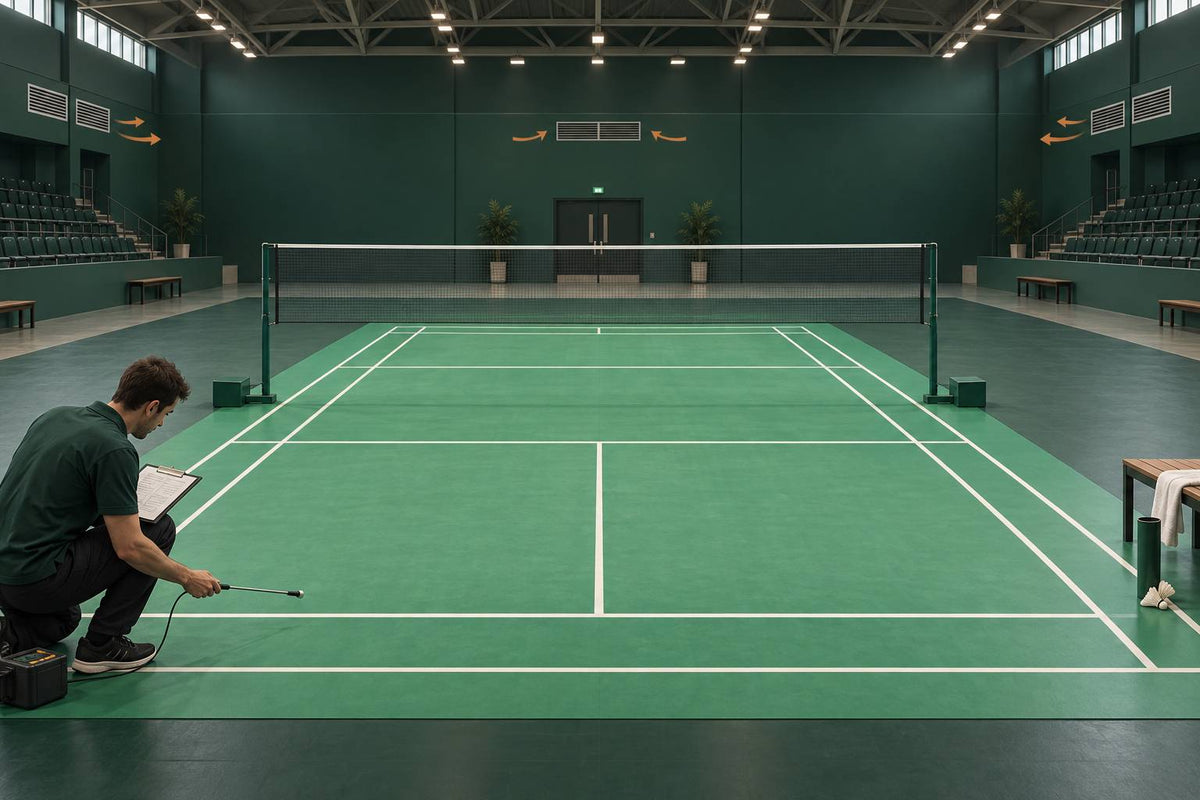
At elite level, the reason organizers may turn off air conditioning is not superstition; it is written into BWF facility rules. Air movement from air conditioning, draughts, or any other source must be tightly controlled or eliminated, with the field of play kept free of draughts. The benchmark is specific: with the competition setup in place and the arena unoccupied, airflow over the field of play should not exceed 0.2 m/s.
The test is also standardized. Airflow is measured using a hot wire anemometer at 3 m, 6 m, and 9 m above the court, with readings taken at a minimum of eight different locations on each court. Venues must also have a way to turn off the A/C without delay if BWF requests it, and adjustable air speed is preferred so organizers can balance court fairness with player and spectator comfort.
How Elite Venues Are Engineered for Still Air

When an elite arena suddenly feels quieter and stiller, it is usually because the building has been engineered to control air, not because comfort has been forgotten. That control still has to share space with comfort: the same facility standards keep the hall’s temperature in an 18–30 °C band even while airflow over the court is pushed toward zero.
The engineering starts before match day. Air supply and extract grilles should be placed and protected with the shuttle’s flight path in mind, with ventilation preferably working around the hall perimeter rather than across the court. Entry and exit points need double-door air-locks so outside air does not rush into the field of play. For Grade 1 tournaments and Olympic venues where airflow may be a problem, computational fluid dynamics analysis is used to predict court-level movement before the event.
For the broader playing-environment checklist, see our guide to badminton court conditions.
Why Your Club Does Not Need the Same Standard

The 0.2 m/s airflow limit is not a rule every club hall is expected to meet. It is a BWF sanctioned tournament facility standard for specified high-level events, including Olympic Games, Youth Olympic Games, Grade 1–3 events, and World Tour levels. Ordinary club nights, lessons, and casual bookings do not need hot-wire anemometer checks at multiple heights just to be playable.
Drafts can affect recreational play too, so address obvious airflow when it changes shuttle flight. Players can adjust, replay obvious wind-affected points by agreement, or choose the more sheltered court when options exist. Elite matches are different because margins are tiny: a slightly drifting lift, serve, or net shot can change the rally at the level where players are aiming for lines and tape.
Which Airflow Standard Should You Choose?
Use the strict still-air standard only when the result depends on elite-level precision. For normal sessions, focus on removing obvious drafts without turning the hall into a laboratory.
| Situation | Choose this | Why |
|---|---|---|
| BWF-sanctioned elite event | Measured airflow control | Air movement over the field of play should not exceed 0.2 m/s, measured at 3 m, 6 m, and 9 m at at least eight locations per court. |
| Major venue design | Engineer still air | Ventilation should avoid the shuttle path, entry points should use air-locks, and Grade 1 or Olympic venues may require airflow modelling. |
| Club or casual play | Comfort plus obvious draft control | Recreational play can still work with a gentle breeze; the 0.2 m/s threshold is a competition-facility standard, not an ordinary club requirement. |
| Shuttle management | Remove damaged feather shuttles | Damage can misdirect flight; for practice or match replacements, check live availability. |
Get 10% off your first order
Join the Badminton House list and we’ll email you a 10% welcome code — plus training guides, technique advice, and badminton updates.
By subscribing, you agree to receive Badminton House emails and can unsubscribe anytime.
That’s the practical lesson: elite courts are engineered around the shuttle, because the shuttle is engineered to slow, float, and reveal tiny air movement. We play badminton ourselves, so if you’re choosing shuttles for training, match play, or a tricky hall, contact us for practical advice.
Choose shuttles that suit your court.
Feather and nylon options for practice, club nights, match play, and the durability demands of a full session.
Shop Shuttlecocks

Leave a comment
This site is protected by hCaptcha and the hCaptcha Privacy Policy and Terms of Service apply.