

Last checked: August 2026 · Written by the player-led team at Badminton House
Badminton training terms are short labels for the shape and purpose of a practice. They are useful only when everyone knows the task, the movement or shot being trained, and the condition for success. This guide covers coaching shorthand, not match scoring or rules vocabulary.
Related reading: For scoring, court and match language, see our beginner badminton terms glossary.
What is official, and what is coaching shorthand?
Most badminton training terms are local coaching shorthand, so ask what the drill is meant to train before worrying about the label. The BWF Laws define match language such as a stroke and a fault, while session names are tools coaches use to organise practice.
That distinction prevents a common beginner error: treating a drill name as though it has one fixed worldwide recipe. A coach might say “rotation drill” for doubles movement after an attack, for a sequence of pre-set corners, or for a queue that rotates through feeder and hitter roles. None of those meanings changes the useful follow-up: “Where do I start, what is fed, what must I recover to, and when does the repetition end?”
The official vocabulary is narrower. The Laws define a stroke as a racket movement intended to hit the shuttle. That is helpful when a coach asks for “three strokes”, meaning three hitting actions, rather than three rallies or three points. Read the definition in the BWF Laws of Badminton.
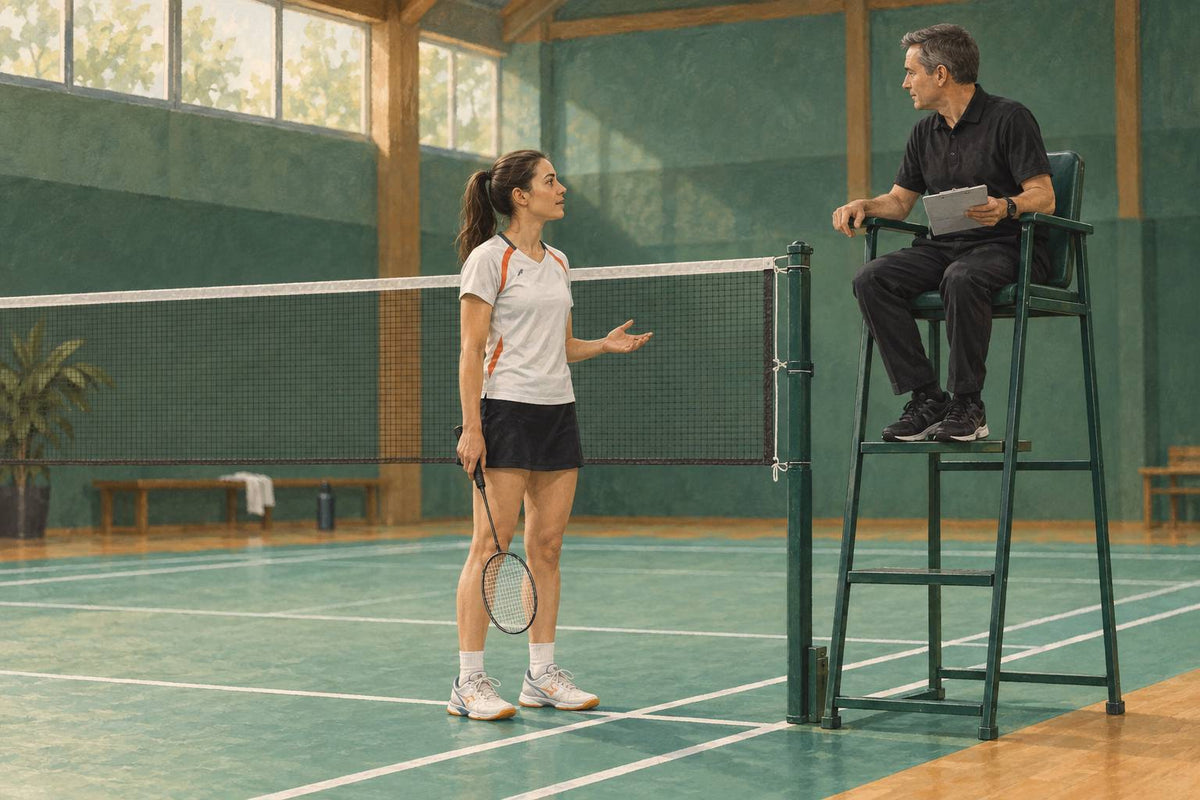
For every unfamiliar term, get four details before the first shuttle: the starting position, the expected response, the recovery position, and whether the next shuttle is predictable. Those details transfer between coaching systems even when the name does not.
Feeding terms: multi-feed, multi-shuttle and pressure feed
Multi-feed and multi-shuttle usually mean a feeder supplies several shuttles in quick succession so the hitter can repeat one response or movement pattern. A pressure feed is a useful local label for a feed that reduces time or space, so confirm exactly which difficulty the coach is adding.
Multi-feed is the BWF Level 1 manual’s name for racket feeding with a stock of shuttles. In a simple version, the feeder sends five shuttles to one rear corner and the player practises arriving, playing the selected stroke, and recovering. It is a clean way to isolate a task because the feeder controls the next shuttle. The player’s job is not to win a rally. It is to make each repetition look recognisably like the agreed action.
Multi-shuttle is commonly used interchangeably with multi-feed. At a club, however, it can also mean any drill using a pile of shuttles, including hand feeding. Do not assume the feeder will use a racket. Ask whether the shuttle will be thrown, dropped or struck, because each gives a different flight and timing cue.
Pressure feed is not a defined BWF drill name. Treat it as an instruction to identify the pressure. Is the feed flatter? Is it wider? Is recovery shorter? Is the feeder varying depth? A productive answer from the player is specific: “I can keep the split step and recover when the shuttle is fed to my forehand rear corner, but I lose balance when the next shuttle comes early to the front.” That gives the coach something to adjust.
Do not mistake volume for match readiness. The BWF manual says multi-feeding can be productive, then reminds coaches that badminton is ultimately played with one shuttle and that a considerable part of training should use one. Use a multi-feed block to rehearse a detail, then test that detail in a one-shuttle exchange. The BWF Level 1 coaching manual makes that progression explicit.

Movement terms: shadow work, front-back and pattern play
Shadow work removes the shuttle so a player can rehearse movement and hitting shape; front-back and pattern play add a route through the court. The practical aim is to make the route, recovery and timing clear before the player must read a live opponent.
Shadow work means performing the movement and often a simulated swing without hitting a shuttle. A coach may call a corner, point to it, or lead the player through a fixed sequence. This is not “easy footwork”. It is a chance to notice whether you leave from a ready position, arrive balanced enough to strike, and recover before the next cue. The BWF progression begins by having players shadow a stroke with a coach and then without that lead, before shuttle work begins.
Front-back usually describes a repeated route between a forecourt position and a rear-court position. It might be net, rear forehand, net, rear backhand, then repeat. The label alone does not tell you the footwork or stroke. Check whether the drill is movement only, net-and-lift, net-and-drop, or a feeding pattern. The most common misapplication is sprinting the route while abandoning the recovery that makes the next movement possible.
Pattern play means a pre-arranged sequence of shots or movements. For example, one player may lift straight, the other may drop straight, and the sequence repeats until a chosen variation appears. Its value is that you know the next decision before the shuttle is hit. Its limit is the same feature: do not claim success in pattern play as proof that you can recognise the same opportunity in an open rally.
If a pattern breaks down, reduce one variable. Keep the route but slow the feed. Keep the feed but shorten the route. Keep both but remove the swing. That is a better adjustment than repeating a poor version faster.
Game terms: conditioned games, two-versus-one and king of the court
Game-based terms turn a rally into practice by changing a rule, a number of players or a scoring consequence. A conditioned game limits one choice to highlight a decision, two-versus-one changes the problem created by player numbers, and king of the court is usually a rotating challenge format.
Conditioned game means a normal-looking game with one training condition. The condition might award a bonus point after a planned shot, require a serve return to a named area, or begin each rally from a supplied situation. It should direct attention without making the rally meaningless. State the condition in one sentence and state how it ends. “Play to 7; a rally that includes the agreed straight drop earns one extra point” is clearer than “work on drops.”
Two-versus-one, also written 2v1, places one player against two. The court area, permitted shots and rotation rule determine whether it is a technical, tactical or movement task. A solo player may practise keeping the shuttle away from the pair, while the pair practise taking space together. The avoidable mistake is using full court and normal scoring before anyone has agreed how the two players should share the court.
King of the court normally means a short rotation game in which the winner remains on a designated side or court while another player queues to challenge. It can be energetic and social, but the title says almost nothing about the learning goal. Give it one: perhaps the winner must first use a clear, or every challenger begins with a high serve. Without that condition it is simply rapid play.
A rotation drill also needs the rule spoken aloud: who rotates, after which event, and to where? In doubles, describe the roles rather than assuming “rotate” means one universal pattern. In groups, say whether players rotate after a feed, a rally, a score or a time interval.
Choose the right question for the drill
The best response to a new badminton training term is to identify the intended skill and select a practice difficulty you can perform with control. Start with a clear, predictable version, then add movement, uncertainty or scoring only when the earlier version has a purpose and a standard.
The BWF manual’s practice ladder runs from simple to complex, slow to fast, and predictable to unpredictable. That gives club players a reliable translation device. If “pressure feed” feels vague, ask which rung you are on. If “conditioned game” becomes chaotic, ask whether the condition has arrived before the underlying shot is stable.
Before the next drill starts
- Ask for the start, response, recovery and end condition.
- Name one quality marker, such as balanced arrival or a chosen target.
- Ask what will change when the drill becomes harder.
That conversation turns shorthand into a repeatable task. It also helps you report what went wrong in useful terms, rather than saying only that the drill felt difficult.

Leave a comment
This site is protected by hCaptcha and the hCaptcha Privacy Policy and Terms of Service apply.