
Reviewed August 2026 by the Badminton House player-led team.
Quick answer: badminton walkover rules
A walkover means one side is awarded a match without the match being played. Do not assume the result is always 21–0, 21–0: BWF competition regulations identify when a walkover may be awarded, while the event conditions determine whether a scoreline is recorded.
No-show
Ask the referee: a late unwithdrawn player or pair can be declared a no-show and the opponent awarded a walkover.
Retirement
A match that starts and then ends is a retirement, not a walkover. Check the event rulebook for its recorded score.
The useful first question is not “what score should I type?” It is “did the match start?” That separates a walkover from a retirement and stops a club spreadsheet from turning a local convention into a rule of badminton.
Running late? Tell the referee or tournament desk before your scheduled call. A message after the other side has been awarded a walkover is much harder to fix.
What a walkover means
A walkover is an administrative result: one player or pair is awarded the match because the scheduled opponent does not play it. At BWF-sanctioned events, if an unwithdrawn player or pair fails to arrive in time, the Referee may declare a no-show and award the walkover to the opponent.
That wording matters. The BWF General Competition Regulations give the Referee the decision on a no-show; they do not turn every late arrival into an automatic score entered by a teammate. The applicable reporting-time rule and the Referee’s decision determine whether the arrival is late enough for a walkover.
The same regulations show why a walkover should not be treated as a played win for every administrative purpose. Under one narrow host-wildcard ranking condition, a walkover does not count as winning a match. That clause does not decide every table or ranking question, but it confirms that the context matters (BWF General Competition Regulations).
What score gets recorded?
There is no universal BWF walkover scoreline to invent. The BWF Laws of Badminton say that, unless otherwise arranged, a match is best of three games and the side winning a rally gains a point. Those are rules for a match that is played, not a formula for a match that never begins.
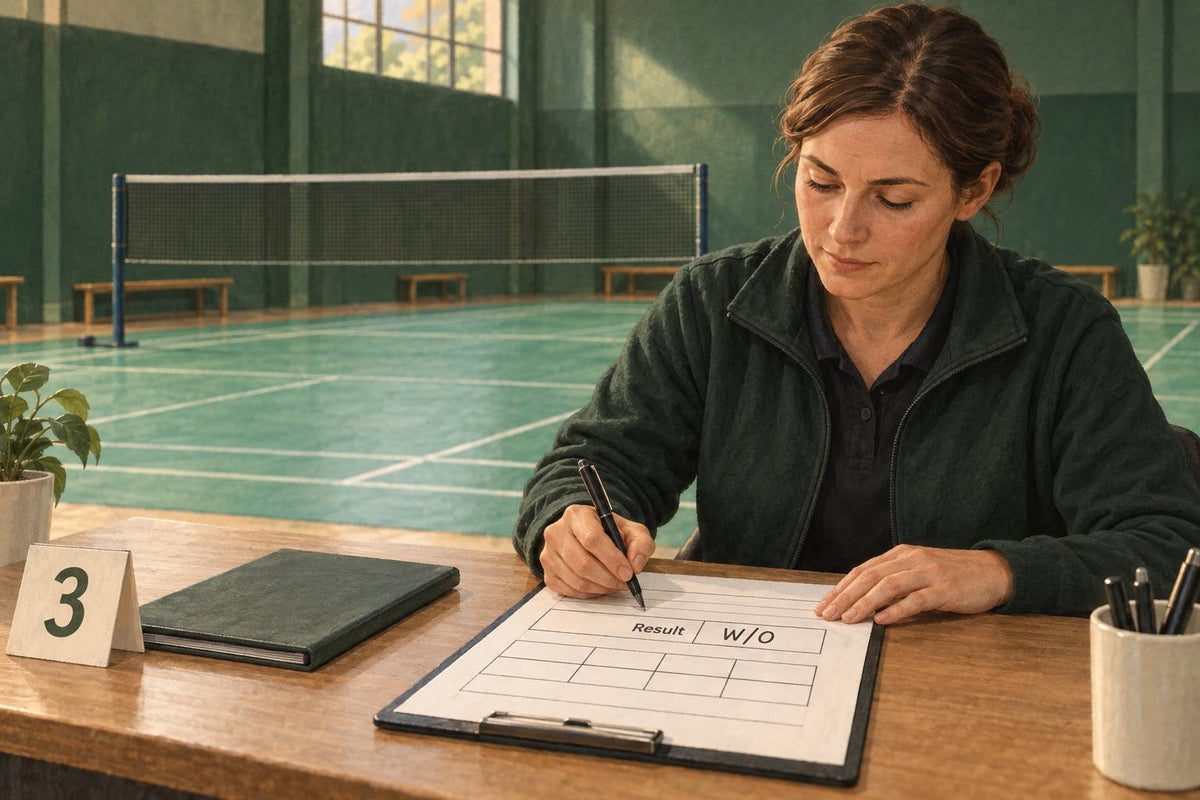
If an event’s published rule says to enter 21–0, 21–0, use that score. If it says to enter “W/O,” award only the match, or apply a separate team-table calculation, follow that instruction instead. Do not copy one event’s convention into another event without checking its conditions of competition.
| Situation | Safe record-keeping move |
|---|---|
| Opponent never arrives | Record the walkover only after the authorised official confirms it. |
| Player stops mid-match | Record a retirement and follow that event’s reporting rule. |
| Team fixture has absences | Use the league’s tie and table rules, not an individual-draw assumption. |
This distinction protects tiebreak calculations. If your competition uses game or point difference, a made-up score can change a group table. The correct source is the applicable published event regulations and conditions, then the Referee’s ruling, rather than a score from another club.
Retirement and withdrawal are not the same
A retirement records a match that began but was not completed; a withdrawal changes the player’s status in an event. Under the BWF regulations, retiring from a match is explicitly not treated as a withdrawal, so use the result label the referee gives rather than relabelling it as a walkover.
The same regulations say that a player who retires or withdraws from one event must be withdrawn from other events entered, with an exception for the BWF World Senior Championships. In a team tie, that player is removed from later matches in that tie and cannot be replaced by a substitute, although participation in future ties remains possible. Those consequences explain why the desk needs accurate information early (BWF GCR withdrawal and retirement provisions).
If a player is injured, do not decide the classification from the sideline. State that the player cannot continue, let the umpire and Referee handle the result, and preserve the scoresheet record.
The five-minute checklist
When a match may not be played, communicate early, confirm the official result, and keep the event’s written rule beside the scoresheet. That is faster and fairer than negotiating a score with the opponent after the scheduled time.
- Find the reporting-time and no-show clause in the prospectus or league rules.
- Tell the umpire or Referee immediately if you are delayed, injured or withdrawing.
- Ask how the case is classified: no-show and walkover, retirement, withdrawal or postponement.
- Record the score exactly as the event rule requires.
- Check your remaining entries before leaving the venue.
For a broader introduction to draw formats and what happens after a first-round result, see our guide to badminton consolation draws.



Leave a comment
This site is protected by hCaptcha and the hCaptcha Privacy Policy and Terms of Service apply.