
Last checked: August 2026 · Written by the Badminton House player-led team.
Quick answer: repeat the method before judging the number
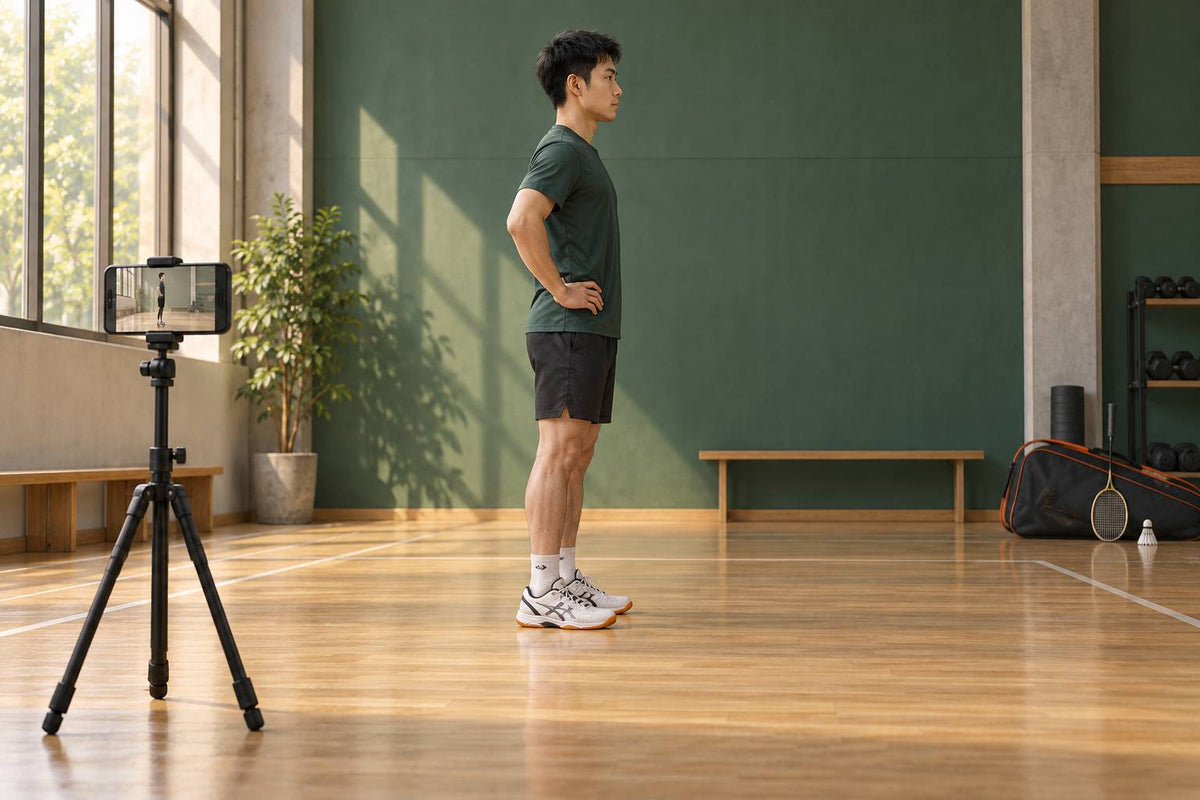
For a home countermovement jump test, use slow-motion video at 120 frames per second or faster, keep your hands on your hips, take five measured jumps with one minute of rest, and record both the mean and best. Compare only with your own matched tests.
Phone
Closest home option: estimate flight time from high-frame-rate video, with a fixed camera and one frame-picking rule.
Wall
A useful jump-and-reach proxy, but arm swing and fingertip reach make it a different test.
Result
Treat a change as convincing only when it exceeds your normal test spread and appears again.
A countermovement jump is simple: stand tall, dip quickly, then jump vertically. The useful test is less simple because arm action, dip depth, shoes, fatigue, landing position, device, and calculation method can all change the number.
This guide starts with a protocol rather than an elite target. Your score can help answer one narrow question: did vertical-jump performance change across an off-court training block when the test stayed the same? It cannot diagnose fatigue, identify badminton talent, or explain which physical quality caused the change.
What does a countermovement jump tell a badminton player?
It gives you a repeatable vertical-jump outcome when the procedure is controlled. That outcome reflects the combined result of force production, movement strategy, and coordination in that jump. It does not reproduce a split step, lunge, change of direction, or jump smash.
Badminton still gives the test a sensible job. The sport contains accelerations, lunges, jumps, and rapid changes of direction, and Badminton Sweden lists tracking change over time and evaluating a training plan as valid reasons to test physical capacity. Read Badminton Sweden's testing report.
Use the CMJ beside, not instead of, court information. A higher jump with unchanged first-step timing may mean the training block improved this test but did not yet transfer to movement. Our five-test badminton fitness guide shows how to keep jump, movement, recovery, accuracy, and balance as separate records.
Which home measurement method should you choose?
Choose the method you can repeat exactly. Slow-motion phone video is the better fit for a hands-on-hips CMJ. A chalk-wall test is simpler, but it measures jump-and-reach with an arm swing. Neither should be reported as equivalent to a laboratory force-platform test.
| Method | What you record | Main limitation |
|---|---|---|
| Phone flight-time CMJ | Airborne frames converted to height; hands stay on hips | Frame choice, rate, tucking, and landing posture affect the estimate |
| Wall jump-and-reach | Highest touch minus standing reach; arm swing allowed | Reach, arm timing, chalk mark, and wall distance add noise |
| Force platform or contact system | Force-time or flight-time output under a defined protocol | Device and equation still matter; it is not the same as either home method |
A smartphone app can be accurate with high-speed video and a controlled protocol. A 2023 meta-analysis found strong validity and reliability overall, but most evidence involved adults. It also identifies manual take-off and landing frame selection, uneven foot contact, and changed landing posture as error sources. Read the smartphone validation review.
Method boundary: write the method beside every score. “34 cm, phone flight-time CMJ, 240 fps” and “41 cm, wall jump-and-reach” are two different records, not a seven-centimetre disagreement.
How do you run the phone CMJ protocol?
Use a clear, non-slip surface with overhead room, a stable side-on camera, and another person to record when possible. Repeat the same comfortable dynamic warm-up, shoes, arm rule, and timing relative to hard training every test day.

- Set the camera. Select 120 fps or faster and keep that frame rate for every test. Frame both feet clearly from the side and fix the phone instead of following the jumper.
- Practise the exact jump. Stand still, feet about shoulder width, hands on hips. Dip and jump straight up without pausing at the bottom. Make two comfortable practice attempts.
- Complete five measured attempts. Jump with maximal intent, rest passively for one minute, then repeat. Discard an attempt if hands leave hips, knees tuck in flight, one foot clearly lands early, or the athlete leaves the view.
- Pick frames consistently. Use one written convention for the instant both feet leave the floor and the first landing contact. Use the same scorer when possible.
-
Calculate and log. Divide flight frames by frames per second for airborne time. Then use
jump height in metres = 1.22625 × time². Record all five results, their mean, and their best.
For example, 0.50 seconds airborne gives 1.22625 × 0.50² = 0.307 m, or 30.7 cm. That decimal does not make a home video laboratory-grade. Round sensibly and preserve the raw frame count so the result can be audited.
The attempt count and one-minute rest come from a published adolescent jump-test review, which also shows why protocol standardization matters. Read the proposed CMJ procedure. Its authors use the best of five. Because a separate meta-analysis found the average more sensitive for monitoring neuromuscular status, this workflow stores both and uses the mean as the primary training-block trend.
How do you run the wall jump-and-reach version?
Use the wall version when high-speed phone recording is not practical. Name it accurately: it is a standing vertical jump-and-reach with an arm swing, not the hands-on-hips CMJ used for the no-arm elite ranges.
- Choose a wall and floor where reaching cannot cause a collision or slip. Use removable chalk or tape only where permitted.
- Stand side-on with both heels flat. Reach as high as possible with the testing hand and mark standing reach. Keep the setup identical next time.
- Dip naturally, swing both arms, jump vertically, and touch at the highest point with the same hand. Do not step into the jump.
- Measure five attempts with one minute between them. Subtract standing reach from each jump touch and record the mean and best.
Standing reach changes with shoulder position, wall distance, and effort. Re-measure it each session, use the same helper, and compare wall results only with prior wall results.
How do you tell improvement from noise?
Build your own noise band before chasing a universal centimetre cut-off. Repeat the complete protocol on more than one rested baseline day. The normal difference between those matched sessions is the spread a later result must beat before you call it progress.
| Result pattern | Interpretation | Next step |
|---|---|---|
| Change resembles baseline-day spread | Inconclusive; ordinary variation can explain it | Repeat under matched conditions |
| Mean rises beyond that spread twice | More convincing evidence that this test improved | Keep the block or progress one variable |
| Best rises but mean does not | One excellent attempt, not yet a stable change | Retest before changing the plan |
| Score falls after hard training or a setup mismatch | Conditions confound the result | Do not diagnose fatigue; repeat when matched |
Badminton House's practical schedule is to retest at the end of a four-to-six-week block. That is a convenient review rhythm, not a physiological law. If the block targets jumping, our badminton plyometric progression can help organize the work while the CMJ remains the outcome.
Do not calculate a simple stretch-shortening-cycle score by comparing CMJ with a squat jump. The ratio can become large because the squat jump is poor, and research questions its stand-alone utility. One clean CMJ trend is more useful than an extra ratio you cannot interpret.
What do badminton elite reference bands mean?
They describe elite context in one federation report, not minimums for a healthy or worthwhile player. Badminton Sweden compiled the ranges below from its elite programme and published studies, then stated that evidence remains limited and more junior data are needed.
| Group in report | CMJ, no arm swing | CMJ with arm swing |
|---|---|---|
| Senior men | 44–49 cm | 50–55 cm |
| Senior women | 34–39 cm | 37–44 cm |
| Elite boys, about U17–U19 | 39–43 cm | 42–46 cm |
The report did not publish a comparable U17–U19 girls' summary band, so do not fill the gap by guessing. More importantly, do not place a phone or wall result into this table. A 2024 review found force-platform jump height can differ by up to about 15 cm depending on the calculation equation alone. Read the jump-height equation review.
For a beginner, the interpretation ladder has no elite rung: establish a safe repeatable baseline, complete the training block, reproduce the test, and look for change beyond personal noise. Your own matched trend answers the question better than a federation number collected with another system.
When should you stop or postpone the test?
Do not test through an unresolved lower-limb injury. Stop for sharp or worsening pain, marked swelling, or loss of normal movement or strength, and seek professional assessment instead of using a maximal jump as a self-clearance test. This matches the red-zone advice in the NHS Trust return-to-activity guide.
Stop immediately for chest pain, unusual shortness of breath, palpitations, dizziness, or fainting during exertion. Fainting during exertion requires medical evaluation before another maximal test; the American Heart Association identifies exertional syncope as a higher-risk pattern.
When the setup is safe and symptoms are absent, the CMJ can be a useful ruler. Keep the ruler unchanged, record the entire set, and let repeated evidence decide whether the training block moved your jump.

Leave a comment
This site is protected by hCaptcha and the hCaptcha Privacy Policy and Terms of Service apply.