
Last reviewed: July 2026 · By Badminton House’s player-led team
Quick Answer: Badminton Fitness Test
Use five self-scored court tests to establish a baseline, then judge progress only under the same setup.
Baseline
Record jump, six-corner time, pulse recovery, serves, and both balance holds; the pattern identifies the area needing attention.
Retest
Repeat after 6–8 weeks; on a roughly 48-second six-corner circuit, a 2–3-second drop is a useful training-sized shift.
Limits
These scores track your own trend, not readiness after injury or a ranking against other players.
A useful badminton fitness test should tell you whether your court movement, repeat effort, control, and stability are improving—not whether you can post one heroic score. This five-part battery uses a wall, court lines, tape, shuttles, and a phone timer to make that check practical. Record the same protocol each time and compare your results with your own previous scores; a court-specific test is more useful than a generic running benchmark for badminton’s multidirectional demands.
Expect short bursts rather than a long endurance grind: badminton rallies are commonly brief and separated by short recovery periods, as outlined in this match-play analysis in Sports.
Want a second set of eyes on your plan? If a score drops sharply, pain changes your movement, or you are unsure how to adapt training, contact our team for practical badminton-focused guidance.
In This Guide
How do you make a badminton fitness test repeatable?
Treat this five-test badminton fitness test as a self-reference battery, not a ranking system: compare every result only with your own previous score. Available badminton testing research uses selected competitive samples rather than age-graded norms for club players, so published numbers are not your target.

Run the same five tests in the same order, after the same badminton warm-up, at the same time of day and on comparable footwear and court surface. Retest every six to eight weeks, not weekly: a systematic review of resistance training in competitive badminton players found interventions longer than eight weeks more effective than shorter programmes.
Use one page for every session:
- Date and conditions.
- Vertical-jump trials and average; three six-corner times and average.
- Repeated-effort bout description plus immediate, one-minute and two-minute pulse.
- Ten serve results per diagonal; three balance trials per leg and the stopping reason.
This battery measures physical qualities plus serve accuracy; it does not grade stroke technique, tactics, or club-readiness skills.
How do you test jump height and six-corner court movement?
Record averages, not standout attempts: use three standing reach-mark jumps against a wall and three timed six-corner circuits. Fixed trial counts make scores comparable, helping you identify your own change under identical conditions rather than chase a one-off personal best.

Jump: Mark your standing reach, jump vertically to touch a second mark, then record the difference for each of three attempts and average them. Treat a change around the test's roughly 5.7–6.5% typical error cautiously unless conditions and method are identical. The common cheat is taking extra trials and reporting only the best.
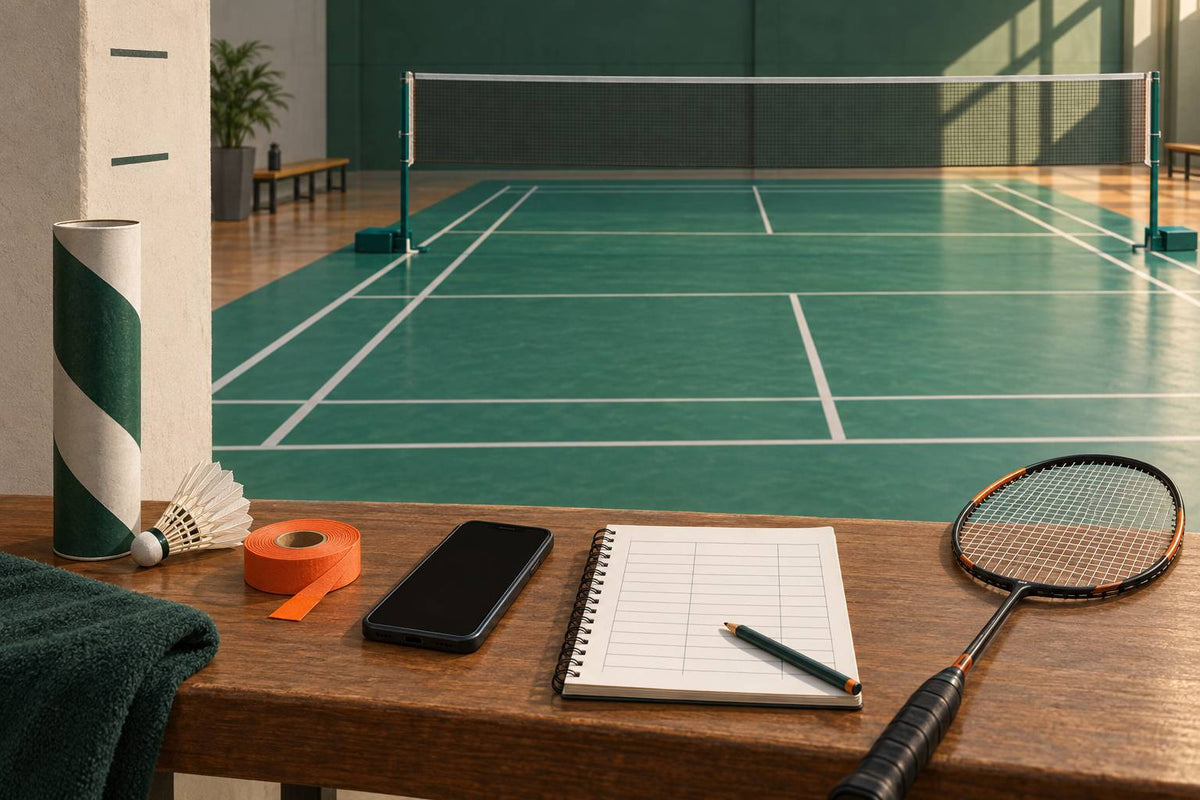
Six corners: Tape a centre base mark and targets at left and right front, midcourt, and rear court. Start at centre, touch every target via the base using normal match footwork, time the full circuit, rest six minutes, then average three runs. Malwanage et al. in PLOS ONE used this six-direction structure, three-run average, and found an approximately 2–3-second eight-week change on a roughly 48-second circuit—not a universal benchmark. Do not cut the centre return or miss a target touch. A planned circuit cannot test reactions to an unpredictable opponent.
How do you score repeated-effort recovery without a heart-rate monitor?
Use pulse palpation at fixed one- and two-minute points after the exact same court-work bout, then compare the recovery pattern with your own prior test. Build the bout from repeated approximately six-second court efforts with approximately 11–12 seconds of recovery, and write the movement, effort count, and rest pattern on your score sheet.
Stop, record pulse immediately if practical, then count it again at one and two minutes. GE HealthCare’s heart-rate-recovery overview defines the common one-minute calculation as immediate post-exercise pulse minus the one-minute pulse; retain all three raw numbers too. A larger drop under identical conditions suggests faster recovery, but there is no valid club-player comparison target and one result cannot diagnose fitness or health.
The usual cheat is shortening the bout, changing its work-rest structure, or starting the recovery clock late. Repeat the same protocol every retest.
How do you score serve accuracy and single-leg balance?
These final two measures are simple only when the target, legal-service rules, stance and stopping rules never change: score 10 serves into the same marked diagonal target per side, then record three single-leg holds on each leg.
Tape the same zone inside each diagonally opposite service court. Use 10 legal serves per side: one point for a shuttle landing in its zone, zero otherwise; record side-by-side totals out of 10. The BWF Laws of Badminton require stationary feet, base-first contact and impact below 1.15 m. A one-point change means one more successful landing on this fixed test, not proof that technique improved. Landing alone misses a low, interceptable short serve; do not move tape, change shuttle condition, or count illegal or out serves as hits.
For balance: barefoot, arms crossed, raised foot near but not touching the stance ankle, eyes on a wall spot. Do three trials per leg, cap at 45 seconds, and record the best hold plus stop reason. Arms uncrossing, stance-foot shift or rotation, or touchdown stops it. An isolated eyes-open gain may be practice; seek repeated change across retests and both legs.
Which badminton fitness test should you prioritise?
Choose the test that matches the part of your game you want to track, then keep the same five-test battery for later retests. Jump, movement, recovery, serve accuracy and balance measure different qualities, so no single score can stand in for overall badminton fitness.
| Choose | Choose this if... |
|---|---|
| Standing vertical jump | You want to follow lower-body explosiveness for overhead attack. |
| Six-corner movement | Court coverage, recovery to base and footwork efficiency are your priority. |
| Repeated-effort recovery | You fade between hard rallies and want a simple recovery trend. |
| Serve accuracy | You need a scored baseline for repeatable diagonal serves. |
| Single-leg balance | You want to monitor left-right control before adding demanding movement work. |
Get 10% off your first order
Join the Badminton House list and we’ll email you a 10% welcome code — plus training guides, technique advice, and badminton updates.
By subscribing, you agree to receive Badminton House emails and can unsubscribe anytime.
We play badminton too, and a useful test result should lead to a clearer next training decision—not a comparison with someone else’s score. If you want help choosing practical training gear or setting up your testing kit, contact us.
A tube of shuttles and tape are enough to mark the movement and serve-accuracy tests. Keep your setup consistent, then check live availability when it is time to replace your test shuttles.
Shop Shuttlecocks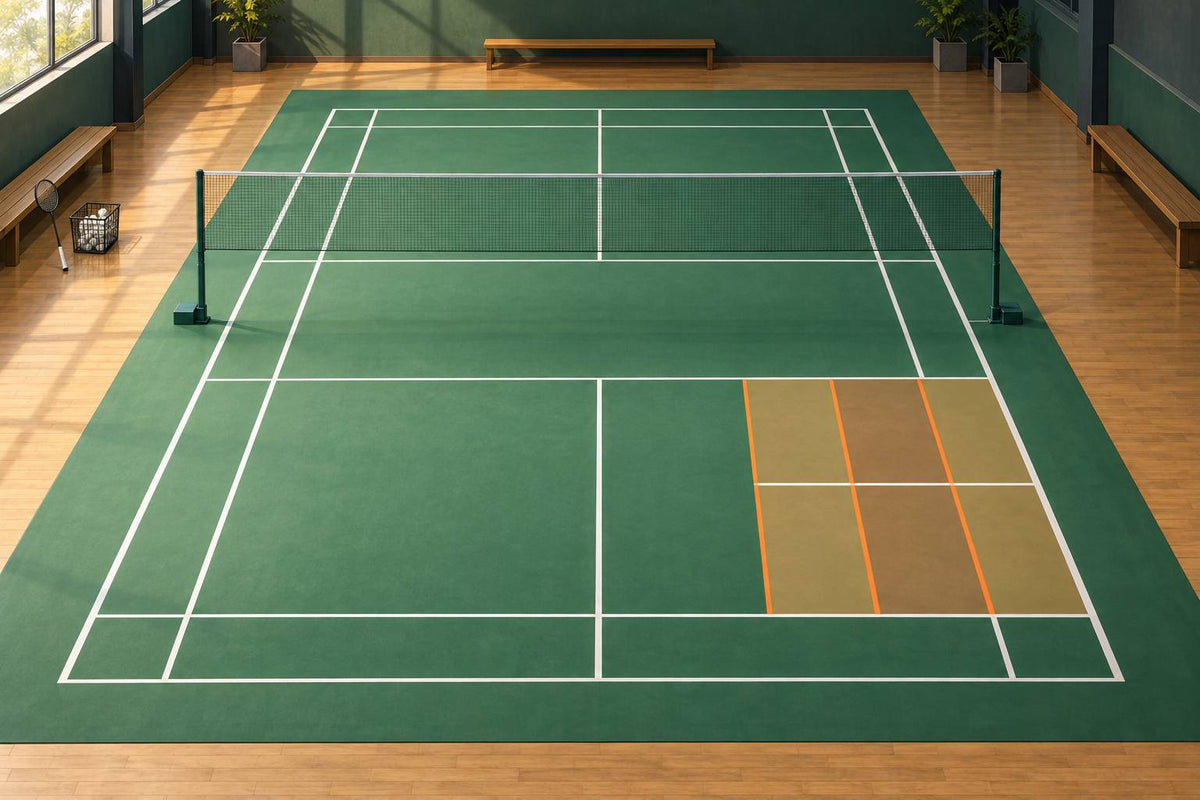

Leave a comment
This site is protected by hCaptcha and the hCaptcha Privacy Policy and Terms of Service apply.