
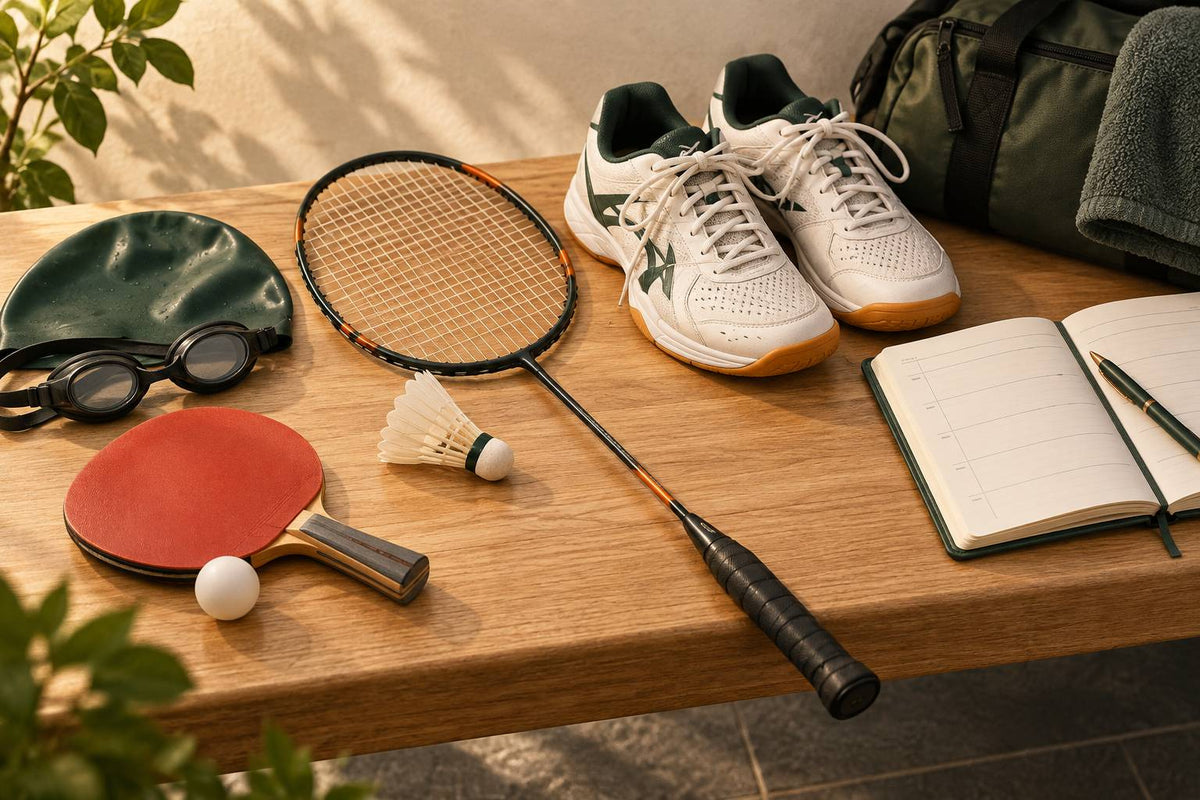
Last checked: August 2026 · Written by the player-led team at Badminton House
Quick answer: cross-training for badminton
Choose another activity for one job—speed, coordination, conditioning, or easy movement—and keep its fatigue low enough that your next badminton session remains sharp.
Best fit
Sprint or plyometric work: use short, fresh sessions when the goal is acceleration and multidirectional power.
Skill
Table tennis can add a light reaction and tracking challenge, but it does not replace badminton footwork.
Recovery
Easy swimming or mobility can fit between court sessions when the goal is movement without another hard leg load.
Badminton players often have weeks when court time is limited. Cross-training can fill the gaps, but only if the extra activity helps your next badminton session instead of making you arrive flat.
The useful question is not “Which sport is hardest?” It is “Which quality does this activity support, and what does it cost me to recover?” Badminton asks for repeated acceleration, braking, diagonal movement, fast decisions, overhead work, and enough capacity to repeat those actions. Another sport may help one quality while adding fatigue somewhere else.
A 2020 analysis of World Championship badminton found diagonal movements were the most frequent movement category and short movements were more common than large ones in the analyzed games. That is a reminder that general fitness helps, but transfer is never automatic. Read the movement analysis.
Which activities complement badminton?
Choose an activity for a specific job and begin conservatively. The time ranges below are Badminton House starting points, not universal prescriptions. Use the low end first, observe your next court session, and change only one variable at a time.
| Activity | Possible transfer | Starting dose | Timing warning |
|---|---|---|---|
| Squash | Repeated movement, anticipation, and opponent reading can feel familiar. | One 40–60-minute session. | Grip, wall rebounds, and movement patterns differ. Keep hard squash away from an important match. |
| Table tennis | Light play challenges tracking, short reactions, and early preparation. | One or two 20–40-minute sessions. | Keep it easy enough that it does not become another hard leg or shoulder session. |
| Sprints and plyometrics | Short, controlled work can support acceleration, jumping, and multidirectional speed. | A brief set of technically clean repetitions. | Do it fresh and separate it from court work when possible. Stop when landing or braking quality deteriorates. |
| Easy swimming | General aerobic movement with a different loading profile from another racket sport. | 20–40 minutes at an easy pace. | Long or hard sets still create fatigue. It is recovery only when it feels restorative. |
| Mobility | Controlled hip, ankle, trunk, and shoulder movement. | One calm 30–60-minute session. | Avoid aggressive end-range work immediately before play. The goal is control, not forced flexibility. |
What actually transfers to badminton?
The closer an activity looks to badminton, the easier it is to assume everything transfers. Squash may train opponent reading, but its wall rebound and grip demands create different habits. Table tennis can sharpen a short reaction, but it does not teach rear-court recovery. Swimming keeps you moving, but it cannot reproduce badminton braking and split-step timing.
- Acceleration: short sprint work may support a quicker start when each repetition remains sound.
- Decision speed: another racket activity adds visual decisions, but the object, court, and scoring context differ.
- General conditioning: swimming or easy aerobic work can maintain activity between court sessions without replacing sport-specific movement.
- Movement control: mobility helps when it improves comfortable control, not when it leaves you sore or unstable.
An eight-week study in elite Polish badminton athletes reported improvements in jump, sprint, and lateral slide-step measures after a plyometric intervention. That supports targeted explosive work, but it was not a universal recreational program. Read the study abstract. For a court-relevant progression, use our badminton plyometric ladder.
Which cross-training choices hurt court quality?
Cross-training becomes counterproductive when it repeatedly takes quality away from badminton. The first sign may not be an injury. You may simply become late to routine shuttles, lose the first step, or struggle to repeat familiar technique.
- Heavy leg work before match play: demanding lower-body work or hard squash can leave braking and lunges slow.
- Long endurance sessions: a long ride or run may fit another phase but flatten court speed the next day.
- Repeated overhead loading: too much throwing, serving, or another overhead sport can fatigue the shoulder before badminton.
- Explosive work while tired: sprinting and jumping are poor choices when landings become noisy, unstable, or visibly different.
- Turning every recovery day into competition: if every easy session becomes hard, the week no longer has an easy day.
Concurrent-training research does not say endurance work is bad. A 2024 systematic review found a small lower-body strength interference effect in males, but outcomes varied by population and measure. Use that as a reason to plan, not a reason to fear cardio. Read the systematic review.
How can two court sessions fit into one week?
This example leaves the badminton sessions as the priority and adds only two purposeful activities. Move the days around your club schedule and keep at least one genuinely easy day.
| Day | Session | Purpose |
|---|---|---|
| Monday | Badminton practice | Make court quality the priority. |
| Tuesday | Easy swimming, 20–40 minutes | Move without another hard court load. |
| Wednesday | Rest or gentle mobility | Keep it easy if Monday was demanding. |
| Thursday | Short sprint or plyometric session | Train speed while fresh. |
| Friday | Rest or light table tennis | Keep the reaction activity relaxed. |
| Saturday | Badminton match play | Assess whether the week left you sharp. |
| Sunday | Rest | Recover before the next week. |
If the week keeps expanding, return to the priorities in our badminton recovery guide before adding another session.
How should you adjust the plan?
Judge the cross-training by the next badminton session. If you reach the shuttle at your normal height, brake under control, and repeat familiar technique, the dose may fit. If you feel heavy, unusually sore, late to ordinary shots, or unable to hold posture, it was too much for that place in the week.
Change one thing first: shorten the session, lower its intensity, or move it farther from badminton. Do not add more activities to compensate for a bad week. Two well-placed cross-training sessions are more useful than five tiring ones.
The best cross-training plan leaves you ready to play badminton well. Keep the activity specific enough to support one quality, conservative enough to recover from, and flexible enough to change when your court performance says it should.

Leave a comment
This site is protected by hCaptcha and the hCaptcha Privacy Policy and Terms of Service apply.