
Last checked: August 2026 · Written by the player-led team at Badminton House
Quick answer: cross-court smash
Use the cross-court smash as a selective change of direction when the defender is committed to the straight side and you can cover the straight block into your opposite forecourt.
Default
Play straight first: it keeps the follow-up simpler and makes cross more valuable once the defender leans.
Cross
Choose it when contact is early and balanced, the defender commits straight, or your doubles partner covers the direct block.
Recovery
Expect the defender's straight block toward the forecourt opposite your hitting corner.
A cross-court smash looks aggressive because it changes direction across the court. The useful question is whether that direction creates a bigger problem for the defender than it creates for your own follow-up.
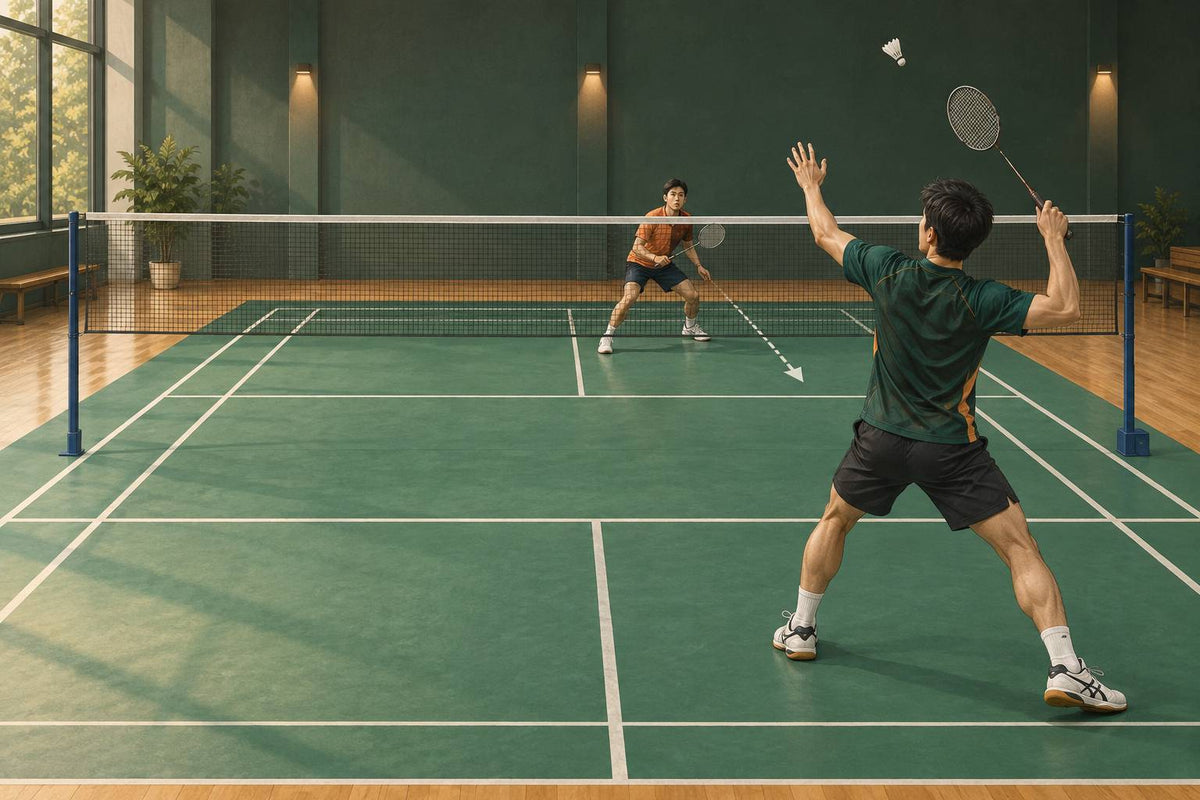
The straight smash normally keeps the attack and recovery on one side. A cross-court smash sends the shuttle to the opposite side, where the defender can block straight down that sideline into the forecourt farthest from the hitter. BWF coaching material specifically uses that straight block off a cross-court smash as a way to make the attacker's next shot more difficult. Read the BWF Level 1 coaching manual.
This is a shot-selection guide, not a lesson on generating smash power. For the broader decision about whether to attack at all, see our when-to-smash guide.
Why does a cross-court smash cost more?
It changes two lines at once. The shuttle travels diagonally to the opposite side, while the simplest defensive reply is a straight block into the hitter’s opposite forecourt. In singles, that reply pulls the rear-court hitter toward the opposite forecourt. In doubles, it asks the front player to protect a line that may not match the rear player's original attack.

The shot can still be right when the opponent has already committed toward the straight defence. Their late change of direction may outweigh your harder follow-up. Without that positional advantage, cross often gives a balanced defender a clear target and asks you to cover more court afterward.
Decision rule: play straight as the stable option; play cross when the defender's position or your partner's coverage pays for the extra recovery.
When is the cross-court smash worth trying?
Look for at least one clear advantage, and preferably two. Cross is most useful when it responds to information rather than habit.
| Condition | What to see | Why cross can pay |
|---|---|---|
| Defender leans straight | Their racket, hips, or first step is committed toward the direct side. | They must reverse before reaching the shuttle. |
| Early, balanced contact | You are behind the shuttle and can see the defender before choosing. | Direction comes from a stable position instead of a late reach. |
| Partner covers the straight reply | In doubles, the front player is ready to protect the straight block into the attacker's opposite forecourt. | The immediate block is covered rather than donated. |
The common thread is information. You are not choosing cross because straight feels boring. You are choosing it because defender position, contact quality, or partner coverage changes the risk.
When does the cross-court smash usually lose?
The cross-court smash usually loses when contact is late, the defender is balanced, or your side cannot cover the straight block into the opposite forecourt. In each case, the diagonal changes direction without creating enough pressure to repay the harder recovery.
- You are deep in the backhand corner. If contact is late or your body is falling away, adding the cross direction makes accuracy and recovery harder.
- The shuttle is low or behind you. A forced reach turns the shot into a gamble instead of a tactical change.
- The defender is centred and ready. A balanced defender can move into the diagonal while you still have to cover the far forecourt reply.
Predictability is another warning. If every straight smash is followed by cross, the opponent starts moving before contact. Use the straight option often enough that cross remains a genuine change.
A 2022 men's singles analysis reported a higher decisive-shot rate for cross smashes than straight smashes in its sample, while straight smashes were chosen more often in non-decisive cases. That supports selective use, not a rule to cross every attack. Read the match-analysis record.
How do contact and recovery make the choice survivable?
A 2018 study of seven male intercollegiate players compared straight and cross-court forehand clears, drops, and smashes. Cross-court shots showed a more forward and inward wrist trajectory and greater shoulder horizontal flexion than straight shots. Treat that as an awareness cue, not a universal pose: do not force cross from the same late contact that barely permits a straight shot. Read the study abstract.
After contact, cover the reply that most immediately punishes the cross: a straight block down the sideline into the attacker's opposite forecourt. In singles, bias the first recovery toward that forecourt; in doubles, the front player may protect it while the rear player prepares for a lift. The defender can still choose a cross block or lift, so this is a first-coverage priority, not a prediction.
Do not both move away from the same lane. If the front player is already drifting toward the other side, the rear hitter should choose straight or another stable option instead of opening two spaces with one swing. Our rear-court doubles rotation guide shows why cross-court attack changes the handoff.
How do you practise the decision?
Ask a feeder and defender to create three repeatable situations. Score the choice and recovery, not merely whether the shuttle lands in.
- Defender shows straight: the defender leans toward the direct side. Choose cross and recover toward the straight block into your opposite forecourt.
- Defender stays centred: choose straight or a controlled neutral shot. Avoid donating the harder recovery.
- Contact arrives late: play the safest available shot rather than forcing cross. Reward the decision, not the highlight.
Begin with cooperative feeds, then make the defender live. Give the attacker one point for choosing cross under the agreed condition and one for covering the expected reply; give no point for cross from a late or unstable position.
Use our badminton base-position guide to refine the recovery starting point. The practical rule stays simple: straight by default, cross by invitation, and recover for the reply you just exposed.


Leave a comment
This site is protected by hCaptcha and the hCaptcha Privacy Policy and Terms of Service apply.