
Last updated: August 2026 · Badminton House
Quick Answer: Entering Your First Badminton Tournament in Canada
Buy your provincial membership (plus a player licence where your province requires one), then enter the specific events on Badminton Canada’s Tournament Software portal before the close date. The membership on its own does not put you in a draw.
Order
Membership or licence first, then the tournament entry on Tournament Software, then your doubles partner accepts the request inside the portal. Three separate actions.
Level
Tick the lowest flight you are eligible for: C or D in an adult A–D ladder, Silver in Alberta’s junior circuit, Junior C in Ontario or Quebec. Move up on results.
Budget
An Ontario adult’s first Open event is $35 membership plus $85 entry. A BC single-event membership is $45 plus $85 entry. Every province is below.
Entering a sanctioned badminton tournament in Canada is an admin exercise before it is a badminton one. The membership, the licence, the Player ID and the entry are four different things, and first-timers routinely buy one of them and assume it covers the rest.
This guide is built from the association pages themselves: what British Columbia, Alberta, Ontario, Quebec, Nova Scotia and Newfoundland and Labrador each require before your name can appear in a draw, what it costs for the 2026-27 season, how the flights are defined, and what happens between check-in and your first scorecard.
In This Guide
The Order of Operations

Every province in this guide runs the same sequence, even where the fees and the names differ.
- Find the event. Sanctioned tournaments across the country are listed on Badminton Canada’s Tournament Software portal. Open the tournament page and read its regulations and close date before you buy anything.
- Buy the membership, and the licence if your province sells one. Your provincial association sells it, in most provinces through the same Tournament Software account. Alberta, Ontario, Quebec and Newfoundland and Labrador all state that it has to be in place before the entry step will go through.
- Enter the events. Back on the tournament page, choose singles, doubles or mixed and pay the entry fee. Badminton NL puts it bluntly in its membership and tournament entry guide: paying for a membership does not enter a player into a competition; each player must make their own entry afterwards.
- Get the partner accepted. For doubles and mixed, the partner request is made inside the portal during entry, and your partner has to accept it there. Until they do, the pair is not in the draw.
Your Player ID. When the membership is approved you receive an ID number: two letters and five digits in Alberta, the letters NL followed by five digits in Newfoundland and Labrador. It ties your membership, entry, ranking points and partner request together; Badminton NL asks for it on every entry. Save it where you can find it at noon on registration day.
What Your Province Makes You Buy First
The name changes by province (membership, licence, affiliation, athlete card) but the question is the same: which one lets you into the tournament you want. The fees below are the associations’ own published figures for the 2026-27 season unless noted; tournament entry fees are on top.
| Province | Season | For a first sanctioned event | Published fees |
|---|---|---|---|
| British Columbia | June 1 to May 31 | A Single Event membership for one tournament, or Provincial for the season. The Single Event fee can later be applied toward a Provincial membership. | Single Event $45; Provincial $90; National $115, totals including the Badminton Canada licence, per Badminton BC players membership. |
| Alberta | July 1 to June 30 | Base membership plus a Provincial Player licence for the Alberta circuit; National Player for national events. Both are bought on Tournament Software, which replaced PlayerWeb on March 31, 2026. | Base member $37.75 adult (15 and older) or $26.00 youth (14 and under); Provincial Player licence $146.00; National Player licence $166.00, per the Badminton Alberta 2026-27 membership campaign. |
| Ontario | September 1 to August 31 | General membership for adult Open and Masters; Provincial Silver for Junior B and C; Provincial Gold for Junior A. Recreational players at an affiliated club can stay Affiliate members until they enter a sanctioned event. | General $35; Provincial Silver $70; Provincial Gold $100; National $140, per Badminton Ontario membership. |
| Quebec | September 1 to August 31 | Tournoi unique for one tournament; Provinciale Argent for categories B and C; Provinciale Or for A and U13 to U19. Affiliation first, then entry and payment on Tournament Software. | Tournoi unique $36; Provinciale Argent $45; Provinciale Or $52; Nationale $73, per Badminton Québec player affiliations. |
| Nova Scotia | September 1 to August 31 | Recreational membership covers unlimited Club Series play and one Scotia Series event; Provincial covers unlimited Scotia and Atlantic Series events. | Recreational $20; Provincial $40; National $60, per Badminton Nova Scotia membership. |
| Newfoundland and Labrador | September 1 to August 31 | Membership must be paid before any sanctioned entry, and the Player ID goes on every entry. A single-event tier exists for out-of-province and out-of-country players. | Regional $10; Provincial $25; National $40; Single Event $16, per the Badminton NL entry guide linked above. |
Two things stand out. Four of the six provinces sell a single-event or entry-level tier between $16 and $45, so a first tournament does not require the full competitive licence. And the season windows do not line up: a BC membership bought in May expires on May 31, so check the dates before you pay.
Choose the Right Flight, Age Group or Masters Band

The letters do not mean the same thing in every province, and the tournament’s own regulations are the final authority. These are the systems you will meet on the entry form, with the definitions the associations publish.
| System | Categories | What decides where you go |
|---|---|---|
| Adult A to D ladder (Nova Scotia’s definitions) | A Open, B Competitive, C Recreational, D Leisure, plus Masters 40+ | Badminton Nova Scotia describes A as players competing at the highest provincial and Atlantic level, B as players who have competed before but are not at Open level, C as players who may have competed locally, and D as leisure players. A club-night regular with no tournament history is C or D. |
| Ontario junior tiers | Junior A (High Performance), Junior B (Competitive), Junior C (Regional), each with age groups from U11 to U19; Junior C also runs U9 | Ranking-point ceilings set by Badminton Ontario’s competition regulations: Junior C players hold no more than 799 Ontario ranking points in any discipline, Junior B no more than 2,999, Junior A has no ceiling. A first-timer has zero points and belongs in C. The membership follows the tier: Provincial Silver for B and C, Provincial Gold for A. |
| Alberta junior circuit | Silver and Gold | Badminton Alberta’s tournament registration guide calls Silver events more suitable for players newer to tournaments; Gold events require a minimum of 2,000 ranking points to enter. |
| Quebec | A, B, C and Élite, with U13 to U23 age groups | The licence follows the category: Provinciale Argent for B and C, Provinciale Or for A and the U13 to U19 age groups, Nationale for the national circuits. |
| Masters | 35+, 40+, 45+, 50+, 55+, 60+, 65+, 70+ and 75+; Alberta also runs 30+ | The date rule is provincial. Badminton Alberta’s age classifications say the age must be attained before or during the tournament dates; Ontario’s regulations say before the start of the tournament. Organizers may merge adjacent bands when entries are thin. |
Junior age groups go by birth year
Alberta’s table effective January 1, 2026: U11 born 2016 or later, U13 born 2014 or later, U15 born 2012 or later, U17 born 2010 or later, U19 born 2008 or later. Nova Scotia phrases the same principle as remaining under the age throughout the calendar year in which the national championship is held. It is the birth year, not your age on tournament weekend; our junior age categories guide covers playing up.
Points, partners and the honest choice
Ontario, Alberta and Quebec all gate their upper tiers on ranking points, which a first-timer does not have; our Badminton Canada rankings explainer shows how they accumulate. If your doubles partner already holds points and you do not, read the tournament regulations for which tier the pair enters before either of you registers. When two flights both look possible, enter the lower one; a result there is what moves you up.
Register on Tournament Software
Ontario publishes the most precise registration schedule of any province, and it is a good model for the rhythm you will meet elsewhere. The rules below are from Badminton Ontario’s tournament registration page for the 2025-26 season.
| Item | Ontario rule | What it means for a first-timer |
|---|---|---|
| Window opens | Junior series: Friday 12:00 PM ET, four weeks before the tournament. Masters and Open series: Thursday 12:00 PM ET, five weeks before. | Registration is first-come, first-served and popular junior draws fill fast. Have your login and Player ID ready before noon. |
| Window closes | Tuesday 11:59 PM ET, one week before for juniors and two weeks before for Masters and Open. Withdrawals close the next day. | Fix a missing partner or a wrong event before that Tuesday. After it, you are asking the organizer for a favour. |
| Event cap | Maximum 2 disciplines per player at 2-day junior tournaments; up to 4 events in the Masters and Open series. | Decide singles, doubles or mixed before the window opens, not at checkout. |
| Draws | Posted to the tournament page by 11:59 PM the Tuesday before the tournament. | That is when you learn your first match time. Our guide to draws, seeds and byes explains what you are looking at. |
| First tournament of the season | 5% of each tournament’s capacity is reserved for athletes entering their first event of the season, by written request to tournaments@badmintonontario.ca before general registration opens. | If a draw is full, this may still get you in. |
| Late entry | Not an Ontario rule, but a common one: Badminton BC adds a late entry fee of $40 + GST after the deadline on its Jack Underhill BC Open Series. | Set a reminder for the close date. |
Partner requests for doubles and mixed
Badminton Ontario’s FAQ is explicit: partner requests must be completed at the time of registration, no email requests are accepted, and both players have to agree through the portal before the pairing counts. In practice: agree the tournament, discipline and tier with your partner first, then both log in the same day, one entering and naming the partner, the other accepting. A request still unaccepted on the close date is an incomplete entry.
What a First Tournament Costs
Three separate charges: the provincial membership, a player licence where the province requires one, and the entry fee for each tournament. The first event of the season carries all three; the next one in the same season is usually the entry fee alone. Worked examples from the published figures:
| Situation | Membership or licence | Entry fee | First-event total |
|---|---|---|---|
| Ontario adult, Open series, one event | General $35 | $85 for a 2-day Open tournament, $5 per extra event (2025-26) | $120 |
| BC adult, one tournament | Single Event $45 | $85 for one event, $105 for two, $115 for three (2026 Jack Underhill BC Open Series) | $130 |
| Ontario junior, Junior C, two events | Provincial Silver $70 | $90 for the first event plus $17 for the second (2025-26, 2-day) | $177 |
| Alberta adult, provincial circuit | Base member $37.75 plus Provincial Player licence $146.00 | Set per event on the tournament page | $183.75 plus entry |
| Quebec adult, one tournament | Tournoi unique $36 | Set per event on the tournament page | $36 plus entry |
Ontario’s junior fees scale with the tier (Junior A $110, Junior B $100, Junior C $90 for a 2-day tournament) and Masters pay $95 for up to 4 events, so the honest lower tier is also the cheaper one. Alberta’s licence is the outlier: it front-loads most of the season’s cost into the first purchase, after which each tournament is entry only.
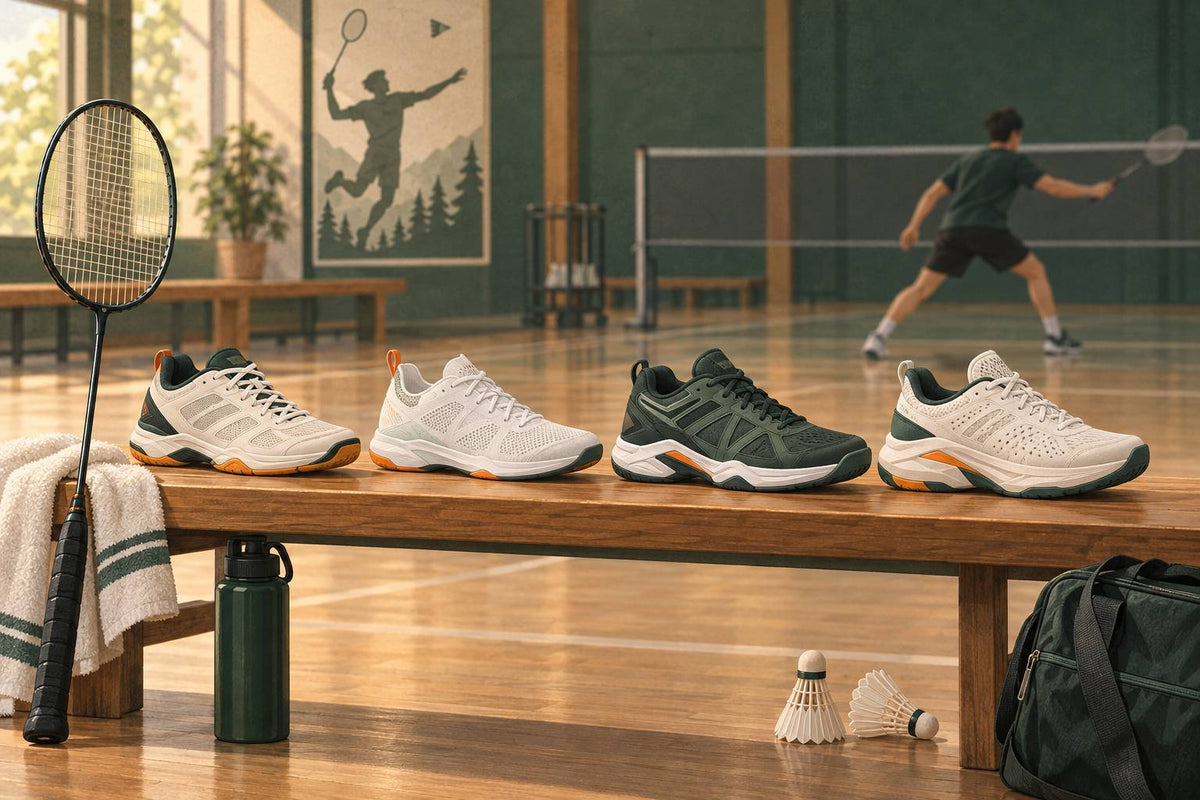
Gear you actually need. Non-marking indoor shoes are the one thing a gym will send you off court for; our non-marking shoes guide shows how to check the pair you own, and the footwear collection is there if you need a new one. Ontario juniors must wear protective eyewear meeting the ASTM F803 standard whenever more than two players are on the court, worn over prescription glasses, which on their own do not count; see our eyewear guide.
Tournament Day
Badminton Alberta’s registration guide is the most explicit official description of what to do once you are in the building. The new part is not the match; it is the queue around it.

Night before
Check the draw and your scheduled time on the tournament page. Times move, so check again in the morning.
Arrive
At least 30 minutes to 1 hour before your scheduled match. Park, change, warm up, and locate the draw desk before anything else.
Check in
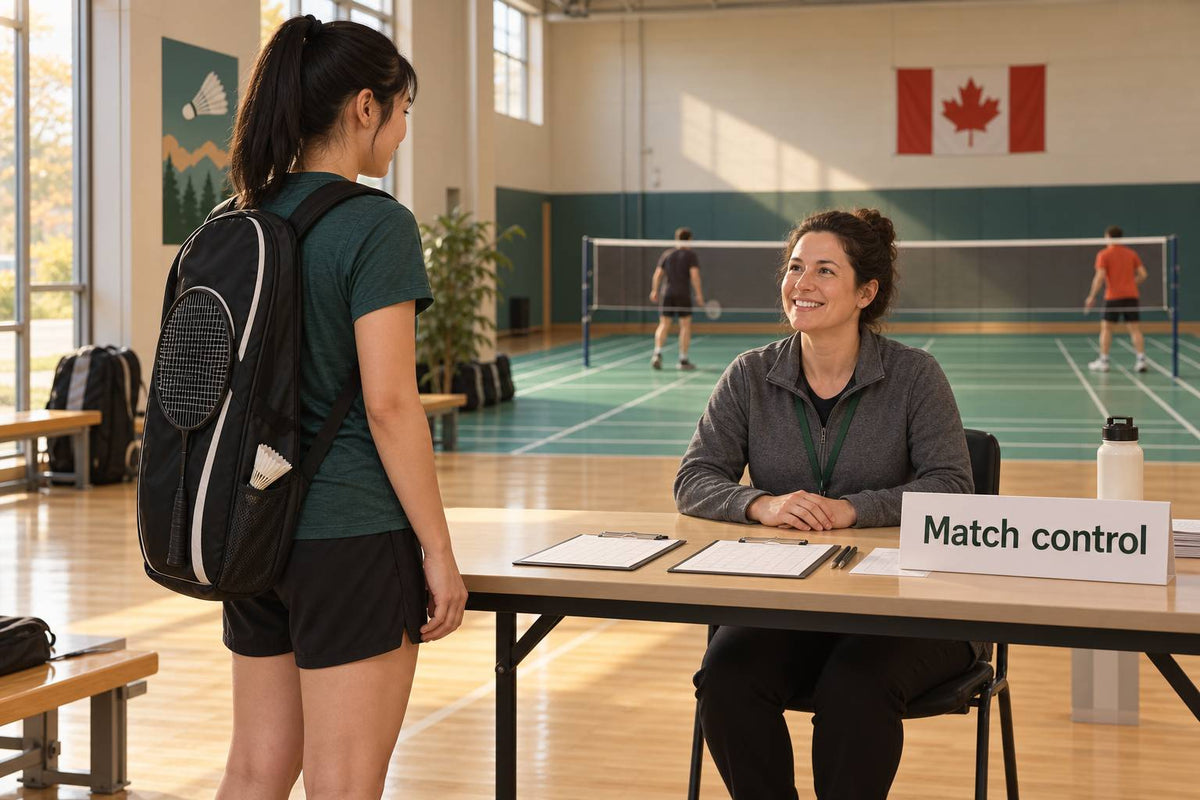
Ask at the draw desk, usually called match control, whether you need to check in. That is also where every question on the day gets answered.
1st available
Matches are queued as 1st, 2nd or 3rd available on a court, not by the clock. If yours is listed that way, stay within earshot with your shoes on; it can be called the moment a court clears.
Called
Pick up the scorecard from match control and go to the assigned court. Afterwards, find out who stays to scorekeep the next match and where the scorecard goes. Leaving before that is the classic first-timer mistake.
Scoring is the standard best of three games to 21 with rally point scoring, extended to 30, which Ontario’s regulations spell out and our scoring guide walks through. Without an umpire you call your own lines: be honest, and if there is a dispute, ask match control for an official rather than arguing across the net. Wait for the receiver to be ready before you serve, and finish with a handshake or a “good game” whatever the score.
Which Category Should You Enter?
| Your situation | Enter | Buy first |
|---|---|---|
| Adult club-night regular, no tournament history | C Recreational or D Leisure, or the lowest flight the event offers | The single-event or general tier: BC Single Event, Ontario General, Quebec Tournoi unique, Nova Scotia Recreational |
| Competed before, not at Open level | B Competitive | The provincial tier |
| Junior, first event, no ranking points | Ontario Junior C, Alberta Silver, Quebec C, in the birth-year age group | Ontario Provincial Silver; Quebec Provinciale Argent; Alberta base membership and Provincial Player licence |
| Aged 35 or over | The Masters band you have reached under your province’s date rule; expect adjacent bands to be merged | Ontario General covers Masters; elsewhere the provincial tier |
| Doubles with a stronger partner | The tier the regulations assign the pair; both register the same day and the partner accepts in the portal | Whatever that tier requires, for both of you |
First-Tournament FAQ
Do I need a membership to enter a badminton tournament in Canada?
For a sanctioned tournament, yes. Badminton Ontario calls membership mandatory for all competitive players in sanctioned events, and Badminton NL requires it paid before the entry goes in. A club’s internal tournament is run on the club’s own terms.
Can I enter one tournament without a full season membership?
In most provinces. BC sells a Single Event membership, Quebec a Tournoi unique licence, Nova Scotia’s Recreational membership includes one Scotia Series event, and Newfoundland and Labrador has a single-event tier for visiting players. Ontario’s and Alberta’s current fee pages do not list one; there you buy the season.
What if the draw is already full?
In Ontario, ask about the reserved spots for a first tournament of the season, in writing, before general registration opens. Everywhere else, email the organizer named on the tournament page and ask whether a place opens after the withdrawal deadline.
What happens if I cannot make it?
Withdraw inside the portal before the withdrawal deadline. Ontario refunds those withdrawals the week after the tournament and gives no refund to a player who fails to appear for a scheduled match.
Entered? Pack from the tournament bag checklist, check your soles against the non-marking guide, and if you are unsure what your level needs, ask us through the contact page.

Leave a comment
This site is protected by hCaptcha and the hCaptcha Privacy Policy and Terms of Service apply.