
Last checked: August 2026 · Written by the player-led team at Badminton House
Quick answer
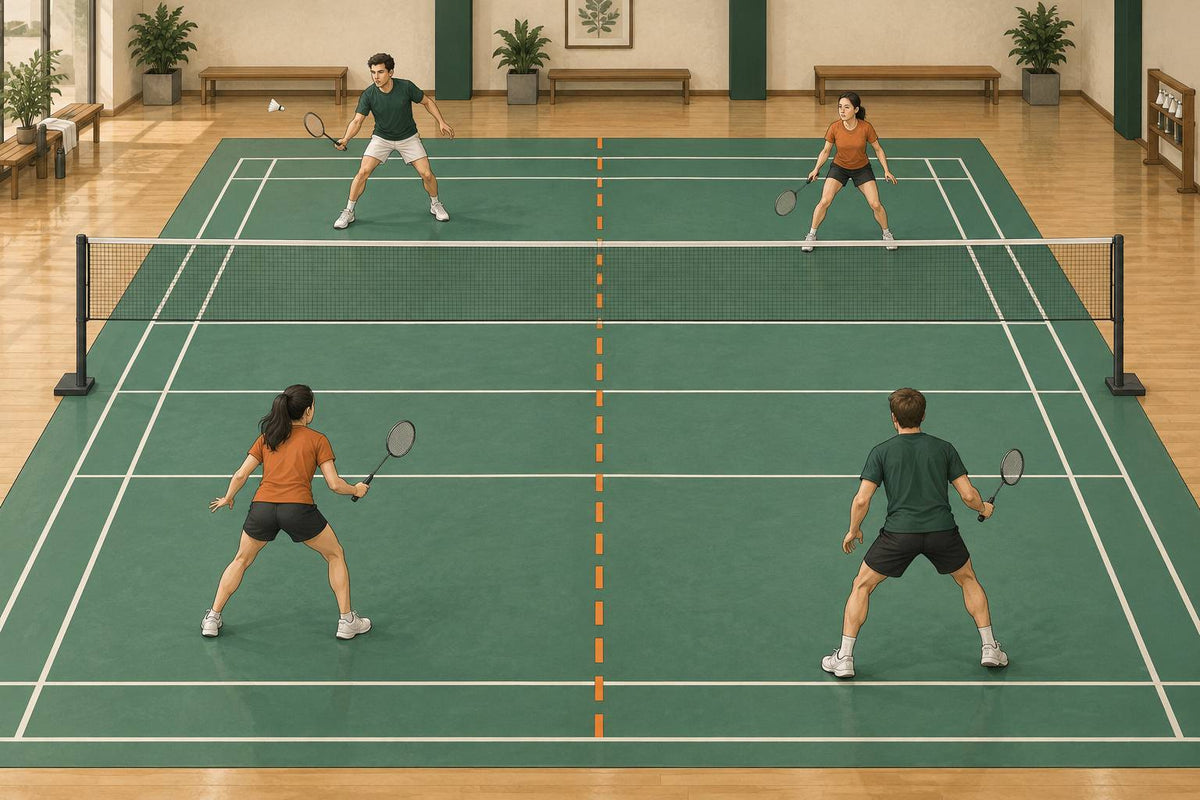
Half-court singles splits one court lengthwise at the centre line, so two games run side by side, each roughly 3.05 m wide, using the full 13.40 m length. With no room to escape cross-court, a rally only survives on length, disguise and a genuinely reliable straight shot. This guide covers three scored formats (straight-only rally, front-and-back only and serve-plus-three), what each one exposes, and how to share one court without arguments.
Start with straight-only rally
It is the simplest of the three to set up and the fastest at finding a weak backhand rear corner.
Related reading: Multi-Shuttle Badminton Drills — for feeder-driven repetition instead of scored games, multi-shuttle drills build the same shots without needing an opponent.
Straight-only rally: find a weak backhand corner fast
Straight-only rally restricts both players to hitting down their own half-court channel, so shots must stay within the same narrow channel. Play games to 11 or 15 points, serving straight into the same channel as a house-rule adaptation; call the other agreed faults as usual. Because cross-court is impossible, a weak backhand rear corner gets attacked on almost every rally and shows within a few points.
Split a full doubles-width court (6.10 m wide and 13.40 m long under the BWF Laws of Badminton) exactly at the centre line, and each channel comes out at roughly 3.05 m wide, narrower even than a full singles court's 5.18 m. Use the shared line as your channel's outer edge and the full length of the court behind you. Any shot that lands cross-court, wide of your channel, or in the net ends the point for your opponent.
Straight-only rally, and the two games after it, are Badminton House's own training designs, not formats drawn from any rulebook. The underlying method is not improvised, though: BWF's own coach education material describes restricting a player's shot choice while normal scoring continues as a way to isolate one skill, and each game below applies that same principle to a different constraint. To make straight-only rally harder, ban the lift for one game: only drives, drops and net shots count, which removes the easy defensive clear and forces faster decisions.
Front-and-back only: no safe midcourt
Front-and-back only bans the middle third of your half-court channel: a shot must land in the front third, near the net, or the back third, near the baseline, and never in between. Games run to 11 points. Removing the comfortable flat midcourt exchange forces constant transitions between net play and rear-court length, exposing slow recovery and hesitant net touch.
Mark the two dead-zone edges with flat tape one-third and two-thirds of the way from the net to each baseline; keep any cones outside the playing channel. A shuttle landing between those marks is out; crossing or intercepting it above the middle zone does not itself end the rally. The format punishes a player who defaults to a safe half-power drive, since that shot has nowhere legal to land. To raise the level, require alternating zones shot for shot: alternate front and back landing targets on successive shots while keeping each shot within the channel.

Serve-plus-three: win it in four shots or reset
Serve-plus-three caps every rally at four shots: the serve, the return, and two more. A winner or fault within those four shots decides the point. If neither player has forced an error or hit a clean winner by the fourth shot, call a let and replay the serve rather than let the rally drift on.
Both players know the count: shot one is the serve, two the return, three the attacking reply, and four the finish or the reset. That compresses exactly the sequence that decides most short rallies in a real match, so both players get repeated reps at building or denying an early advantage instead of settling into a long exchange. These constraint games are meant to stay short so players rotate through fast, unlike a full match played to 21 points across the best of three games. To make it harder, drop the cap to serve-plus-two so only three shots are live, or require a different serve each time (flick, low or drive) so the receiver cannot anticipate.
Sharing one court: line calls and where to stand
Two half-court singles games run side by side on one full court, so a club with more players than courts can put four people on at once instead of two waiting their turn. The shared centre line belongs to both games equally, and agreeing one fair call keeps both rallies honest.
Agree the convention before you start. Under the laws of the sport, every line on a court is part of the area it marks, so treat a shuttle that touches the shared centre line as good for whichever game is currently rallying. A shuttle that visibly drifts into the next channel mid-flight and could hit someone is a let, replayed rather than scored, never a fault on the player who hit it.
Between rallies, both servers and receivers should stand a half-step back from the shared line and keep their eyes up, and leave enough room for each player’s swing; stop either rally when a neighbouring shuttle or player creates interference. The posts and the net stay exactly where they always are, spanning the full width no matter which half either game is using, so nothing about the court setup itself needs to change.
Run it this session
- Tape or agree the centre-line channel, then start with straight-only rally to games of 11.
- Swap in front-and-back only once both players can hold a straight rally without drifting wide.
- Finish with serve-plus-three so every player gets fast, high-rep reads on the first four shots.
- Set the shared-line convention out loud before the first serve, not after the first dispute.



Leave a comment
This site is protected by hCaptcha and the hCaptcha Privacy Policy and Terms of Service apply.