
Last checked: August 2026 · Written by the Badminton House player-led team.
Quick answer: use the lane, then remove it
Run one known-choice baseline, two live two-choice tasks, and a constraint-off transfer check. The lane should make the decision easier to observe, not become a permanent substitute for full-court singles.
One pair
Best fit: adult or older-teen club players who already control straight clears, drops, lifts, and net shots.
Four tasks
Known location, rear-court choice, forecourt choice, then alternating half- and full-court points.
Stop
Reset for a loose shuttle, unsafe feed, lost footing, pain, dizziness, or anyone entering the court.
These half-court badminton singles drills have one narrow purpose: make a player's first decision visible, then see what remains when the width restriction disappears. They are Badminton House practice designs, not official match formats, rehabilitation, or research-tested performance programmes.
Need drills for two pairs sharing one court? Use the shared-court half-court drill guide. This session assumes one pair, one shuttle, and an empty neighbouring lane.
Why is this half-court singles session different?
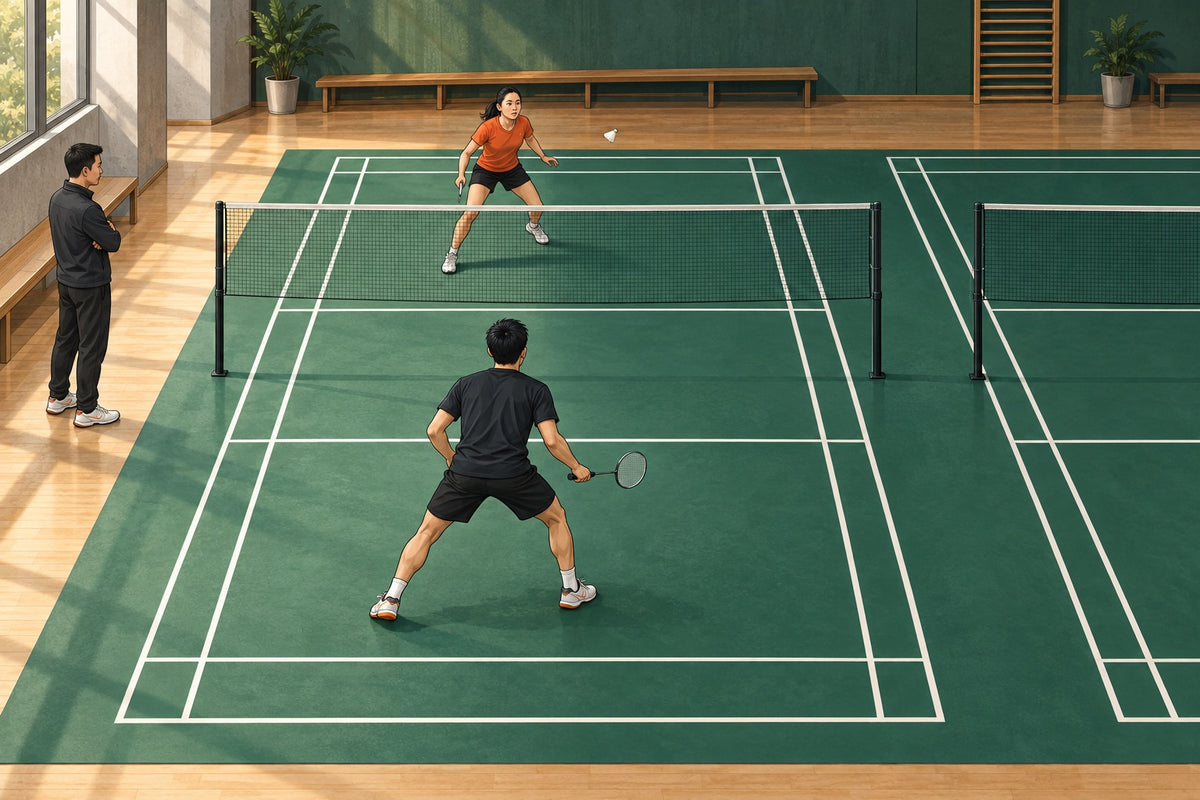
This session uses half a court as a temporary decision constraint, not as another catalogue of strokes. One pair progresses from a known straight route to two live choices and then removes the width restriction. Use it when the strokes already exist and the question is whether the player reads and organizes them.
The evidence supports restraint. A study of 12 youth elite UK players found that forward-lunge mechanics differed among handfeed, multifeed, and match-play conditions as unpredictability changed. It did not test learning, transfer, adults, or this session. Read the predictable-feeding study.
A separate study of 28 under-11 players found different stroke frequencies, variability, and play patterns when researchers shortened the court and lowered the net. That tells us a changed space can change observed play in that child population. It does not validate an adult half-width lane or promise match improvement. Read the under-11 modified-court study.
Treat the four tasks below as an observation ladder. If the player makes a clear first move in the known task but guesses in the two-choice task, keep the choice visible for longer. If the response holds in the lane but disappears on the full court, record that gap instead of claiming the drill has transferred.
How do you set the lane and the boundaries?
Use one full-length singles channel from the centre line to one singles side line. Both players stay in the same channel on opposite sides of the net, the other lane remains empty, and only one shuttle is live. Use the painted lines rather than placing cones in either movement path.
For this drill, a shuttle touching either channel edge is in. That matches the BWF rule that court lines form part of the area they define, but the half-width restriction is still your practice rule rather than an ordinary-singles law. See the BWF Laws and court diagrams.
Population and Para boundary: this article is written for standing adult and older-teen club players. The BWF Laws contain separate provisions and diagrams for Wheelchair Badminton and for standing classes that use half-court singles. Do not treat this temporary training lane as a Para court prescription. A Para coach should adapt space, feeds, recovery language, and mobility clearance with the athlete and their sport class.
Session stop rules: agree on the word “reset” before the first feed. Either player uses it for an untrackable shuttle, a loose shuttle underfoot, unsafe spacing, lost footing, pain, dizziness, or another person entering the court. Let the rally end, clear the space, and restart calmly. A player returning from injury should follow their existing clinician and coach plan rather than use this article as clearance.
Which four decision drills should you run?
Run the tasks in order: establish a known-location baseline, hide one rear-court choice, hide one forecourt choice, then alternate lane points with full-court points. The counts below make the session easy to operate. They are editorial choices, not optimal or research-validated doses, so stop a set sooner when control declines or safety is compromised.
1. Known-location baseline: two sets of six
The feeder calls “front” or “back” before sending one playable straight shuttle to that area. The worker moves, returns straight, and shows a balanced first recovery step. Alternate the two locations in a known order for six feeds, pause, then repeat. Swap roles after two sets.
Observe: did the first move match the called location, did the return stay in the lane, and did the player finish under control? This is the comparison task. It does not test anticipation because the answer is announced.
2. Rear-court two-choice: two sets of eight
The worker sends a comfortable straight lift. From the rear court, the feeder chooses a straight clear or a straight drop without calling it. The worker reads the live stroke, returns straight, and resets. Count only feeds that were playable enough to present a real choice; repeat an obvious mishit without charging the worker.
Observe: record the first movement error, not the final rally result. If the worker commits forward before the feeder contacts the shuttle, show the choice earlier or slow the feeder's action for the next set.
3. Forecourt two-choice: two sets of eight
The worker plays a gentle straight net shot. The feeder chooses a straight net reply or a straight lift. The worker responds once and both players reset. Keep the feeder's contact playable; the point is to distinguish a shuttle staying at the net from one leaving toward the rear court.
Observe: watch whether the worker waits long enough to read the contact, starts in the useful direction, and reaches a balanced hitting position. Do not add a third option yet. One hidden choice is enough for this comparison.
4. Constraint-off transfer: two six-point cycles
Play three rally points inside the half-court lane, then open the full singles court for three rally points. Repeat that six-point cycle once. Start each lane point with a neutral straight feed. When the full singles court opens, start each point with a normal singles serve. In either space, let the rally continue with any shot allowed by that task. The score is secondary; record which first decision changed when width returned.
Observe: compare one item only, such as the first move after an opponent's rear-court contact. If it remains organized in both spaces, keep that observation. If it changes on the full court, the result is a useful gap, not a failed player.

How do you progress or regress the choice?
Progress only the information demand: announced location, two live choices, then the same choice inside open play. Keep feed quality, lane, and observation stable while that demand changes. If the player starts guessing or the feeder loses control, make the choice visible again before adding pace, scoring, or another destination.
BWF Coach Education Level 1 includes planning and delivery of progressive coaching sessions. That supports deliberate progression as a coaching responsibility, not the exact thresholds below. See the BWF Level 1 overview.
| What you see | Next editorial choice | Keep constant |
|---|---|---|
| Fewer than six useful first moves in eight playable choices | Return to the announced version or show the choice earlier | Location, lane, and observation |
| Six or more useful first moves in two sets | Keep two choices and remove the verbal cue | Feed pace and return rule |
| Lane decisions hold but full-court decisions change | Alternate three lane points with three full-court points again | The single observation being recorded |
Six of eight is a practical session marker selected for this guide. It is not a pass standard or a forecast of match readiness. A coach may use a different count, but should state it before the set and avoid moving the target after seeing the result.
How do you record transfer and end the session?
Finish with a four-line note, not a claim that the session worked. Record the choice the player read, the first movement that broke, whether the same observation held on the full court, and the simplest opening task for next time. That creates a repeatable comparison without turning one booking into a performance verdict.
Four-line practice record
Choice read most cleanly: rear clear or drop
First repeated error: moved forward before contact
Full-court check: same cue held or changed
Next starting task: announced rear choice at slower pace
End immediately if the court is no longer clear, the feeding choices are no longer playable, or either player triggers a stop rule. Otherwise, finish after the second transfer cycle and leave the lane removed. The useful output is the next question to practise, not a promise that four drills have changed match performance.


Leave a comment
This site is protected by hCaptcha and the hCaptcha Privacy Policy and Terms of Service apply.