
Last checked: August 2026 · Written by the Badminton House player-led team.
Quick answer: make the narrow lane deliberate
Half-court badminton drills work when both players know the lane, the shot pattern, the switch point, and the stop call. Start cooperatively, add pace only while control remains, then introduce one free choice or a short score. The restriction should clarify the skill, not create a crowded miniature match.
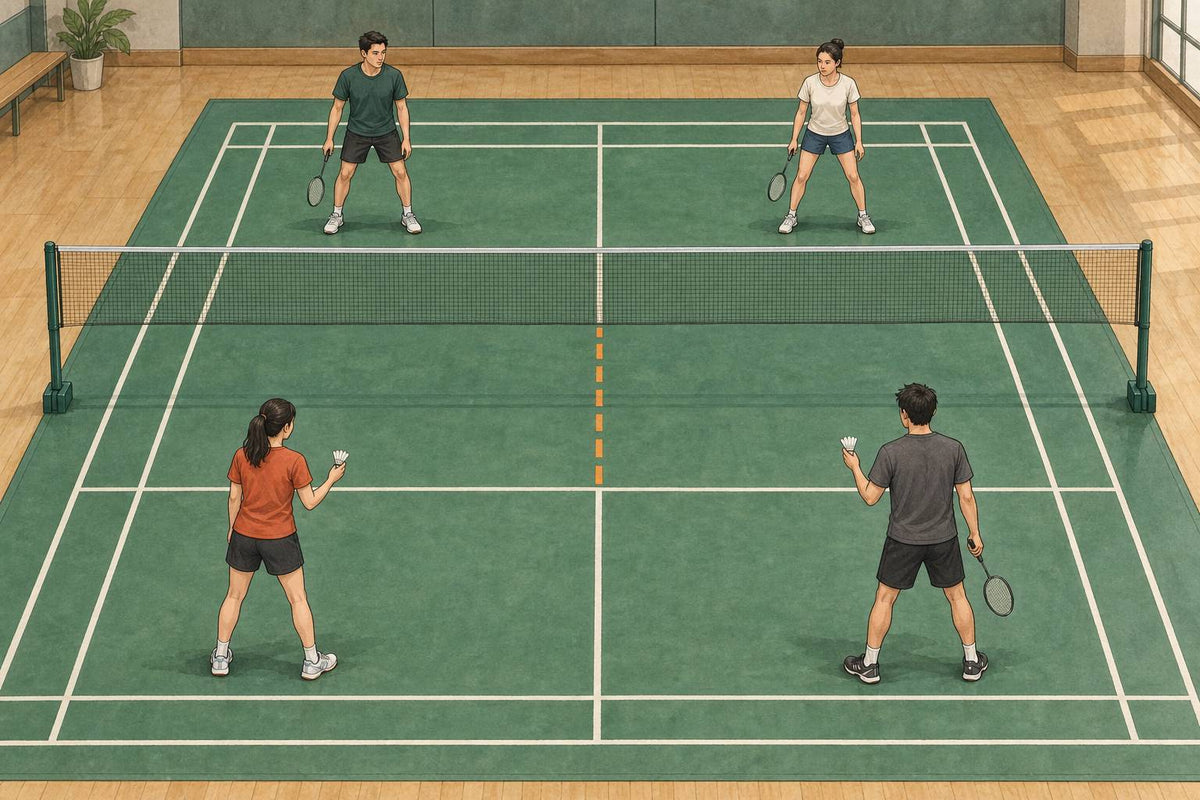
A busy club session does not have to become a queue. One court can support two active pairs when each pair owns a straight channel and everyone agrees what happens when a shuttle crosses the shared line. The lane also gives one pair a focused way to practise length, net control, drives, and recovery without needing a full court.
The timings and repetition counts below are starting choices, not universal prescriptions. Shorten a block when the pattern loses its purpose. Extend it only while both players still move safely and can identify the error they are trying to correct.
Need a broader partner session? Use our badminton drills for two players. This guide stays focused on the half-width constraint.
What does half-court practice train?
Half-court practice removes most lateral escape space, so each player must control height, length, direction, and recovery inside a straight channel. That makes a short clear, loose net shot, or drifting drive easier to notice. It does not reproduce full-width defence, wide recovery, or every cross-court attacking choice.
Use the full court length and one width channel, from a side line to the centre line. This is a training boundary, not a new official singles court. Under the BWF Laws, a line belongs to the area it marks; for a club drill, agree before starting whether the shared centre line counts as in and use the same call throughout. See the BWF court diagram and line rule.
A study of modified playing spaces in under-11 badminton found that changing the court constraint changed stroke frequency, variability, and play patterns. That supports the narrower point that space can shape a practice task. It does not prove that every adult improves from half-court work or establish one ideal lane size. Read the modified-court study.
How do you set up a shared lane?
Give each pair one side-line-to-centre-line channel, name the allowed shots, and choose one stop call before the first feed. If two pairs share the court, nobody crosses the centre line during a live rally. Rotate players and collect loose shuttles only after both lanes have stopped.
- Assign the lane. One pair takes the left channel and the other takes the right. Use the existing painted lines rather than placing objects in the movement area.
- Name the pattern. Say whether the rally is cooperative, fixed sequence, one-free-shot, or scored. Both partners should know the next legal choice.
- Choose a stop call. Anyone who sees a crossing player, racket, or shuttle calls “stop.” Both pairs let the rally die immediately.
- Set a switch point. Change feeder, starting player, or lane after a time block or completed patterns, never in the middle of a live exchange.
- Pick one observation. Track length, net height, recovery, or boundary control. One visible goal makes the drill easier to adjust.
Start at a pace that lets the receiver return to a useful base position. If the feed repeatedly arrives before recovery is possible, slow it or simplify the route. The purpose is to repeat a recognizable badminton movement, not merely to survive the next shuttle.

Which half-court badminton drills should you use?
Choose the drill that matches the fault you can see. Use the first four as controlled exchanges, then add choice through the last three. Each drill has a clear setup, one observation, and a next step so the pair can progress without changing several demands at once.
-
1. Straight clear gate
Exchange high, straight clears from rear court to rear court. Begin with six controlled returns or about 90 seconds. Watch whether the shuttle reaches useful depth without drifting over the centre line.
Progression: after three clears, allow either player to use one straight drop, then rebuild the clear exchange.
-
2. Clear, drop, lift
Player A clears, Player B drops, Player A lifts, and Player B clears to restart. Complete six to ten patterns, then swap the first hitter. Watch the drop height, lift length, and whether each player recovers after contact.
Progression: let the drop player choose fast or slow pace while the route stays straight.
-
3. Net shot and lift loop
Start with a straight net shot, lift to the rear court, play a straight drop, and return to the net. Work for 90 seconds to two minutes. Watch for a lift that stalls in midcourt or a net shot that sits above comfortable tape height.
Progression: add one controlled push after the net exchange, then return to the loop.
-
4. Midcourt drive channel
Both players stand around midcourt and exchange flat drives inside the lane. Count consecutive legal drives rather than winners. Watch preparation height, balance, and whether the exchange turns into uncontrolled lifts.
Progression: allow one direction change per sequence while both players remain in the lane.
-
5. Front-back movement route
A feeder alternates an easy rear-court shuttle and an easy forecourt shuttle in the same channel. The worker hits, recovers toward base, and moves again. Start with four to six complete front-back routes.
Progression: make the order less predictable only when the worker still stops under control and keeps the racket out of the neighbouring lane.
-
6. Pattern plus one free shot
Begin with three named shots, such as clear, drop, lift. After the third shot, either player may choose one free reply. Play five short rallies, then switch who starts. Watch whether the free choice improves reading or simply destroys the pattern.
Progression: permit two free shots after both players can organize the one-choice version.
-
7. Half-court singles game
Play full length inside one lane to 7 or 11. A shuttle outside the lane ends the rally. This is a club practice format, not ordinary BWF singles. Watch whether the narrow court creates lift-only rallies or encourages controlled changes of pace.
Progression: add one condition for one game, such as no smash or one required net shot. Our half-court singles drill develops this version further.
How do you progress without losing quality or safety?
Change one variable at a time: width, pace, predictability, freedom, or scoring. A practical order is a cooperative full-width pattern, the same pattern in one lane, one free shot, then a short scored game. If a new error overwhelms the intended skill, return to the last stable version.
That order follows the BWF coaching manual’s broad progression from simple to complex, slow to fast, and predictable to unpredictable. It is a teaching principle rather than a fixed timetable, so the pair can spend longer at any step that still produces useful practice. Read the BWF Level 1 coaching manual.
- Pause crossing shuttles: a shuttle entering the other lane makes both rallies dead.
- Keep bodies and rackets inside: do not reach or step into the neighbouring channel to save a rally.
- Collect together: wait for both lanes to stop, put rackets down, then retrieve shuttles.
- Stop the block: pause if the floor becomes slippery, traffic grows unpredictable, or either player can no longer control the lane.
Finish by naming one fault the restriction exposed and one drill to repeat next time. If length failed, return to the clear gate. If recovery failed, use the front-back route at lower pace. If choice failed, rebuild the fixed pattern before scoring. The badminton practice session plan can place the chosen block inside a longer session.


Leave a comment
This site is protected by hCaptcha and the hCaptcha Privacy Policy and Terms of Service apply.