
Last checked: August 2026 · Written by the player-led team at Badminton House
Quick answer: handicap badminton
For a club game, give the developing side a clearly announced points head start, keep the target at 21, and change only one allowance after a complete game. If you are using the formal BWF handicap provision, its 21-point halfway triggers are 11, not a separate target score.
Club start
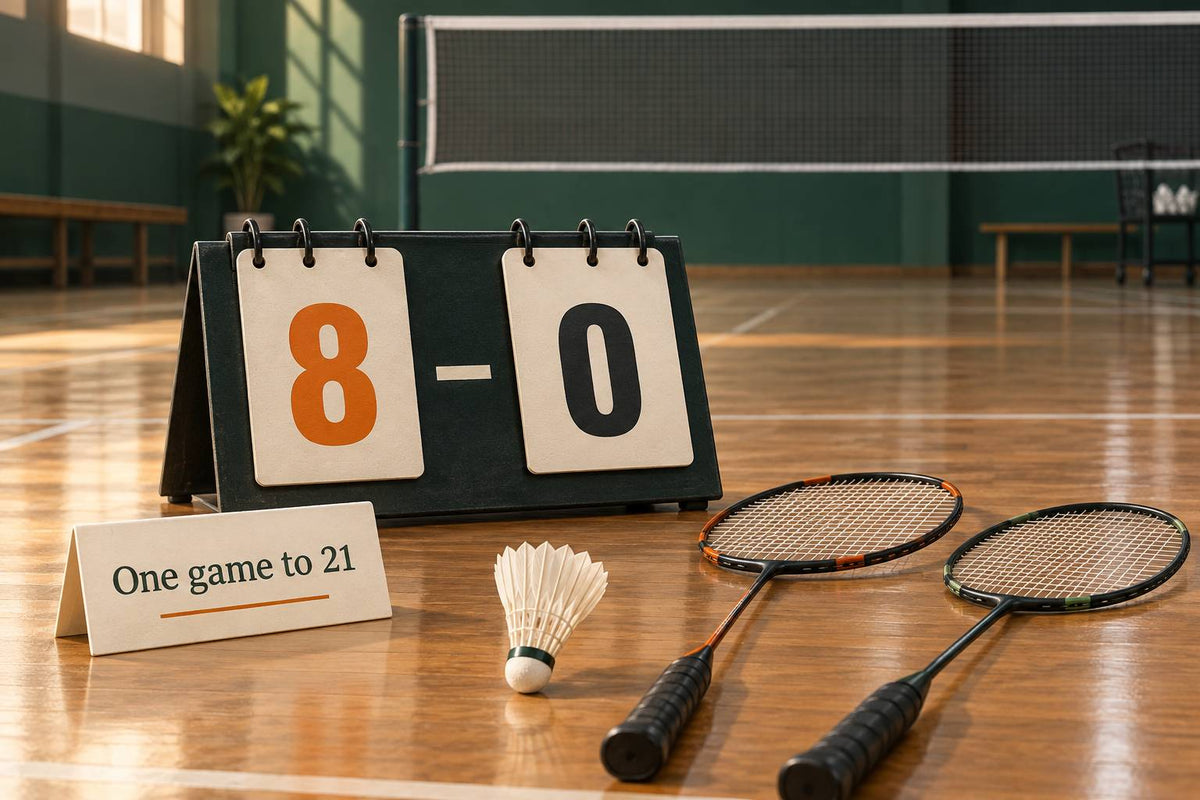
Write the opening score down. “One game to 21; Pair B starts at 8–0” is clear. The size of that start is a local choice, not a universal BWF table.
At 11
In a formal handicap match to 21, the third-game or one-game end change is when either side reaches 11; the in-game interval condition is when the leading score reaches 11.
Next game
Review both the score and the rallies. Move the head start a little only when the game was still plainly one-sided.
A handicap game is useful when two players or pairs can rally but the ordinary score never feels uncertain. The most dependable club version is a points head start: one side begins with points already on the sheet, while the normal target and ordinary badminton decisions remain visible. The head start is not a label for either player. It is a temporary setting for this matchup on this night.
Different job, different guide: for other local handicap choices such as shot conditions or a short test game, read our badminton handicap scoring guide. This page concentrates on the score-sheet mechanics of a head start and the formal BWF exceptions.
How do you set a clean head-start game?
Use one sentence before the toss: “One game to 21; Pair B starts at 8–0; we will review the start after the game.” The usual pre-match toss still determines who serves or receives first, or which end to start from. A score of 8–0 does not by itself decide the first server. The BWF Laws of Badminton set out that toss procedure.
Keep the target visible. The formal BWF Handicap Matches provision says the score required to win does not vary from Law 7. In ordinary current Law 7 scoring, the game is first to 21; from 20-all a two-point margin is needed, and 30–29 is the cap. A head start changes the starting score, not the finish line.
A useful first rule for a club
Start modestly enough that the stronger side still has to build points and the developing side still has to win rallies. If an 8–0 start produces a 21–3 finish, the issue may be too large for a score adjustment to create useful practice. Change partners, shorten the court task, or choose a coaching game instead of making the head start extreme.
What happens in an 8–0 game to 21?
Suppose Pair B begins at 8–0. Pair B wins the next three rallies while Pair A wins four, so the sheet reaches 11–4. The finish target remains 21. In a formal handicap match played as one game, Pair B has reached 11, which is half of 21 rounded up, so this is the end-change point. Pair B is also leading at 11, so it meets the condition for the permitted in-game interval.
| Score-sheet moment | What it means | Why |
|---|---|---|
| Before the first serve: 8–0 | Pair B has the agreed local head start. | The start is the club’s announced allowance. |
| Pair B reaches 11 | Change ends in a one-game formal handicap match. | Ceiling of 21 divided by 2 is 11. |
| Leading score reaches 11 | The permitted in-game interval condition is met. | The formal provision uses the leading score at half the target. |
| 20–20 | The usual two-point finish applies. | The winning target is not changed by the formal handicap provision. |
Notice the two different words in the provision. The end change uses one side reaching half the target. The interval uses the leading score reaching half the target. Record both on the score sheet before play begins rather than casually borrowing the ordinary non-handicap third-game rule.
How should a club adjust the head start?
Do not calculate a permanent ranking from one game. Instead, write one result and one observation: “8–0, Pair A won 21–15; Pair B reached the net but could not convert short returns.” If the result was still comfortably one-sided, add a small amount for the next game. If the game was close and both pairs had useful rallies, leave the number alone once before changing it again.
- Keep the target fixed. Use the same 21-point finish for the test and the review.
- Change one variable. Move only the starting score, not the start and a shot ban at the same time.
- Set the next score aloud. For example, “Next game starts 10–0; same target; same review after 21.”
- Stop escalating when rallies disappear. A large lead cannot repair a pairing in which one side cannot safely or meaningfully enter exchanges.
In doubles, give the starting points to the pair, not separately to each player. The score belongs to the side, so the two partners use the normal doubles service and rotation sequence from that shared score. Keep the allowance on the event sheet beside the pair name so a substitute scorer is not forced to guess.
The rule to write before anyone serves
Name the target, starting score, first-service procedure, 11-point triggers if the formal handicap provision applies, and one review point after the game. That makes a head start a shared format rather than a mid-game negotiation.

Leave a comment
This site is protected by hCaptcha and the hCaptcha Privacy Policy and Terms of Service apply.