
Last checked: August 2026 · Written by the Badminton House player-led team.
Quick answer: how do you start a badminton club?
Secure a recurring indoor venue before recruiting, get its equipment and insurance requirements in writing, price the full season rather than only the court hour, and launch with a capped roster plus named safety and session leads. Treat the first month as a pilot.
Venue
Ask first: recurring dates, marked courts, posts, nets, storage, access, cancellation, insurance, and the complete price.
Pilot cap
A conservative starting choice is six players per court: four playing and two in a visible rotation. Adjust from observed waiting time.
Owners
Name who holds the booking, tracks money, leads the session, and takes charge or calls for help in an emergency.
A badminton club becomes real when the weekly operation works without one organiser improvising every decision. The logo, name, and group chat can wait. First settle who grants access to the gym, what the room includes, what every session costs, who may attend, and who acts when something goes wrong.
Starting something lighter? If you only need to organize recurring games for a small adult group, use our badminton drop-in launch guide. This article covers the extra venue, finance, governance, insurance, and safeguarding questions that come with calling the program a club.
Ask the venue for a written club offer
Tell the community centre that you want recurring indoor badminton, not a single social booking. Ask which application or permit applies, how far ahead dates are released, whether the same time can be retained, and what can displace the booking. Municipal language differs: the City of Guelph, for example, treats five or more rentals as seasonal, while the City of Toronto publishes its own recreation-facility booking routes. Neither example defines a Canada-wide process.
| Get in writing | The exact question | Why it changes the club plan |
|---|---|---|
| Space | How many playable badminton courts are marked, and what run-off areas are shared? | Sets the initial roster and whether coaching can run beside games. |
| Equipment | Are posts and nets supplied, set up, stored, or charged separately? | Prevents a first night with courts but no usable nets. |
| Access | Who unlocks, when can setup begin, and when must everyone leave? | Turns the paid booking into the actual playing window. |
| Conditions | What insurance, supervision, footwear, cleanup, cancellation, and incident-report rules apply? | Defines obligations before money or registrations are accepted. |
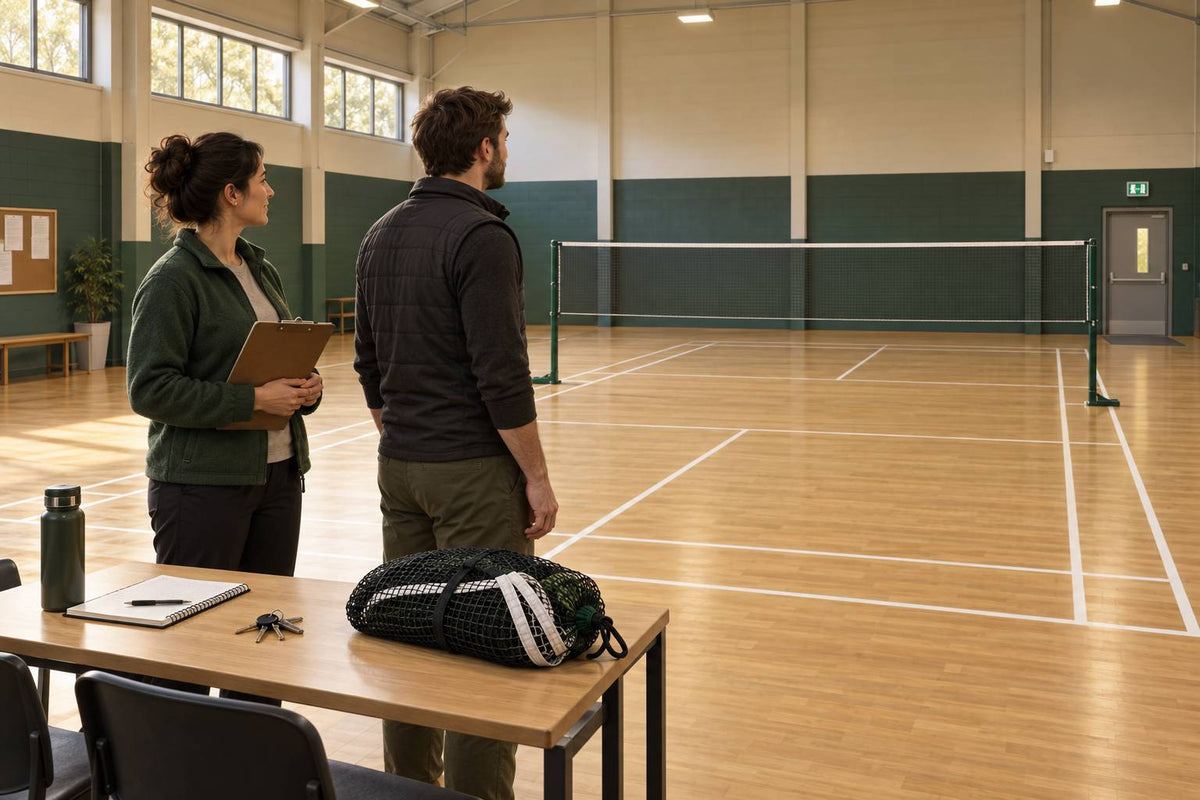
Never assume “gym rental” includes the badminton setup. Guelph says posts are available but renters bring nets and rackets; Calgary's Village Square gymnasium says staff set up nets while users bring or rent rackets. Inspect the actual room and record its floor, lighting, ceiling, court lines, storage, washrooms, accessibility, and emergency exits.
Build the budget from the complete quote
Ask for the all-in cost of the dates you intend to run. The headline court rate may omit staff, setup, taxes, risk fees, insurance, storage, or cancellation exposure. Calgary, for example, publishes prime and non-prime gymnasium rates plus a separate risk-management fee. Use the quote for your venue, not a rate copied from another city.
A transparent pilot formula is: (fixed season costs + expected session costs + a modest reserve) ÷ expected paid player-sessions. Keep the assumptions beside the result. If ten sessions cost $1,650 in venue and required fees, the club expects $240 in shuttles, and keeps a $150 reserve, the total is $2,040. With twelve paid places for ten nights, the break-even amount is $17 per player-session. This is a worked planning example, not a recommended Canadian fee.
Publish the money rule before taking payment
State what the fee covers, when it is due, whether a missed night is refundable, how a waitlisted player takes a spot, who approves spending, and what happens to any season-end balance. Keep a simple record of money in and money out.
For a first doubles-based pilot, six registered players per court is an understandable starting cap: four active and two rotating. It is not an occupancy or federation standard. Track how long people sit, how quickly games change, and whether beginners get meaningful court time. If the cap is wrong, change it for the next registration block rather than quietly overselling the current one. Our club court-rotation guide gives several visible queue options.
Confirm insurance, affiliation, and safeguarding
Ask the venue what proof it needs and which activities the policy must cover. Requirements can be specific: Vancouver's facility-use insurance guidance requires proof before permission and specifies at least $2 million in commercial general liability coverage with additional-insured wording in that municipal context. That is a Vancouver example, not a universal minimum.
Then compare the venue route with provincial affiliation. Badminton BC's 2026–27 club package includes a $5 million certificate of insurance, while Badminton Ontario publishes a separate club insurance program. Coverage, eligibility, participant registration, and fees differ, so obtain the current terms that apply to your province and activities. A waiver does not replace venue approval or insurance.
If coaches, volunteers, or minors are involved, document the safeguarding process before registration. The Coaching Association of Canada's Responsible Coaching Movement organizes leading practice around the Rule of Two, background screening, and ethics training. Confirm the exact municipal, provincial, sport-organization, and venue requirements that govern your club. Badminton Canada's national safe-sport process applies to participants under its national authority; it should not be assumed to replace a community club's local obligations.
Write one operating sheet for members and volunteers
Keep the first version short enough to read before joining. It should identify the purpose and playing level, dates, player cap, registration and waitlist, fees, cancellations, footwear and equipment, court rotation, conduct, photography choice, injury reporting, and who can make a session decision.
| Role | Owns before play | Owns during play |
|---|---|---|
| Club lead | Venue agreement, calendar, policies, and named backups | Final local operating decision and venue contact |
| Session lead | Roster, court plan, equipment, and opening briefing | Rotation, conduct, stop time, and pack-down |
| Finance lead | Budget, payment record, and approved purchases | Records exceptions rather than changing fees at the door |
| Emergency team | Facility address, exits, phone, first-aid location, and participant information process | Carries out the distinct charge-person and call-person responsibilities assigned before play. |
The charge-person and call-person split follows the NCCP Emergency Action Plan framework. Walk through it in the actual building: confirm the address, entry door, phone coverage, first-aid and AED locations, who meets responders, and how an incident is recorded. Do not wait for an emergency to discover that only one volunteer knows the plan.
Run a four-week pilot before expanding
Invite only the roster the confirmed courts can serve. On the first night, arrive early, inspect the floor and setup, name the session and emergency leads, explain the rotation, and finish with enough time for pack-down. Afterward, record attendance, waiting time, shuttle use, incidents, money collected, and one operating problem.
- Week one: test access, setup, briefing, rotation, and closing time.
- Week two: keep the same rules and correct only a clear safety or access issue.
- Week three: compare attendance, waitlist demand, actual cost, and court time with the plan.
- Week four: publish the next block's cap, fee, rotation, volunteer roles, and any single rule change.
Expand only when the venue, budget, volunteers, and player experience all support it. A dependable twelve-person club is a stronger foundation than a forty-person list attached to one overwhelmed organiser.


Leave a comment
This site is protected by hCaptcha and the hCaptcha Privacy Policy and Terms of Service apply.