
Last checked: August 2026 · Written by the player-led team at Badminton House
Quick answer
BWF sets out a staged Shuttle Time programme and allows teachers to select, repeat, and adapt lessons for pupil level. The cited manuals do not compare one universal timetable or establish a universal learning or concentration outcome.
Start with Use the sequenced programme as a progression framework
Use the staged programme and its flexible lesson components to plan one group’s session. The cited material supports adapting selection, timing, and difficulty for pupil level; it does not prove that a single 60-minute order improves learning or concentration for every child.
- State one session goal before selecting activities.
- Use the BWF components as a planning frame, then adapt timing and task difficulty to the group.
- Finish with a short review of what the teacher delivered and observed.
- Use that observation to select, repeat, or adjust a later lesson rather than treating one timing pattern as universal.
Related reading: Teaching Badminton in Schools: A 6-Lesson PE Unit Plan — for planning a broader multi-lesson school sequence.
Use the sequenced programme as a progression framework
BWF Shuttle Time is a sequenced schools programme that moves from Starter Lessons to Swing and Throw, Throw and Hit, and Learn to Win activities. The programme overview lists the lesson modules and their intended sequence. BWF Shuttle Time Manual

The session sequence gives a coach a planning frame, not a fixed clock. A review lets the teacher summarise the focus and use what was delivered and observed when planning a later session. Teachers can select, repeat, and adapt the staged work for pupil level rather than assuming every child must follow the same path.
Use the BWF format as flexible components
BWF’s general format lists a five-minute introduction, 30–40 minutes of physical development, 20 minutes of technical or tactical activity, and a five-minute review or cool-down. Lessons are designed for 60 minutes, but timing may be shortened and components interchangeable. BWF Shuttle Time Manual

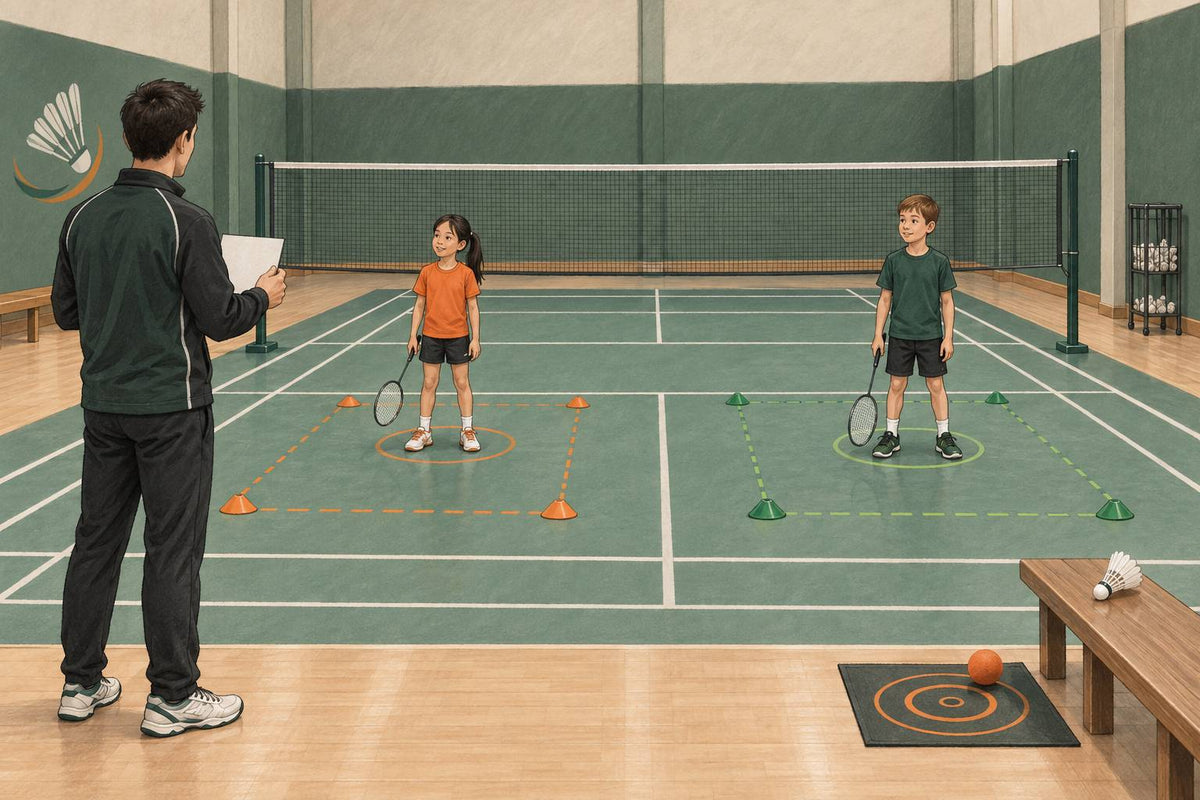
Those printed components give a coach a usable frame, not an outcome guarantee. The manual explicitly allows a shorter lesson and interchangeable parts, so a local plan can preserve the learning focus while changing duration, activity difficulty, or order for the group in the hall. As a local group-management choice, record the space and rotation arrangement beside the activity; Shuttle Time gives examples for groups, practice areas, and rotations but does not prescribe one layout for every group.
Adapt activity difficulty and warm-up intensity to the group, then review the session
BWF says session intensity and frequency should be adjusted to the group and individual, and that planned sessions need stated goals plus review and evaluation. Use that boundary to observe one group’s response, adjust the next activity, and review what happened rather than assuming one sequence suits every child. BWF Shuttle Time Manual and BWF Level 1 Manual

The cited manuals do not test whether one universal order improves learning or concentration. A coach can make a local management choice about space and turns, then record what the group actually completed and use that observation—not an assumed universal timetable—to change the next session.
Build the next session from a short review
- Choose one age-appropriate goal, then use the BWF components as a frame rather than as a universal clock.
- Record local space and rotation choices for the children and hall present; they are management choices, not a BWF-prescribed layout.
- Shuttle Time places Swing and Throw before Throw and Hit, while allowing teachers to select, repeat, and adapt work to pupils’ level.
- End with one observation about the activity, space, or explanation to test in a later session.
A concise note preserves what the group actually practised while leaving the next session open to a shorter timing, changed activity, or different order.
Review one session goal
| End-of-session note | What to record |
|---|---|
| Stated goal | The one age-appropriate goal selected before play |
| Activity completed | What the group actually completed |
| Next local adjustment | One change for the next session, not a universal timetable |
Questions the cited sources do not settle
- The cited manuals provide lesson examples and a flexible format; they do not compare one fixed age-specific 60-minute script with alternatives.
- A universal learning, enjoyment, retention, or safety outcome from a fixed activity order.



Leave a comment
This site is protected by hCaptcha and the hCaptcha Privacy Policy and Terms of Service apply.