
Last checked: August 2026 · Written by the player-led team at Badminton House
Quick answer: King of the court
Use one designated court, short games and a visible rotation rule. Make the game length and the constraint serve the skill you want to see, then change them when the session needs a different challenge.
Default
To 7: enough rallies to settle into a pattern while keeping a clear reset point.
Fast
Use a 90-second block when you want rapid partner changes and the group already understands the rule.
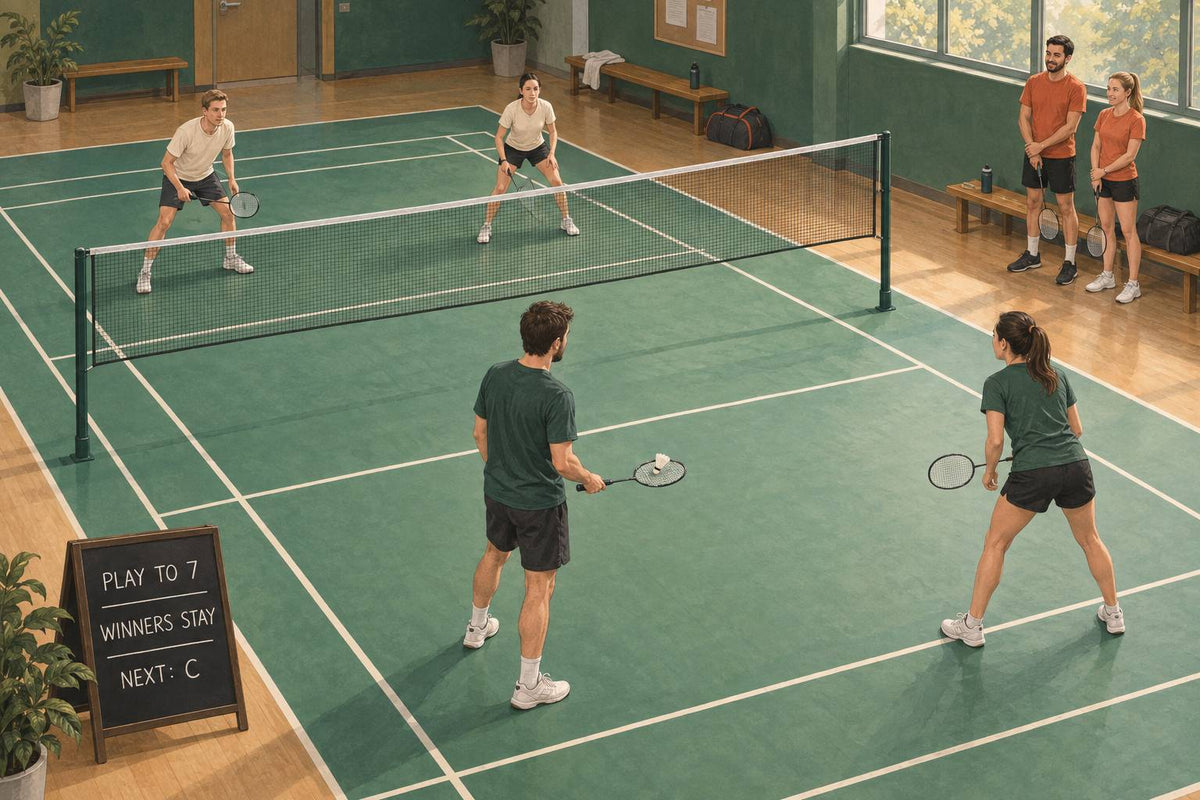
King of the court badminton is a club-training format in which one pair, or one singles player, occupies the featured court and a new challenger comes on after each short game. It is an organiser-made practice game, so state the rotation, score and learning constraint before the first serve.
Keep the purpose narrow. This is a training format, not a fairness system for a social drop-in. For a court-sharing method, see our badminton club court rotation system.
Set up one court and one visible rule
A workable king-of-the-court court needs a named starting side, a challenger order and one rule for who stays after a game. Put the next pair beside the court, keep the score caller obvious, and use the same sequence for a whole block so players spend less time negotiating than playing.
For doubles, place Pair A on the court as the first “king” and list the remaining pairs in a fixed order. Play a game. In this Badminton House option, the winning pair remains and the losing pair goes to the end of the list; the next listed pair challenges. The organiser calls the score, then points to the next pair before the new serve. That small habit avoids the familiar pause in which four people ask who is on next.
Give every arriving pair the same two questions: which end are you starting at, and what is today’s constraint? Do not add a third conversation while the next game is waiting. A whiteboard with “court pair”, “next pair”, score target and constraint is enough. If partners are changing, write the names in pairs before the block starts rather than rebuilding the list after each game.
Choose the opening king by a simple method that does not become the session’s story: the first ready pair, a coin toss, or the pair assigned by the organiser. The format becomes confusing when people treat that first placement as a ranking. It is only the place from which the first rotation begins.
Use one shuttle condition for the block if possible. A mid-block shuttle change is sometimes necessary, yet it also changes the immediate question the players are solving. When you change it, say so clearly and allow one familiarizing rally before the next scored game. That preserves the value of comparing decisions across the block.
The format borrows the shape of a game, yet its score is locally chosen. BWF’s standard Laws set a normal game at 21 points and a match as best of three unless otherwise arranged; that is useful context, not a reason to make a training rotation run to 21. BWF Law 7 also uses rally scoring, which makes a short target easy for a group to follow.
| Board line | Example | Why it matters |
|---|---|---|
| Court pair | Ava / Noor | Everyone can see who currently owns the court. |
| Next pair | Mika / Sam | The change is decided before the last rally ends. |
| Block | To 7, winners stay | Players know the target without asking the organiser. |

Choose the game length for the behaviour you want
Shorter games produce more arrivals, while longer games give a pair more time to notice and adapt to the same opponents. Choose one length for a block rather than changing it after every result; then the group can compare its decisions under the same conditions instead of reacting to a shifting format.
Try to 5 when the session starts late, the group is new to the format, or you are using a simple constraint. It creates a rapid turnover, but a pair can lose before it has tested an adjustment. To 7 is a practical default: teams usually have time to see a pattern, talk briefly between rallies and try one response. To 11 gives more room for tactical adjustment, although the queue moves more slowly.
A timed 90-second game is another editorial option. Start a visible timer, finish the rally at the signal and let the leading side win. This works best after one scored block, because players need to understand the winner-stays rule before time pressure is added. Use a score target when you want the end point to feel clear; use time when the organiser needs the block to end at a precise moment.
Keep an end condition for ties. One simple choice is next point wins. Announce that choice first. The point is not to imitate formal competition; it is to prevent an extra discussion from swallowing the next group’s turn.
Add one constraint to make the game a practice
A single constraint turns a rotating game into a focused practice because it tells players which decision to repeat under score. Start with a simple, observable rule, keep it for several games, and remove it if players cannot explain it or the rallies stop before the intended skill appears.
Use “the rally starts from a lift” when you want the attacking pair to build an attack and the other pair to organize defence. Use “serve must be low” when the group needs repeated attention to the first exchange. Use “no overhead clear after the first two shots” when the intended question is whether a pair can create width with drives, pushes and net shots. These are coaching choices, not BWF regulations.
The BWF Level 1 manual describes progressive practice as moving from simple to complex, slow to fast and predictable to unpredictable. It also describes differentiation: players can work on the same skill while using different practice levels. That coaching guidance supports a useful organiser choice: keep the overall game shared, then adjust the rule for a newer or more experienced pair.
- Newer group: announce the permitted first shot and let the rally continue normally.
- Mixed group: give the stronger pair a narrower target, such as earning its first point only after a net exchange.
- Established group: add a bonus point for the intended pattern, then remove it after a few games and see whether the habit remains.
Do not stack three constraints at once. Players then remember a rule sheet rather than reading the rally. One constraint creates a useful post-game question: did the pair create the required situation, and what stopped it when it did not?
Stop a long run and adapt the format for singles
A win cap keeps the featured court useful when one pair is repeatedly stronger than the challengers. Set the cap before the block, move a capped pair off after its final allowed win, and keep the rest of the rotation unchanged so the response feels like a planned format rule rather than an argument about ability.
For example, cap a pair at three wins. After win three, send that pair to the back of the list and promote the last challenger, even if the challenger lost. The next listed pair comes on as normal. If the group is close in level, use a higher cap or none at all. If the purpose is to give many pairings a turn against a strong pair, use a lower cap and say so at the start.
A second option is to split the winners. After a pair wins twice, each player partners someone from the waiting list for the next game. This changes the social and tactical problem, so use it only when partner mixing is part of the session’s purpose. Do not describe either option as universally fair; they are tools for an organiser’s stated outcome.
For singles, keep one player on the court as king, line up the challengers and play to 5 or 7. A whole-court game can be demanding, so choose a score target that lets players reset their attention between turns. You can use the same lift-start, serve or shot-selection constraints, but write the rule in singles language: one player must create the chance, recover to base and finish the rally without a partner covering the next shuttle.
Run the next block
- Write the court pair, next pair, score target and one constraint.
- Play four games without changing the format.
- Ask what pattern the constraint produced, then keep, simplify or replace it for the next block.



Leave a comment
This site is protected by hCaptcha and the hCaptcha Privacy Policy and Terms of Service apply.