
Last checked: August 2026 · By the player-led team at Badminton House
Quick answer: king of the court badminton ladder
Put fixed pairs on numbered courts, play short rounds, then move winners one court up and losers one court down. The top-court winner and bottom-court loser stay put, so everyone always knows where to go.
Default
To 7: short enough for regular court changes, long enough to settle into a real game.
Partners
Keep pairs fixed for the whole block if the point is current-level grouping; mix only in a separate social round.
Purpose
A local club format, not an official ranking or a replacement for formal match results.
A king-of-the-court badminton ladder is a multi-court format: winners climb toward Court 1, losers move toward the bottom court, and the group gradually finds competitive pairings for that session. It works best when the organiser writes the movement rule before the first serve and lets the same rule run long enough to become automatic.
Do not confuse this with the one-court version. For a featured-court, winner-stays training game with tactical constraints, use our king-of-the-court badminton format. This guide is for a ladder across several courts.
Set the ladder before anyone serves
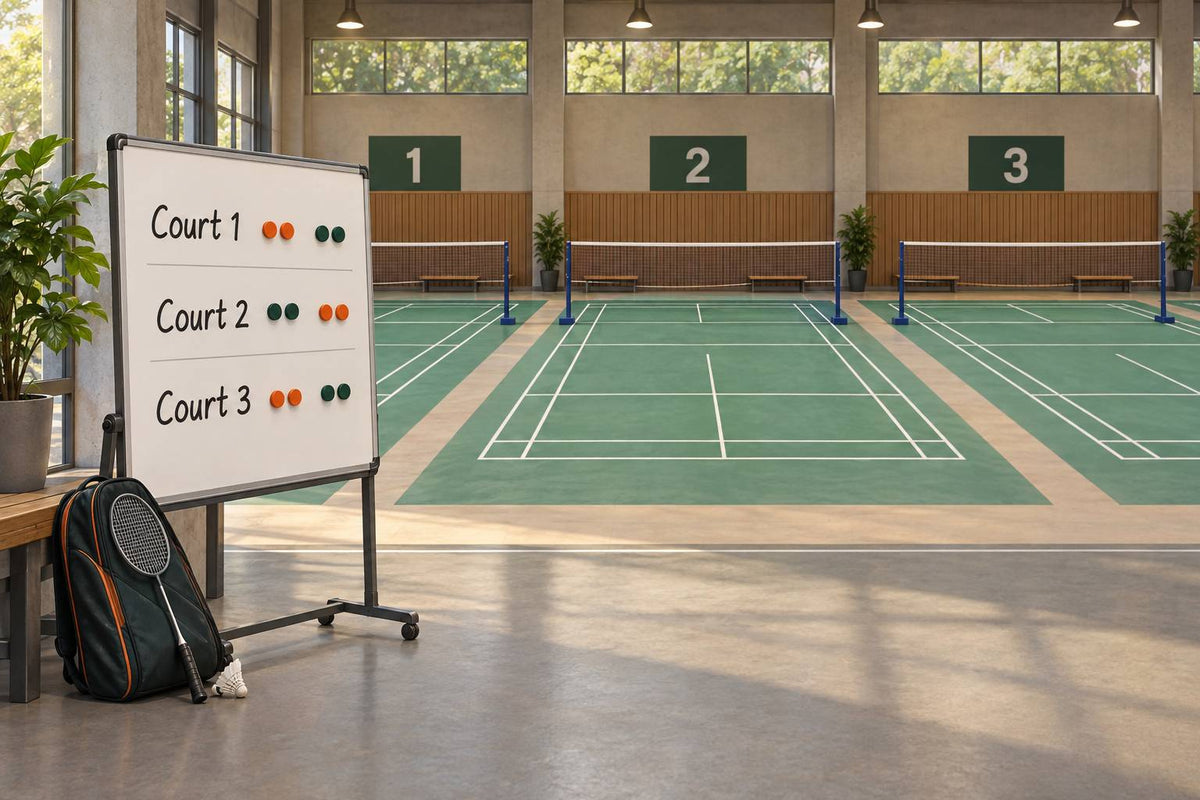
Number the courts from strongest end to development end, put one pair on each side, and make the first round a seed round. Do not call the opening order a ranking; it is simply a starting place. The movement rules below are editorial local rules designed to remove the between-round debate.

| Court after a round | Winning pair | Losing pair |
|---|---|---|
| Court 1 | Stay on Court 1. | Move down to Court 2. |
| Middle court | Move up one court. | Move down one court. |
| Bottom court | Move up one court. | Stay on the bottom court. |
Write Court 1 at the top of a board and list the pairs on their starting courts. Give every pair the same two pieces of information: game target and movement direction. A visible system is kinder than an organiser trying to remember who won where.
Use short rounds and a clean reset
Play to 7 for six to eight rounds, allowing about a minute for the move. When a game reaches 6–6, use next point wins. If time, rather than score, matters most, ring a bell at four minutes and let the leading pair win; announce the tie rule before the block starts.
Short games are a local coaching choice, not standard BWF match scoring. The Laws set a normal game at 21 points within a best-of-three match, while the Badminton Leaders Handbook gives coach-selected examples of games to 5, 7, or 10 points. BWF Laws and the coaching handbook make that distinction clear: name your local format and make it easy to follow.
- Round one: seed the ladder and let people learn the movement pattern.
- Rounds two to six: use identical score and movement rules; do not add handicaps mid-block.
- Final round: either keep the ladder running or freeze courts and play one longer game. Say which one before the prior round starts.
Choose fixed pairs or a social variation
Fixed pairs make the ladder readable: the same pair moves because of its own result. This is the default when the group wants competitive doubles. If the goal is meeting players, finish the ladder first, then run a clearly separate mixed-partner round; changing partners every round makes court movement look more meaningful than it is.
Simple organiser options
- Newer players: play to 5 and use a relaxed first serve so the rally starts more often.
- Established doubles group: play to 7 with ordinary serves and fixed partners.
- Large group: make one court a waiting/rotation court only if you can state exactly how a pair re-enters; otherwise run fewer courts cleanly.
Badminton coaching materials use organised rotations and groups taking turns to play; a ladder applies that same clarity to a club block. See the rotation examples. The test of a good system is simple: every player knows where to go when the shuttle lands.
Keep the ladder competitive without making it hostile
The ladder is useful when it produces better-matched games, not when Court 1 becomes a status symbol. Call the results, reset promptly, and let players try again on the next round. A pair that stays low has more repeats against an achievable opponent; a pair that climbs earns a fresh problem at the next court.
Use the final board only as a snapshot of that block. Do not publish it as a club ranking unless your club has separately defined a real ranking system, attendance rules, and a way to handle absent players. For an ordinary training night, the better closing question is: which court produced the most useful games, and what should we change next week?

Leave a comment
This site is protected by hCaptcha and the hCaptcha Privacy Policy and Terms of Service apply.