
Last checked: August 2026 · Written by the Badminton House player-led team.
Quick answer: Is a shuttle from another court a let?
No. An outside shuttle is not automatically a let. Stop and replay only when the umpire, or a player on an unumpired court, judges that it materially obstructed or distracted play.
Default
Keep playing: an outside shuttle that does not obstruct or distract the players does not automatically create a let.
Stop
Call attention to a genuine obstruction, distraction, or safety risk while the rally is still active.
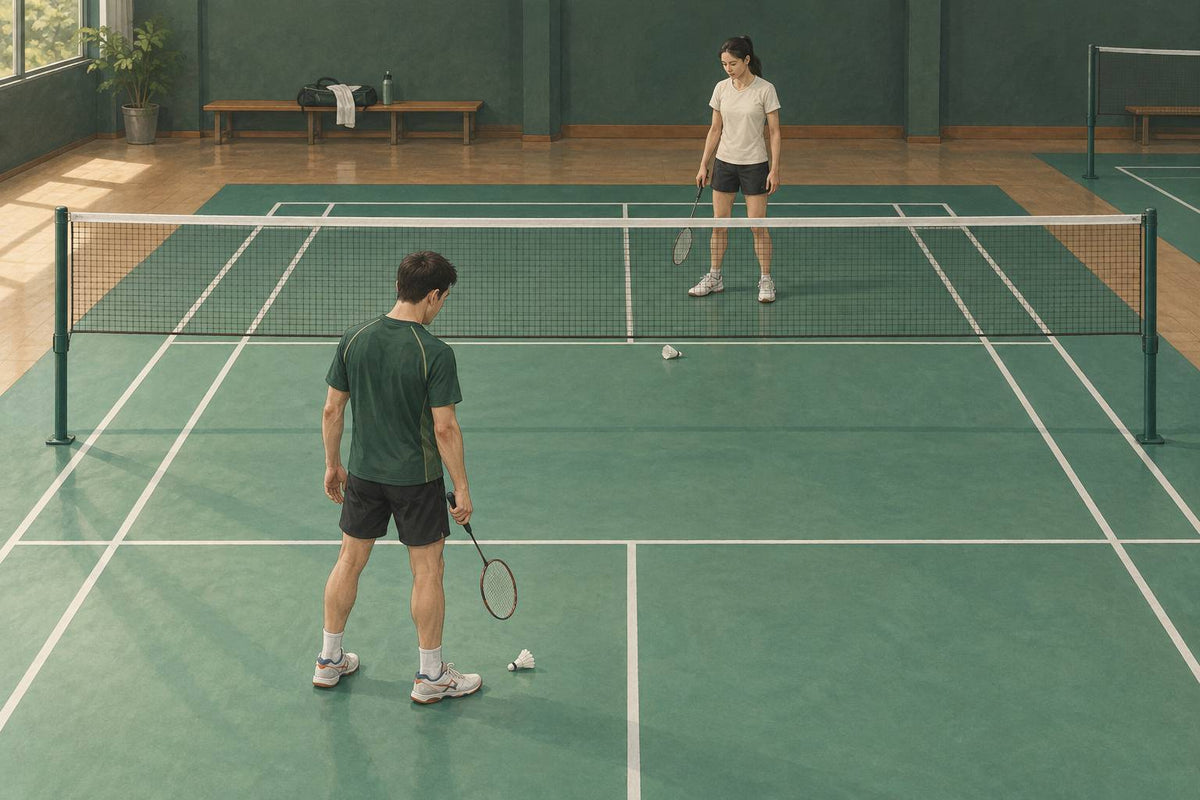
A shuttle from a neighbouring court can be startling, but surprise alone does not decide the rally. The useful question is whether the outside shuttle changed the players’ ability to play the shot. Current technical-official guidance specifically rejects an automatic let when the umpire judges that the shuttle did not obstruct or distract the players.
Related rule: For the broader list of let situations, read our badminton let rules guide. This article focuses only on an intrusion from an adjacent court.
Is an outside shuttle automatically a let?
An outside shuttle is not automatically a let. The current BWF Instructions to Technical Officials say that no let is called when the umpire judges that the shuttle from outside the court did not obstruct or distract the players. The rule leaves the materiality judgment to the official rather than setting a universal distance or timing threshold.
That means the shuttle’s mere presence is not enough. A birdie that rolls near a back corner after the players have already seen it may be harmless. A shuttle flying through a player’s hitting space during a defensive exchange is much more likely to affect the rally. Those examples explain the decision, but they are not official distance rules.
Do not claim that every movement beside the court creates a let. Decide whether the event obstructed the player, distracted the player, or created an immediate reason to stop for safety. If the situation is unclear in an organized match, bring it to the person responsible for the match rather than inventing a permanent local threshold.
The current BWF technical-official instructions are the source for this outside-shuttle distinction. They do not say that every shuttle crossing a court boundary must be replayed.
When does the intrusion affect the rally?
The intrusion matters when it changes the rally in a meaningful way: a player cannot safely reach the shuttle, loses the visual or physical space needed to play a shot, or is distracted at a decisive moment. The Laws provide the framework, while the particular rally determines whether the interference was material.
| Situation | Practical decision |
|---|---|
| Outside shuttle stays well away from the players’ path | Do not assume a let. Continue if neither player was obstructed or distracted. |
| Outside shuttle crosses a player’s movement or hitting space | Stop the rally if the obstruction affected the shot or created a safety concern. |
| Player reacts, hesitates, or loses sight of the rally because of the intrusion | Raise the issue immediately. The relevant question is the effect on play, not simply where the shuttle came from. |
| Players notice the outside shuttle only after the rally has ended | Do not automatically replay the point after the fact. A later observation of the outside shuttle does not, by itself, establish that the rally should be replayed. |
Use the table as a decision aid, not as a substitute for the official’s judgment. The BWF provisions distinguish obstruction, deliberate distraction, suspension, and a shuttle touching an outside object. They are separate situations, so one cannot be turned into a blanket “neighbouring shuttle” rule.
Safety comes first on a club court. If continuing would put a player into another person, racket, or shuttle, call “stop” clearly and avoid the collision. That immediate safety instruction is Badminton House practical guidance. It is not a claim that the BWF Laws prescribe one exact spoken phrase for every unumpired court.
Do not encourage players to continue through a genuine collision hazard merely to avoid a replay. The rule against automatic lets prevents unnecessary replays; it does not require a player to make a dangerous movement.

Who can stop play in an umpired match?
In an umpired match, the umpire controls the match, court, and immediate surrounds. The umpire applies the Laws and decides whether an outside shuttle obstructed or distracted the players. A player should not overrule the umpire by declaring a personal let after the umpire has allowed play to continue.
If you see an outside shuttle entering during a live rally, keep playing when you can do so safely and let the umpire make the call. If the umpire stops the rally and calls a let, accept that ruling and prepare to replay. If the umpire does not stop play, do not restart the point yourself because the shuttle looked unusual.
The umpire’s control also explains why a player’s late objection is limited. The current Laws identify the umpire’s authority over the match and its immediate surrounds, including faults and lets. A player can point out what happened, but the player does not become the umpire simply by speaking first.
The current Laws of Badminton identify the umpire’s control and the distinction between an umpired and unumpired match.
What should you do on an unumpired court?
On an unumpired court, a player may call a let, so the safest process is to stop promptly when the outside shuttle materially affects play, explain the reason briefly, and replay from the last service. If the players disagree, pause the score and ask the organizer or referee to settle the dispute.
- Stop clearly if needed. Say “let” or “stop, outside shuttle” while the rally is still active. Use a voice loud enough for the other player to hear.
- State the effect, not a conclusion. Say, “It crossed my hitting space,” or “I lost the shuttle when it came through,” rather than “Any shuttle from another court is a let.”
- Agree on the timing. If both players agree that the intrusion affected the rally, record the let and replay. Do not change the score as though one side won the point.
- Escalate a disagreement. If one player says the intrusion was harmless and the other says it changed the shot, stop arguing at the net and ask the organizer or referee for the local decision process.
- Restart calmly. Once the let is accepted, confirm the server and receiver, keep the score unchanged, and begin the next service.
A simple club-court script
“Let, outside shuttle. It crossed my path, so I could not play safely. Let’s replay that service. If we disagree, we’ll ask the organizer.”
This script is Badminton House guidance for a respectful unumpired discussion. It is not a quoted BWF procedure or a universal facility policy.
Prevent the next avoidable interruption
Badminton House practical guidance: Before serving again, remove the outside shuttle only when both courts have stopped. Do not walk into a neighbouring rally to retrieve it. If the same court repeatedly sends shuttles into yours, pause between rallies and ask the organizer to coordinate a safe retrieval signal or adjust the local court procedure.
That coordination does not turn every future intrusion into a let. It reduces a known risk before service while preserving the obstruction-or-distraction test for the next live rally.
How is the rally restarted after a let?
After a valid let, the play since the last service is void and the last server serves again. The score does not move because of the interrupted rally. First confirm that a let was actually called, then identify the last server before restarting.
A later observation does not automatically erase the rally. If the point was completed, treat the outside shuttle’s later discovery as a reason to clear the court before the next service, not by itself as a reason to replay the point.
For a quick reset, use this sequence:
- Confirm that the umpire, or a player on an unumpired court, called a let.
- Keep the score unchanged.
- Identify the last server.
- Remove the outside shuttle or wait until the neighbouring court is clear.
- Serve again under the same service order.
Law 14 in the current BWF Laws sets out both the let grounds and the restart consequence. The adjacent-court example still depends on whether the intrusion obstructed or distracted play.

Leave a comment
This site is protected by hCaptcha and the hCaptcha Privacy Policy and Terms of Service apply.