
Last checked: August 2026 · Written by the Badminton House player-led team.
Quick answer: the official shuttle speed test
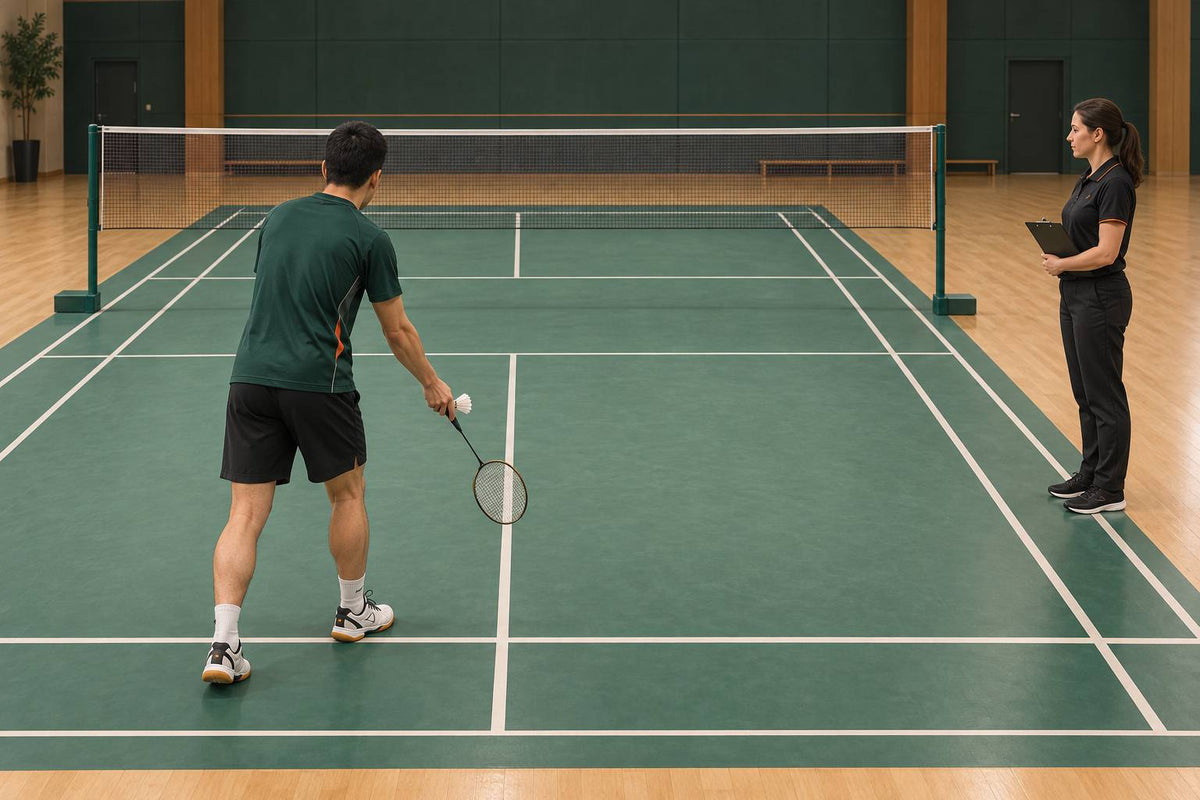
The official check is not an umpire ritual before every match. A Referee oversees tournament testing, while an active player or approved qualified person hits the shuttles. The pass zone is 530–990 mm short of the far back boundary line. Players must not alter feathers to force a result.
When
Official default: before the tournament's first day, then only when changed conditions or observations justify another check.
Who hits
An active tournament player or a qualified person approved by the Referee, not automatically the Umpire.
Pass zone
The shuttle lands from 530 mm through 990 mm short of the opposite back boundary line.
Authority
The Umpire controls individual shuttle changes; the Referee decides the shuttle speed used.
The phrase “umpire shuttle test” hides how the official process actually works. The stroke is made by a player or approved tester, the Referee evaluates the results, and an Umpire becomes relevant when match play or player feedback raises a later issue. That distinction matters because the test is a controlled equipment check, not a pre-match routine every pair performs.
Who performs the official check, and when?
Before the first day of play, the Referee oversees shuttle testing. The current BWF instructions assign the strokes to an active tournament player or a qualified person approved by the Referee. They do not tell every match Umpire to run a new test before calling love-all.

The tester is there to produce repeatable flight information, not to select the tournament's speed. The Referee assesses the strokes and sends the decision to Shuttle Control. The instructions explicitly say not to tell the tester which speed was chosen or ask for that person's opinion.
This workflow comes from the BWF Instructions to Technical Officials in force from November 2025. It separates hitting the test shuttles from making the official decision.
How is the Law 3 test stroke hit?
The tester uses a full underhand stroke and contacts the shuttle over the back boundary line. The shuttle travels upward and parallel to the side lines. A diagonal shot, a flat drive or contact made away from the back line is not the stroke described by Law 3.
- Set the contact point: the shuttle must be over the back boundary line when struck.
- Use the prescribed action: make a full underhand stroke rather than a serve, drive or overhead clear.
- Send it upward: the trajectory must rise after contact.
- Keep it straight: the flight direction runs parallel to the side lines.
The exact wording and Diagram B appear in BWF Law 3, in force from April 2025. Those mechanics matter because the Referee must consider strength, trajectory and contact location before interpreting where the shuttle lands.
How do officials read the landing window?
A correct-speed shuttle lands no less than 530 mm and no more than 990 mm short of the opposite back boundary line. That creates a 460 mm-wide pass band. Optional test marks may show the band on the floor, but the numerical limits still control when a hall has no painted marks.
| Landing point | What it indicates |
|---|---|
| Less than 530 mm short of the far back line | The shuttle travelled beyond the correct-speed band: too fast for this test. |
| 530–990 mm short | Inside the Law 3 correct-speed band. |
| More than 990 mm short | The shuttle fell before the correct-speed band: too slow for this test. |
Officials do not treat one landing spot as self-explanatory. All available speeds are tested from both ends, and the Referee accounts for how hard and how high the tester hit, plus whether the shuttle was contacted over the back line. The process checks the shuttle and the quality of the test stroke together.
When do officials retest or change speed?
Retesting happens when there is a reason, not simply because another match is starting. The Referee may order it when playing conditions change substantially, with temperature and humidity given as examples, or when visual observations or Umpire feedback suggest the selected speed no longer fits.
The BWF technical-official instructions say testing need not happen on every later day when conditions have stayed stable and the tubes are consistent. Official testing establishes the event's working speed and then checks it again only when evidence warrants another look.
During a match, the Umpire decides whether one worn or damaged shuttle should be changed. A change of speed is different. If both sides request it, the Referee speaks with the Umpire, weighs those comments against court observations and decides. The ITTO notes that another player test may be performed but often adds no valid information.
For selecting a likely tube before any official check, see our shuttle speed guide. The court test remains the direct read of how that shuttle flies in the actual hall.
May players alter feathers to change speed?
No. BWF Law 16.6.2 says a player must not deliberately modify or damage a shuttle to change its speed or flight. The ITTO adds that a shuttle whose speed or feathers were deliberately interfered with is discarded, with the misconduct law applied when appropriate.
The technical-official instructions contain one narrow last-resort exception when no correct-speed shuttles exist. It is an official, neutral procedure, preferably handled by the Service Judge or another neutral person. It is not permission for a player to bend, tip or tune feathers, and this guide intentionally gives no modification method.
The official sequence
A player or approved tester hits. The Referee evaluates. The Umpire manages individual shuttle changes during the match. The Referee decides speed. Players leave the feathers alone.


Leave a comment
This site is protected by hCaptcha and the hCaptcha Privacy Policy and Terms of Service apply.