
Last updated: July 2026 · Written by the team at Badminton House
Quick Answer: Shuttlecock Speed 76, 77, or 78 in Canada
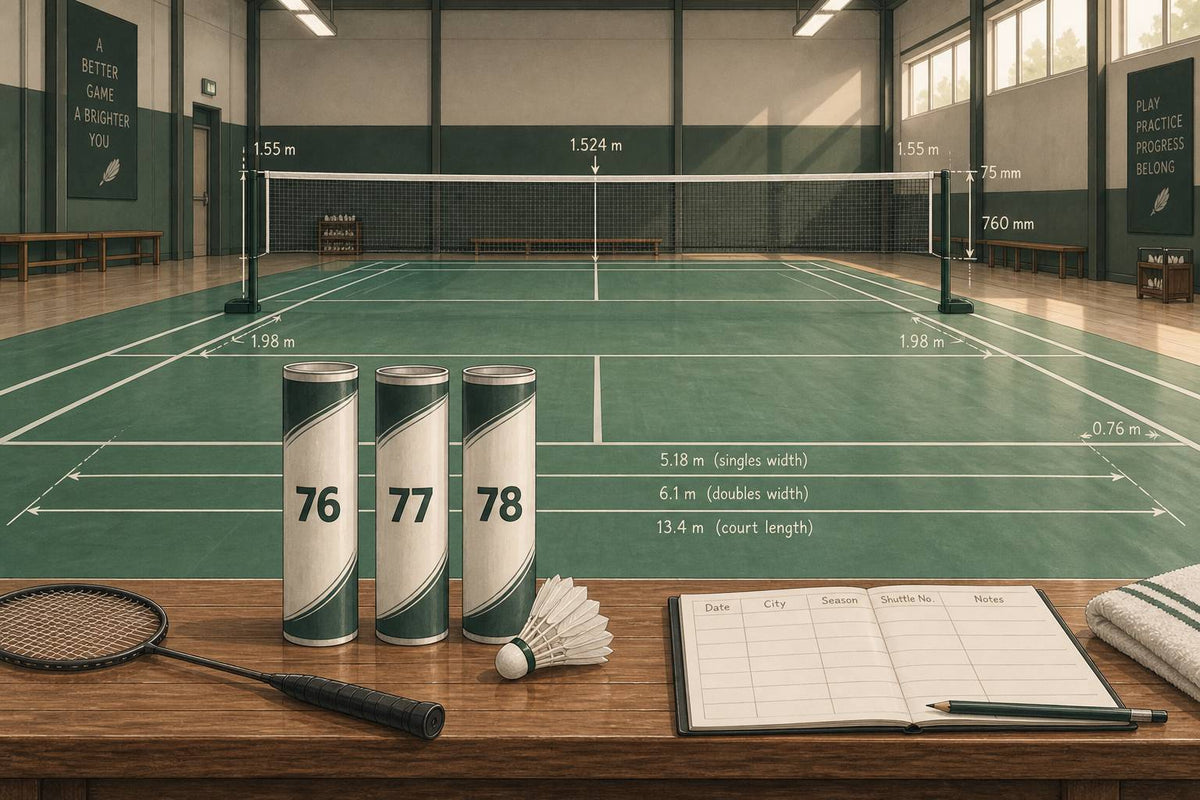
For most Canadian indoor play, start with speed 77, then adjust after a proper shuttle speed test in your actual gym.
76
Usually worth testing in higher-altitude cities such as Calgary and Edmonton, or in very warm halls where shuttles fly long.
77
Best starting point: the most practical first choice for many clubs and recreational players across Canada.
78
Often useful in cold, dry winter gyms and some slower sea-level halls where speed 77 lands short.
The honest answer on badminton shuttlecock speed in Canada: speed 77 is the common baseline, but your city, season, gym temperature, humidity, altitude, and playing level can all move you toward 76 or 78.
This badminton shuttle speed guide explains what the numbers mean, how Canadian conditions affect feather shuttle flight, and how to test before you buy a full case. The goal is not to find a universal speed. The goal is to find a reliable range for your hall.
Need shuttles for a Canadian club night? Browse badminton shuttlecocks or use our shuttle finder to narrow the choice by play type and budget.
In This Guide
What Do Shuttlecock Speed Numbers Mean?
Within a manufacturer’s 76/77/78 system, higher numbers generally indicate a faster, longer-flying feather shuttle under the same conditions. The scale is not universal: Yonex’s Aerosensa 20 listing, for example, uses temperature grades 1–5. Compare the exact product’s guidance before mapping numbers across brands.
That does not mean speed 78 is "better" than 77, or that 76 is only for advanced players. It means the shuttle is tuned for different air conditions. A speed that is perfect in one gym can be too long in another gym across the same city.
| Speed | Plain-English meaning | When to test it in Canada |
|---|---|---|
| 76 | Slower, shorter flight | High-altitude or warm halls where 77 and 78 land long. |
| 77 | Medium baseline speed | Most first-time purchases for indoor Canadian club play. |
| 78 | Faster, longer flight | Cold/dry winter gyms, slower halls, or sea-level conditions where 77 lands short. |
The practical lesson: buy by flight result, not by number. If a 77 shuttle repeatedly lands short in your gym after a correct test, speed 78 is not "too fast" for you. If a 77 repeatedly lands long, speed 76 may be the smarter tube.

Which Speed Should You Start With in Your City?
These city ranges are editorial suggestions for which tubes to test, not measured venue results or fixed city specifications. The actual hall, product and repeatable speed test decide the choice.
| City or region | Likely starting range | Why | Practical note |
|---|---|---|---|
| Calgary | 76-77 | Higher altitude makes shuttles travel farther. | Test 76 if 77 carries beyond the back boundary. |
| Edmonton | 76-77 | Altitude is lower than Calgary but still relevant compared with coastal cities. | Winter dryness can pull some halls back toward 77. |
| Vancouver, Victoria, Halifax | 77-78 | Sea-level play often needs a little more shuttle speed. | Start at 77, then test 78 if clears consistently die short. |
| Toronto, Ottawa, Montreal, Quebec City | 77-78 | Most halls sit in a middle range, but winter HVAC can make shuttles feel slow. | Many players keep 77 as default and test 78 in colder months. |
| Winnipeg, Regina, Saskatoon | 77-78 | Cold, dry winter indoor air can slow feather shuttles and increase brittleness. | Follow the shuttle maker’s storage guidance and test speed; avoid unverified conditioning treatments. |
| Moncton and Atlantic indoor gyms | 77-78 | Sea-level conditions, older halls, and winter heating can vary widely. | A 77 tube is the sensible first test for many local sessions. |
For clubs ordering by the case, the safest approach is to test one tube each of two nearby speeds before committing. If your group plays across multiple venues, write down the hall, month, and winning speed. A simple club log is often more useful than any national chart.
How Do Temperature, Altitude, and Season Change Shuttle Speed?

The feather shuttle speed that works in September may not feel right in January. Canadian gyms can swing from humid summer halls to cold, dry winter spaces with powerful heating systems.
Cold or dry winter gym
The shuttle may feel slower and feathers may break faster. Test 78 if 77 lands short from a proper stroke.
Warm summer hall
The shuttle may carry farther. Test 76 or 77 if 78 starts drifting long.
Higher altitude
Thinner air generally lets shuttles travel farther, which is why Calgary and Edmonton often test lower than sea-level cities.
If you only remember one rule, remember this: warm air and altitude usually push you toward lower speed numbers; cold, dry, or slow halls often push you toward higher speed numbers. The court test still decides.
Free shipping on $200+ · Canadian badminton specialty shop
How to Speed-Test a Badminton Shuttlecock

A shuttle speed test should be boring and repeatable. Do it before a session, using fresh shuttles, with a player who can hit a clean full underhand stroke. Avoid judging speed from smashes, mishits, or tired clears at the end of the night.
- Use a position that lets you strike the shuttle directly over one back boundary line.
- Hit with a full underhand stroke, contacting directly over the back boundary line.
- Hit upward at an angle and parallel to the sidelines.
- Under BWF Law 3, the correct-speed landing is 530–990 mm short of the opposite back boundary line.
- Repeat with several fresh shuttles before choosing a speed.
| Test result | What it means | What to do |
|---|---|---|
| Lands well short | The shuttle is too slow for the hall or stroke tester. | Retest with the next higher speed, such as 77 to 78. |
| Lands near the expected back-court zone | The shuttle is in the usable range for that hall. | Use it for the session and note the conditions. |
| Lands long or keeps drifting | The shuttle is too fast for the hall. | Retest with the next lower speed, such as 77 to 76. |
Some players tip feathers to slow a shuttle in a pinch, but that is a session workaround, not a buying strategy. For regular club play, choosing the right tube speed is cleaner and more consistent.
Club testing tip: test with the players who will actually use the shuttles. A national-level tester and a recreational group can reach different conclusions from the same tube because stroke speed and contact quality are part of the result.
Feather vs Nylon Speed Notes
This article focuses on feather shuttles because speed 76, 77, and 78 are most relevant to feather tubes. Nylon shuttles are usually sold as slow, medium, or fast, and they do not slow down and drop in quite the same way as feather.
For training, schools, casual play, or budget sessions, nylon can make sense. For club play, league nights, tournaments, touch shots, and realistic flight, feather is still the standard. For a deeper breakdown, read our feather vs nylon shuttlecock guide.
Switching from nylon to feather? Do not judge feather speed from your nylon timing. Feather slows and drops more sharply, so give yourself a few rallies before changing speeds.
Buying Tips for Canadian Players
If you are buying for yourself, one tube of speed 77 is often the right first experiment. If you are buying for a club, test adjacent speeds before ordering in bulk. If your club plays year-round, you may end up using one speed in winter and another in summer.
- For first-time feather buyers: start with speed 77 unless your club already recommends a different speed.
- For Calgary and Edmonton groups: test 76 and 77 before committing to a case.
- For sea-level cities: test 77 first, then 78 if shuttles repeatedly land short.
- For winter leagues: expect colder, drier gyms to change both flight and feather durability.
- For mixed-level club nights: choose the speed that suits the group after repeat tests, not the strongest player only.
To compare tube types beyond speed, see our badminton shuttlecock comparison for Canada. To shop by budget and play style, browse our shuttlecock collection.
"The right shuttle speed is the one your hall proves, not the one a chart promises."
- Badminton House shuttle guide
Get Shuttle Speed Cheat SheetCheck current shipping and return terms · Canadian badminton specialty shop
FAQ
What shuttlecock speed should I use in Canada?
Start with speed 77 for many indoor Canadian halls, then test. Move to 76 if the shuttle lands long, or 78 if it lands short.
Is speed 77 the best badminton shuttle speed in Canada?
It is the best starting point for many players, but it is not universally correct. Calgary, Edmonton, cold prairie gyms, humid coastal halls, and older school gyms can all point to different choices.
Should Calgary players use speed 76 or 77?
Calgary players should usually test 76 and 77 because altitude can make shuttles travel farther. If 77 lands long in your hall, use 76. If 76 lands short, use 77.
Should Vancouver or Halifax players use speed 77 or 78?
Many sea-level players start at 77 and test 78 if the shuttle repeatedly lands short. The final choice depends on the hall, temperature, humidity, and playing group.
Do I need a different shuttle speed in winter?
Sometimes, yes. Cold, dry winter gyms can make feather shuttles feel slower and more brittle. If your usual speed starts landing short in winter, test the next higher speed.
Do nylon shuttles use speed 76, 77, and 78?
Usually no. Nylon shuttles are commonly sold as slow, medium, or fast. The 76, 77, and 78 labels are most useful when buying feather shuttle tubes.
How many shuttles should a club test before buying a case?
Test several fresh shuttles from each candidate speed in the actual hall, ideally with more than one capable tester. If two speeds are close, test again on another day before ordering a large quantity.
Get 10% off your first order
Join the Badminton House list and we’ll email you a 10% welcome code — plus subscriber-only restock alerts, giveaways, and honest gear advice from players.
By subscribing, you agree to receive Badminton House emails and can unsubscribe anytime.

Leave a comment
This site is protected by hCaptcha and the hCaptcha Privacy Policy and Terms of Service apply.