
Last checked: August 2026 · Written by the player-led team at Badminton House
Quick answer
Special Olympics badminton organizes equitable competition through divisioning, available event choices, and specific Unified rules. The rows below separate those jobs.
Divisioning
Ability is primary; age and gender are also considered.
Unified doubles
One athlete and one Unified partner of similar age and ability.
Events
The rulebook lists six event types; each Program chooses what it offers.
This guide explains the current international framework. A local Special Olympics Program decides which available events it offers and applies the rules to its competition. The final section offers a starter club-session example; official Programs should follow their own Accredited Program requirements.
What is Special Olympics badminton?
Special Olympics badminton provides training and competition for people with intellectual disabilities. Its badminton rules build on BWF rules, with Special Olympics provisions for divisioning, available events, individual skills, and Unified play. Divisioning is an ability-matching process; it is not the same system as Para badminton sport classification.
The current Special Olympics Sport Rules Article I describes the organization’s mission as year-round training and competition for children and adults with intellectual disabilities. The badminton-specific rules apply Special Olympics requirements alongside the international sport’s ordinary playing rules.
| Framework | How competition is organized | Common labels |
|---|---|---|
| Special Olympics badminton | Athletes are placed into equitable divisions using ability as the primary factor, with age and gender also considered. | Division numbers or group labels used by the event. |
| Para badminton | Eligible athletes are assigned sport classes according to how a physical impairment affects badminton activities. | WH1, WH2, SL3, SL4, SU5, and SH6. |
These are different competition frameworks, not mutually exclusive descriptions of people. A person may have more than one disability, and a club should never assign either a division or sport class by looking at someone. For the physical-impairment framework, use our Para Badminton Classification: WH1 to SH6 Explained.
How does divisioning work in badminton?
Divisioning starts with evidence of playing ability and may be checked again at the competition. Ability is the primary factor, while age and gender also shape the final groups. Entry scores, previous competition, seeding rounds, preliminary events, coach assessment, and short match play can all contribute to the decision.
- Submit or collect an ability measure. Article I permits an entry score from prior competition or a score produced through seeding or a preliminary event. The head coach is responsible for ensuring that the submitted score represents the athlete’s current ability.
- Check badminton skills and match play. The badminton coaching guide describes a first-stage coach assessment followed by in-person match validation at competition.
- Create the divisions. Organizers treat ability as the primary factor while also considering age and gender, the available entry pool, safety, and the target division size.
The current Badminton Athlete Divisioning Assessment Form rates ten areas, including shuttle control, serves, net play, overhead strokes, defence, and rallying with movement. The ten ratings are averaged to produce a player rating for initial divisioning. This is a competition assessment tool, not a weekly lesson plan.
Important rule detail: Special Olympics suggests no more than 15 percent variance between the highest and lowest scores in a division, but Article I explicitly calls this a guideline, not a rule. The ideal division has three to eight competitors or teams, though entry numbers may make that impossible.
Divisioning should therefore be explained as structured matching, not as a guarantee. An athlete can improve quickly, play differently under competition pressure, or meet an opponent with an awkward style. Accurate current information and honest effort make the process more useful.

Which Special Olympics badminton events are available?
The current badminton rules list six available event types, ranging from individual skills to Unified mixed doubles. A Program may choose which events it offers, so an event appearing in the international rulebook does not mean it will appear at every local, national, regional, or World Games competition.
The September 2024 Special Olympics Badminton Sport Rules list:
- Individual Skills Competition
- Singles
- Doubles
- Unified Sports doubles
- Mixed doubles
- Unified Sports mixed doubles
Individual Skills Competition gives athletes a competition option built around six scored activities rather than a full match: Hand Feeding, Racquet Feeding for overhead strokes, the “Ups” Contest, Forehand Stroke, Backhand Stroke, and Serve. Coaches should select and train for the event that fits the athlete’s skills and interests rather than treating a full match as the only meaningful destination.
How does competitive Unified doubles work?
In competitive Unified badminton doubles, one Special Olympics athlete and one Unified partner play together. Article I defines the athlete as a person with an intellectual disability and the partner as a person without an intellectual disability. For badminton, the pair must be similar in age and ability.
“Similar ability” does not mean the two players need identical strokes. It means they should have comparable badminton ability so both can participate meaningfully without one player controlling every rally. The badminton-specific rule fixes the on-court ratio at one athlete to one Unified partner and lets each team choose its service order and court selection.
Article I makes meaningful involvement a requirement of the competitive model. Every teammate should contribute to the team’s success. A team should not include a player who dominates play, blocks the other teammate from contributing, or creates a safety risk.
| Good competitive Unified pairing | Poor pairing signal |
|---|---|
| Both players understand the basic rules, positioning, and service order. | One player treats the other as a spectator or stays in front of every shuttle. |
| Both receive, make decisions, and attempt the shots available in their area. | The stronger player repeatedly calls the other away from playable shots. |
| The non-playing coach prepares the pair and gives feedback between appropriate periods of play. | The partner acts as an on-court coach instead of a teammate. |
Special Olympics also recognizes Player Development and Recreation Unified models, which use different structures and ability-matching requirements. Do not apply those requirements when describing competitive Unified badminton doubles; organizers and coaches should use the model named for their event.
What could a starter club session look like?
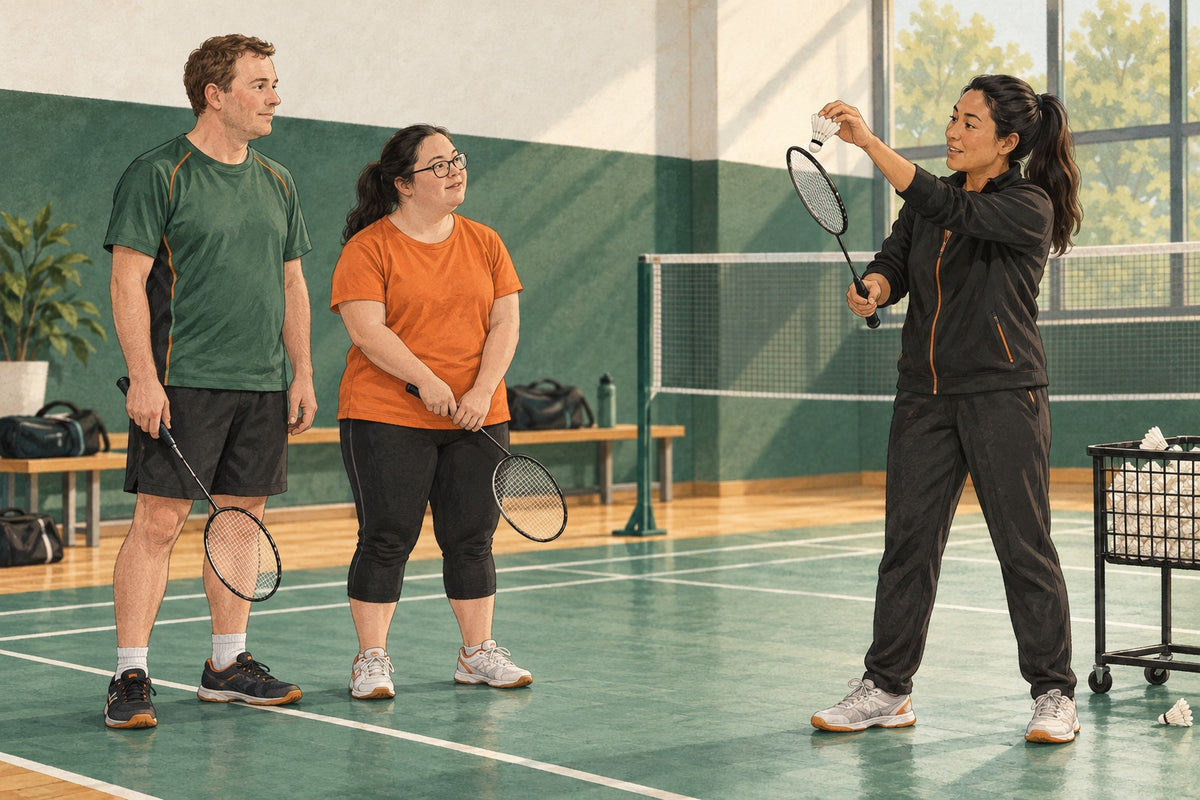
A starter session needs a safe indoor space, enough coaches or assistants for the athletes’ stated needs, equipment each player can track and control, one clear session goal, and a simple-to-complex activity order. Duration, staffing, shuttle choice, and support should follow the actual group rather than one universal template.
The official Special Olympics Badminton Coaching Guide 2026 tells coaches to consider venue, time, duration, court space, participant numbers, coaches or assistants, playing level, additional needs, and the session goal. It recommends progressing from simple to complex, slow to fast, and predictable to unpredictable.
Badminton House example, not an official Special Olympics session format: the 50-minute outline below turns those planning principles into a first club session. It is not a competition standard, accreditation requirement, or substitute for the official coaching guide.
| Time | Session job | Coach focus |
|---|---|---|
| 0–5 minutes | Welcome and individual check-in. | Ask what helps each athlete participate and explain the one session goal. |
| 5–12 minutes | Predictable warm-up and object tracking. | Use clear demonstrations, repeat the same movement, and check court spacing. |
| 12–25 minutes | One skill with a reliable feed. | Keep the feed predictable before adding movement or a decision. |
| 25–38 minutes | Cooperative pair activity. | Match partners by the task and make sure both players contact the shuttle. |
| 38–46 minutes | Short conditioned game or individual-skill challenge. | Choose the format that lets the athlete use the skill practised that day. |
| 46–50 minutes | Cool-down and review. | Ask what worked, what should change, and what the athlete wants next time. |
For practice, choose the shuttle or adapted object the athlete can see, track, and control consistently, then progress toward the equipment needed for the intended event. A session lead can explain and demonstrate; a feeder can create reliable repetition; a court assistant can support spacing and transitions; and a playing partner can rally without taking over. For this non-official club example, staffing should follow individual needs. Any activity delivered within Special Olympics must also follow the Accredited Program’s supervision and safety requirements.
For broader adaptations to space, task, equipment, and people, use our STEP drill-adaptation guide. For running one shared club night with disabled and non-disabled players, see Inclusive Badminton Sessions: Adapt the Session, Not the Player.
Plan the first session on one page
- Name one skill or participation goal.
- Confirm space, equipment, athlete preferences, and support roles.
- Move from predictable practice toward one short game or challenge.
- Ask the athlete what to keep or change before planning the next session.

Leave a comment
This site is protected by hCaptcha and the hCaptcha Privacy Policy and Terms of Service apply.