
Last checked: August 2026 · Written by the player-led team at Badminton House
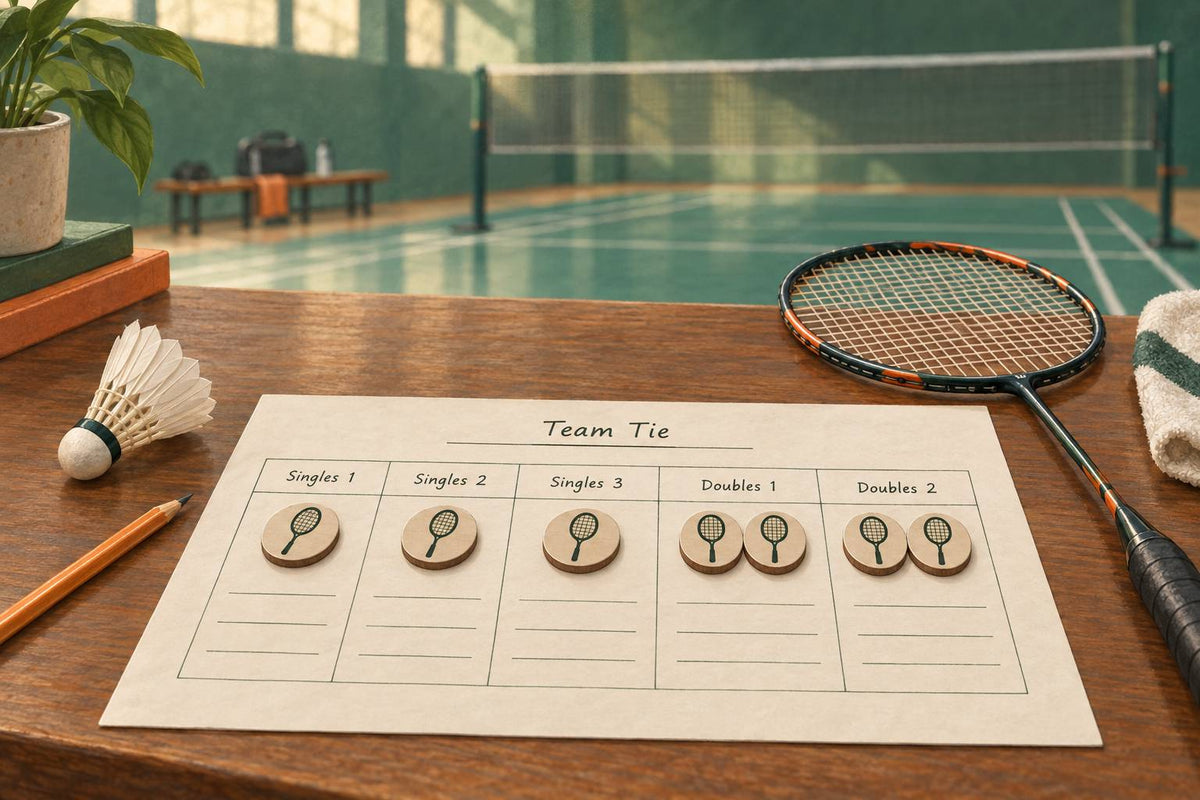
The Thomas Cup format is a national-team tie of three singles matches and two doubles matches. Uber Cup uses the same structure for women’s teams, while Sudirman Cup uses five different disciplines in a mixed-team tie. Once you separate those two meanings of “five matches,” a team-event score becomes much easier to read.
Related reading: See how singles and doubles ask different questions of a player.
Which cup is which?
Thomas Cup is the men’s world team championship and Uber Cup is the women’s equivalent. They are paired events, so the same team-tie logic applies to both. Sudirman Cup is different: it is the world mixed-team championship, where one tie includes one match in each of badminton’s five disciplines.
The names describe the competition, not a player’s individual event. A Thomas or Uber squad needs three singles positions and two doubles positions. A Sudirman squad must cover men’s singles, women’s singles, men’s doubles, women’s doubles and mixed doubles. BWF’s Thomas & Uber FAQ identifies the first two as the men’s and women’s world team championships; its Sudirman Cup history records the mixed-event five-discipline format.
| Event | Team type | Five scheduled matches |
|---|---|---|
| Thomas Cup | Men | First, second and third singles; first and second doubles |
| Uber Cup | Women | First, second and third singles; first and second doubles |
| Sudirman Cup | Mixed | Men’s singles, women’s singles, men’s doubles, women’s doubles, mixed doubles |
That distinction changes what “depth” means. In Thomas and Uber, a team cannot hide a weak third singles or second doubles position behind a star. In Sudirman, a squad also needs a credible mixed-doubles pairing. Treat the event label as your first shortcut when deciding what a scoreline says about a team.
Start with the discipline list before judging a result. A team may have a celebrated singles player, yet the tie still asks it to win across the listed positions. Conversely, a strong doubles unit matters only in the doubles slots. This is a cleaner way to discuss “team strength” than treating one individual result as a verdict on the whole squad.
How does a Thomas or Uber tie work?
A Thomas or Uber tie contains five individual matches, so three match wins secure the team result. The scheduled categories are first, second and third singles plus first and second doubles. The individual score within each match matters to that match; the tie score counts how many of those matches each country wins.
A simple way to read the board is to count completed match wins, not games. If Team A wins first singles, first doubles and second singles, it leads 3–0 in the tie. That is already an uncatchable lead in a five-match tie. It does not mean every listed match was necessarily played, because the phase of the tournament governs what happens next.
The current BWF Thomas & Uber Cup regulations specify both the five-match composition and the different completion rules. This is the source to use when a broadcast graphic or an older explainer appears to conflict with the current event.
- Match score: the result of one singles or doubles contest.
- Tie score: the count of those match wins between the two countries.
- Team result: secured as soon as one side has three wins, subject to the phase’s completion rule.
For viewers, this avoids a common mistake: a 3–2 score represents a close five-match contest, while 3–0 only tells you one team reached three wins first. It does not, by itself, tell you whether later matches were scheduled, played, or needed for standings.
It also explains why an individual match can still matter after the team result looks settled. In group play, a third singles player and second doubles pair still take the court, collect an official result and give their team a fuller picture of the squad. In a knockout, those same positions may never be called because advancement has already been decided. Do not read an unplayed position as a benching decision without checking the phase.
For example, a knockout score that reaches 3–0 has already produced a winner. A group score that reaches 3–0 has also identified the tie winner, but the published completion rule still requires the remaining matches. The numbers look alike; the operational meaning is different. The phase, rather than the margin alone, supplies the missing context.

Why group ties and knockout ties look different
At the Finals, 16 teams are drawn into four groups of four and the top two from each group advance. In group play, all five matches are completed even after a country has reached three wins. In a knockout tie, play ends once the winning third match has been secured.
The difference is practical. Group standings can use match results beyond the winner of the tie, so the remaining two matches still carry information. A knockout exists only to identify the team that advances, so there is no sporting need to continue once the outcome cannot change. Olympics.com’s event coverage also describes the four-group, top-two-to-quarter-finals route.
When following a group tie, stay for the fourth and fifth matches even at 3–0. When following a quarter-final, semi-final or final, expect a 3–0 or 3–1 tie to finish before every scheduled category appears. This is an event-format rule, not an assessment that the unused players could not have competed.
A schedule can therefore be read as a plan, not a promise that every listed match will occur. In a knockout, the five categories tell you the possible route to three wins. In a group, they tell you the complete programme for the tie. Keeping that distinction in mind makes delayed start times and absent later matches easier to interpret without guessing.
What does the format ask of a squad?
The format asks a captain to build a complete ordered team, not simply select one outstanding player. BWF regulations require singles players and doubles pairs to be entered in ranking order. That limits the idea that a manager can casually relabel players to manufacture a preferred individual matchup.
The useful viewer question is therefore: where can this team find three wins? A singles-heavy squad may look strong until second doubles is exposed. A balanced team can pressure several positions and still survive a loss at first singles. In Sudirman, the same calculation spreads across five disciplines and makes mixed doubles a potential tie-decider.
Use ranking order as a guardrail on your pre-tie predictions. It tells you that the labels first, second and third singles are not casual nicknames a captain can reshuffle at will. It does not tell you who will win. The more useful question is whether the ordered entries give a plausible route to three match wins across the actual categories.
This perspective also keeps post-match analysis fair. If a team loses, name the positions that decided the tie rather than reducing the explanation to one star player. If a team wins before a later knockout match is needed, distinguish that completion rule from a judgement about the uncalled player. The format gives viewers a disciplined vocabulary for both conversations.
That vocabulary works before, during and after a tie: name the cup, phase, positions and match wins.
Use this scorecard shortcut
- Identify the cup: Thomas, Uber or Sudirman.
- List the five scheduled matches for that cup: the five positions in Thomas or Uber, or the five disciplines in Sudirman.
- Check whether the tie is a group tie or a knockout.
- Count match wins, then ask which remaining positions are still live.



Leave a comment
This site is protected by hCaptcha and the hCaptcha Privacy Policy and Terms of Service apply.