
Last updated: July 2026 · Written by the team at Badminton House
Quick Answer: Badminton Singles vs Doubles
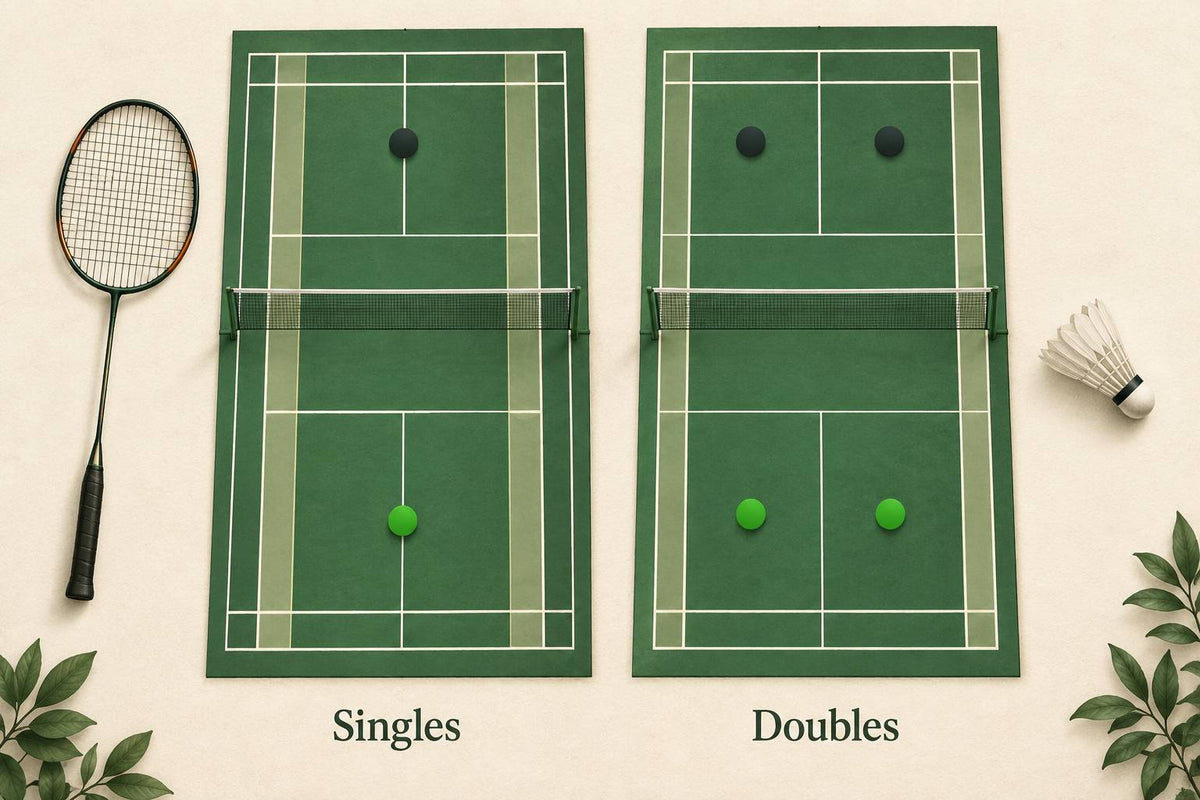
If you play both, treat singles and doubles as different games: singles rewards centre-base control and rally construction, while doubles rewards rotation, fast reactions, and partner spacing. The measurable difference: singles is played on the narrower 5.18 m court and the serve can reach the back boundary, while doubles uses the full 6.1 m width but the serve must land 0.76 m short of it.
Play Both
Best choice: match your habits to the rally: recover toward a central base behind the short service line in singles, then switch to front/back attack and side-by-side defence patterns in doubles. For gear, start with balance and feel before obsessing over labels — our head-heavy vs head-light guide explains the trade-off.
Singles
Prioritize full-court control: singles uses the narrower court, but you still have to move between all four corners, build points patiently, and use the long service court. Power-focused singles players often look toward head-heavy frames such as the Astrox style when available in Canada.
Doubles
Prioritize speed and roles: position relative to your partner, rotate front/back when attacking, defend side-by-side after lifting, and consider head-light or speed-oriented rackets for faster exchanges. See our doubles racket guide; Badminton House prices are in CAD and Canadian orders over $200 ship free.
Badminton singles vs doubles can feel like two different games played on the same court. The rallies ask different questions: singles gives you more court to cover alone, while doubles gives you less time to react and more decisions to coordinate with a partner.
That difference matters for Canadian club players who move between drop-in doubles, ladder nights, lessons, and tournament events. If you use the same serve choices, recovery position, and racket setup in every format, you may feel comfortable in one game and constantly rushed in the other.
This guide explains the practical differences between singles and doubles: court lines, serving boxes, rally construction, rotation, communication, and how your racket choice should match the format you actually play most.
Choosing a racket for your main format? Browse our badminton rackets collection to compare options by balance, flex, and playing style before you buy.
In This Guide
- Court Lines: What Changes Between Singles and Doubles
- Serving Rules: Same Score Logic, Different Service Box
- Singles Strategy: Control the Centre and Build the Rally
- Doubles Strategy: Rotation Matters More Than the Centre
- Front Court, Fast Reactions, and Communication
- Why Your Racket Choice Should Differ by Format
- Canadian Club Takeaway: Match Your Gear to What You Actually Play
- Which Should You Choose: Singles, Doubles, or Train Both?
Court Lines: What Changes Between Singles and Doubles

Singles and doubles are played on the same badminton court length: 13.40 m. The big change is width. Singles uses the narrower 5.18 m court, while doubles uses the full 6.1 m width out to the doubles sidelines.
That extra width changes everything. In singles, the side tramlines are out during the rally, so you are trying to stretch one player forward, backward, and diagonally. In doubles, the full width is in, so the court opens up for wider drives, sharper blocks, and attacking angles between two defenders.
| Court feature | Singles | Doubles | What it means in play |
|---|---|---|---|
| Court length | 13.40 m | 13.40 m | The back boundary is the same length of court, but the serve rules use different long-service markings. |
| Court width | 5.18 m | 6.1 m | Singles rewards corner-to-corner movement; doubles adds width for fast drives, blocks, and interceptions. |
| Net height | 1.55 m at the ends; 1.52 m in the middle | 1.55 m at the ends; 1.52 m in the middle | The net does not change between formats, so the difference is court coverage, not net setup. |
| Short service line | 1.98 m from the net | 1.98 m from the net | A legal serve must land on or beyond the short service line within the correct diagonal service court; the box shape changes by format. |
| Doubles long service line | Not used for singles serves | 0.76 m in from the back boundary | Doubles serves land in a shorter, wider box, which is one reason low serves and quick net pressure matter so much. |
| Posts | Placed on the doubles sidelines | Placed on the doubles sidelines | The posts stay on the outer doubles lines whether singles or doubles is being played. |
A simple way to read the court: singles is long and narrow; doubles is short-and-wide on serve, then full-width during the rally. That is why a singles player can use height and depth to move an opponent, while a doubles pair often looks to take the shuttle early before the wider court becomes hard to defend.
If you are new to indoor club play in Canada, take a minute before your first game to identify the singles sidelines, doubles sidelines, short service line, and doubles long service line. Most confusion at drop-in comes from players using the wrong side line or forgetting that the doubles serve cannot reach the back boundary.
Serving Rules: Same Score Logic, Different Service Box

The scoring logic for serving is the same in singles and doubles: when the server’s score is even, including 0-0, the serve starts from the right service court; when the server’s score is odd, the serve starts from the left service court. The serve is always played diagonally into the opposite service box.
Where players often get mixed up is not the score logic — it is the shape of the service box. Singles uses the long service court: the serve can travel all the way to the back boundary line, but it must stay inside the singles sidelines. Doubles uses the short-and-wide service court: the doubles sidelines are in, but the rear tramline is out on the serve.
| Serving situation | Singles | Doubles |
|---|---|---|
| Score is 0-0 or even | Serve from the right service court. | Serve from the right service court. |
| Score is odd | Serve from the left service court. | Serve from the left service court. |
| Side boundaries on serve | Singles sidelines are in; doubles sidelines are out. | Doubles sidelines are in, so the service box is wider. |
| Back boundary on serve | The back boundary line is in, so a high deep serve can be legal. | The doubles long service line is the back limit; the rear tramline is out on serve. |
Quick way to remember it
Singles serve = long and narrow. Doubles serve = short and wide. After the serve is returned, normal rally boundaries apply for that format.
That difference changes serve selection. In singles, the deeper service box makes the high serve more useful because it can push the receiver toward the back court. In doubles, the shorter rear boundary makes the flick serve less threatening, so receivers can stand farther forward and attack short serves more aggressively.
Doubles also has a serving sequence that beginners at Canadian club nights often find confusing. If your side serves and wins the rally, the same server serves again, but from the other service court. The serve does not automatically switch to your partner just because your team won a point.
Example: your pair starts at 0-0 from the right. You serve, your side wins the rally, and the score becomes 1-0. Because your team’s score is now odd, you serve again from the left service court. If your side wins again and the score becomes 2-0, you serve again from the right. You keep serving until your side loses a rally.
When the receiving side wins the rally, they gain the next serve. Their new score decides who serves: even score means the player positioned in the right service court serves; odd score means the player positioned in the left service court serves. The important detail is that service-court positions are based on where players were set for the rally, not where they happened to finish after scrambling around the court.
For tournament play, also remember that the serve has its own technical requirements: the whole shuttle must be below 1.15 m at contact, the forward racket movement must continue until delivery, and the shuttle must be released without added spin and struck cork-first. If a match dispute comes up, check the official BWF Laws of Badminton rather than relying on gym folklore.
Singles Strategy: Control the Centre and Build the Rally
In badminton singles vs doubles, singles usually feels more methodical because every shot is your responsibility. One player has to cover all four corners, and a rally can ask you to move 6–7 metres in multiple directions before the point is over. That changes the whole mindset: you are not just trying to hit a winner; you are building pressure until your opponent is late, off-balance, or forced into a weak reply.
The core positioning habit is simple: after you hit, recover toward a central base behind the short service line. This does not mean standing still in the exact middle of the court. It means returning to a neutral launch point where you can reach the next clear, drop, lift, net shot, or drive without giving away one corner too easily.
Singles positioning checklist
- Recover after every shot: do not admire your clear, drop, or smash. Move back toward your base immediately.
- Use height and depth: deep clears and high serves buy time while forcing your opponent to travel farther.
- Move your opponent corner to corner: singles pressure comes from repeated movement, not only one powerful shot.
- Stay patient: longer rallies reward balance, footwork, and shot quality more than rushed attacks.
This is also why a high, deep serve is common and useful in singles. The singles service court is long, so a well-placed deep serve can push the receiver toward the back boundary and give the server time to settle into that centre-base position. From there, you can start the rally on your terms instead of being pulled forward immediately.
If you are new to singles, the fastest improvement usually comes from cleaner recovery steps, not from hitting harder. Once your recovery is reliable, our beginner singles strategy guide shows how to build each rally around one simple question per shot. For the movement foundation behind this centre-base idea, see our guide to badminton footwork basics.
Doubles Strategy: Rotation Matters More Than the Centre

The biggest mindset shift in doubles is this: it is not two singles players sharing one court. In singles, you usually recover toward a central base after your shot. In doubles, your position is relative to three things: your partner, your shot, and whether your pair is attacking or defending.
That is why beginner doubles often feels messy. Both players drift toward the middle, both chase the same shuttle, or both wait for the other person to cover the gap. Strong doubles pairs move as a unit. When one player changes role, the partner adjusts immediately.
| Formation | When you use it | Main job |
|---|---|---|
| Front-and-back attack | Your pair is hitting downward: smashes, drops, pushes, and interceptions. | Back player creates pressure; front player hunts weak replies and net kills. |
| Side-by-side defence | Your pair has lifted or is under smash pressure. | Each player protects one half of the court and looks for a block, drive, or lift that resets the rally. |
The simple trigger is: the pair hitting downward usually has the initiative. If your side can smash, steep drop, or push the shuttle down, you normally want a front-and-back attacking shape. The rear player applies pressure from the back court, while the front player stands ready to intercept flat replies, kill loose net shots, and keep the opponents from escaping.
The opposite is also true: the pair that lifts usually defends side-by-side. Once you lift, you have given the opponents a chance to hit down. Both players should split the width of the doubles court so one player is not trying to defend smashes across the full 6.1 m doubles width.
Club-night cue. After you lift, say “split” or “side” and get level with your partner. After your partner plays a tight net shot or forces a lift, move into attack instead of standing in a singles-style centre base.
Rotation is the part that separates comfortable doubles players from players who simply stand in fixed zones. Move forward from the rear only when the shot and your partner’s position allow them to cover behind you; a short shot alone is not a reason to abandon the rear court. If your partner is already closest to the net after a block or net shot, they take the front and you cover behind them.
Good doubles rotation can change several times in one rally. A typical sequence might look like this:
- You lift: both players move side-by-side to defend.
- Your partner blocks a smash tight to the net: your partner moves forward to cover the net.
- The opponents lift: you move back to attack from the rear court.
- You smash or drop downward: your partner stays forward to intercept the reply.
The common mistake is to admire your own shot. In doubles, your shot is not finished when the shuttle leaves your strings. Your shot tells your partner what the next formation should be. A lift means defend together. A downward shot means attack together. A short shot often means the closest player takes the front while the other player covers the back.
This is also why doubles feels so much faster than singles. The court is wider, the shuttle is often driven flatter, and the attacking angles are shorter. You do not have time to recover to a personal centre every shot. You need a shared structure so both players know which space is covered before the shuttle comes back.
For Canadian players who mostly play drop-in or club doubles, this rotation habit matters more than copying singles footwork patterns. If doubles is your main format, pair this positioning work with equipment that supports fast exchanges; our doubles racket guide is built around front-court, rear-court, all-round, and defensive roles.
Front Court, Fast Reactions, and Communication
This is where badminton singles vs doubles starts to feel completely different. Doubles uses the wider court, but it often feels faster because reaction time is effectively reduced: the shuttle travels faster, attacking angles are shorter, and two players can keep pressure on the rally instead of giving you time to reset.
In singles, you can often recover toward your base and read the next corner. In doubles, the next shot may be a flat drive at your body, a net kill attempt, or a quick change from attack to defence. That is why doubles rewards compact swings, early racket preparation, and clear partner roles.
Why doubles feels quicker
- The court is wider: doubles extends to the doubles sidelines, so the defence must cover more width than singles.
- The attack is closer: with one player at the front and one at the back, attacking shots can be intercepted earlier.
- The shuttle comes back sooner: drives, blocks, pushes, and interceptions reduce the time you have to make a full swing.
- Roles change mid-rally: a pair may switch between front-and-back attack and side-by-side defence several times in one rally.
The Front Player Is the Playmaker
In doubles attack, the front player is not just “standing at the net.” Their job is to hunt. They look for weak blocks, loose net replies, and half-lifts that can be killed or intercepted before the opponents recover.
A good front player does three things especially well:
- Threatens the net: staying ready for net kills and tight pushes so the opponents are afraid to block softly.
- Cuts off flat replies: holding the racket up and slightly in front, ready to intercept drives through the middle.
- Creates pressure for the rear player: forcing lifts so the back player can keep smashing, dropping, or attacking steeply.
The key is restraint. If the front player lunges at everything, they can open gaps. If they stay too passive, the pair loses attacking pressure. The best front-court players make the opponent feel like every soft reply is risky.
Communication Calls That Prevent Doubles Confusion
Because doubles positioning is relative to your partner, silent rallies break down quickly. You do not need complicated systems at Canadian drop-in nights or club play; you just need short, early calls that make roles obvious.
| Call | When to use it | What it solves |
|---|---|---|
| “I’m taking net” | After you play a short shot, move in, or become the closest player to the net. | Tells your partner to cover the rear court instead of both players drifting forward. |
| “Watch the flick” | Before receiving serve, especially if the server has been mixing in flick serves. | Keeps the receiver alert so they do not overcommit to attacking the short serve. |
| “Yours!” | When the shuttle is between partners, behind your shoulder, or better suited to your partner’s angle. | Prevents hesitation, racket clashes, and both players leaving the shuttle. |
| “Mine!” | When you are committing early to the shuttle and want your partner to hold position. | Removes the half-step of doubt that often loses fast doubles rallies. |
Good doubles communication is short and useful. Call early, call clearly, and avoid long explanations during the rally. The goal is not to coach your partner mid-point; it is to make the next responsibility obvious.
Club-night tip: if you keep getting caught in the middle, agree before the game who takes forehand-middle, who covers flick serves, and when the front player commits to the net.
Once you feel how little time doubles gives you, the gear difference starts to make more sense too. Reaction speed, compact defence, and front-court interceptions all shape what you should look for in a racket — which is what the next section covers.
Why Your Racket Choice Should Differ by Format
Once you understand the strategic difference between badminton singles vs doubles, racket choice starts to make more sense. Singles gives you more time to load up, recover to base, and build a point. Doubles gives you less reaction time, more interceptions, and more pressure in flat exchanges. That changes what “easy to use” feels like in your hand.
For many doubles players, especially front-court players and fast rotating pairs, a head-light, maneuverable frame is easier to defend with, drive with, and intercept with. Yonex describes the Nanoflare line as head-light and designed for swing speed and maneuverability, which is exactly the kind of feel many players want when the rally turns into rapid blocks, pushes, and counter-drives.
Singles players, or doubles players who spend a lot of time attacking from the rear court, may prefer a more offensive head-heavy setup. The Yonex Astrox 100 ZZ, for example, is specified as a head-heavy, stiff racket with optimized weight distribution to maximize momentum for offensive plays, and it is positioned for backcourt specialists. That kind of frame can help players who rely on steep clears, heavy smashes, and rear-court pressure — but it may feel slower in tight doubles defence.
| Format or role | Racket feel that often fits | Why it matches the rally |
|---|---|---|
| Doubles front court | Head-light or very quick all-round | Helps with interceptions, net kills, blocks, and fast racket preparation. |
| Doubles rear court | All-round to head-heavy, depending on strength and timing | Gives more help on smashes and clears, but should still be fast enough for rotation and defence. |
| Singles | All-round or head-heavy offensive | Supports deeper clears, heavier attacking shots, and point construction from the back court. |
| Mixed club nights | Forgiving all-round | Useful if you play singles occasionally but most of your Canadian drop-in games are doubles. |
The key is not to buy the most powerful racket on paper. Buy the racket that helps you win the exchanges you actually face. If your doubles points are lost because your defence is late, a faster frame may help more than extra smash weight. If your singles rallies are lost because your clears land short and your attack lacks depth, a more stable or head-heavy frame may be the better direction.
For a deeper breakdown of Yonex series fit, read our Astrox vs Arcsaber vs Nanoflare comparison. If you want the weight side of the decision without mixing it into this strategy section, use our 3U vs 4U vs 5U badminton racket guide. Doubles-focused players can also check our doubles racket guide for Canadian players.
Match the racket to your real format. Browse our badminton rackets collection for current availability, and choose based on whether your weekly games are mostly singles, doubles, or a mix of both.
Canadian Club Takeaway: Match Your Gear to What You Actually Play
The smartest gear choice is not always the most powerful racket on the wall. It is the setup that matches the format you play most often.
That matters in Canada because club play often leans doubles. In our Victoria badminton guide, Friday club doubles is a staple format — and that kind of drop-in doubles night is exactly where fast handling, quick grip changes, and reliable accessories become more useful than a singles-only power setup.
Practical gear takeaways
- If you mostly play singles: prioritize a racket that helps you control length, attack from the rear court, and finish when you earn a short lift. The Yonex Astrox Series is the natural collection to browse for head-heavy, offensive-style frames.
- If you mostly play doubles: do not choose only for smash power. Faster handling matters at the net, in flat exchanges, and during defensive blocks. For a deeper shortlist, use our Best Badminton Rackets for Doubles in Canada 2026 guide.
- If you split singles and doubles: choose a balanced setup before going extreme. A racket that feels good for both rear-court singles clears and doubles drive defence will usually serve a club player better than a frame built for one narrow role.
- Do not ignore the small stuff: fresh grips, overgrips, and court-bag essentials from Accessories can make a bigger difference on a long doubles night than players expect, especially when hands get sweaty and rallies speed up.
When you are comparing gear, check the price in CAD and build your order around what you actually need for club play. Badminton House offers free Canadian shipping on orders over $200, which can make sense when you are combining a racket, grips, strings, or other accessories in one order.
If you are unsure whether your current setup leans too far toward singles power or doubles speed, start by identifying your usual format, then choose the racket balance, grip feel, and accessory setup that supports that game.
Which Should You Choose: Singles, Doubles, or Train Both?
If you are deciding what to enter at club night, what to practise this month, or what kind of racket setup makes sense, do not start with the label. Start with the rallies you actually enjoy.
3-question self-check
-
Do you like longer, more methodical rallies where you cover all four corners?
Choose singles first. Singles rewards players who can recover toward a central base after each shot, build points patiently, and handle repeated movement in multiple directions. -
Do you like fast exchanges where your position changes with your partner and the shot just played?
Choose doubles first. Doubles is built around shared coverage, front-and-back attack when your pair is hitting down, side-by-side defence when your pair lifts, and clear calls like “yours” or “watch the flick.” -
Do your weekly sessions switch between formats or rotate partners?
Train both, but tune your habits for the format you play most. Singles habits help your footwork and rally discipline; doubles habits help reaction speed, rotation, and communication.
Gear checkpoint. If your answers point to singles or rear-court attacking play, compare power-oriented options in the Yonex Astrox Series. If your answers point to speed, rotation, and doubles defence, read the Astrox, Arcsaber, and Nanoflare comparison before choosing a frame.
For a deeper gear decision, use the 3U, 4U, and 5U weight guide for weight fit and the doubles racket guide for front-court, rear-court, rotating all-rounder, and defensive roles. Small format-neutral upgrades like grips and court-bag essentials are in Accessories.
One final test: if losing a point makes you think “I was out of position,” singles training will expose that quickly. If it makes you think “we were not moving together,” doubles training is the better next step.
Get 10% off your first order
Join the Badminton House list and we’ll email you a 10% welcome code — plus subscriber-only restock alerts, giveaways, and honest gear advice from players.
By subscribing, you agree to receive Badminton House emails and can unsubscribe anytime.
Singles and doubles ask different things from your footwork, shot choices, and racket setup. If you are not sure whether your gear suits the format you actually play most, contact us — we play badminton ourselves and we are happy to help you choose a practical setup for Canadian club nights, leagues, and training.
Match your racket to your real game
Browse our badminton racket collection, then ask us if you want help narrowing down singles power, doubles speed, or an all-round club setup.
Browse Badminton RacketsFree shipping on $200+ · 14-day returns · Canadian badminton specialty shop

Leave a comment
This site is protected by hCaptcha and the hCaptcha Privacy Policy and Terms of Service apply.