

Last checked: August 2026 · Written by the player-led team at Badminton House
Quick answer
Two shuttles create a nonstandard practice constraint. For anticipation, BWF asks for practice that lets players read an opponent’s whole-body cues, and its caution concerns structured multi-feeding—not every two-shuttle variation.
Start with Why two live shuttles are a nonstandard constraint
Use two shuttles as a deliberately local coordination constraint, not as normal badminton or a proven faster-hands programme. The cited material supplies no fixed two-shuttle arrangement, dose, or safety protocol, so a local version needs a clear coaching question.
- Name the local coaching question before adding a second shuttle.
- Write down the chosen players, court area, sequence, and ending point as local choices rather than a source-backed protocol.
- For anticipation, use a separate practice where players can read an opponent’s whole-body cues.
- Change only one local constraint at a time, without claiming a safe dose or match-transfer result.
Related reading: Multi-Shuttle Badminton Drills: Training Guide — for ordinary multi-shuttle practice structures.
Why two live shuttles are a nonstandard constraint
Badminton is played with one shuttle, so a two-shuttle activity is a nonstandard practice constraint rather than a normal rally. The Level 1 manual describes the basic one-shuttle nature of badminton. The manual provides a teaching principle, not a fixed protocol. BWF Level 1 Manual

How to progress a constrained practice
BWF coaching guidance recommends simple-to-complex, slow-to-fast, and predictable-to-unpredictable progression after competence is established. Those are general progression principles, so a two-shuttle setup remains a local constraint choice rather than a BWF-tested format, protocol, or event rule. BWF Level 1 Manual

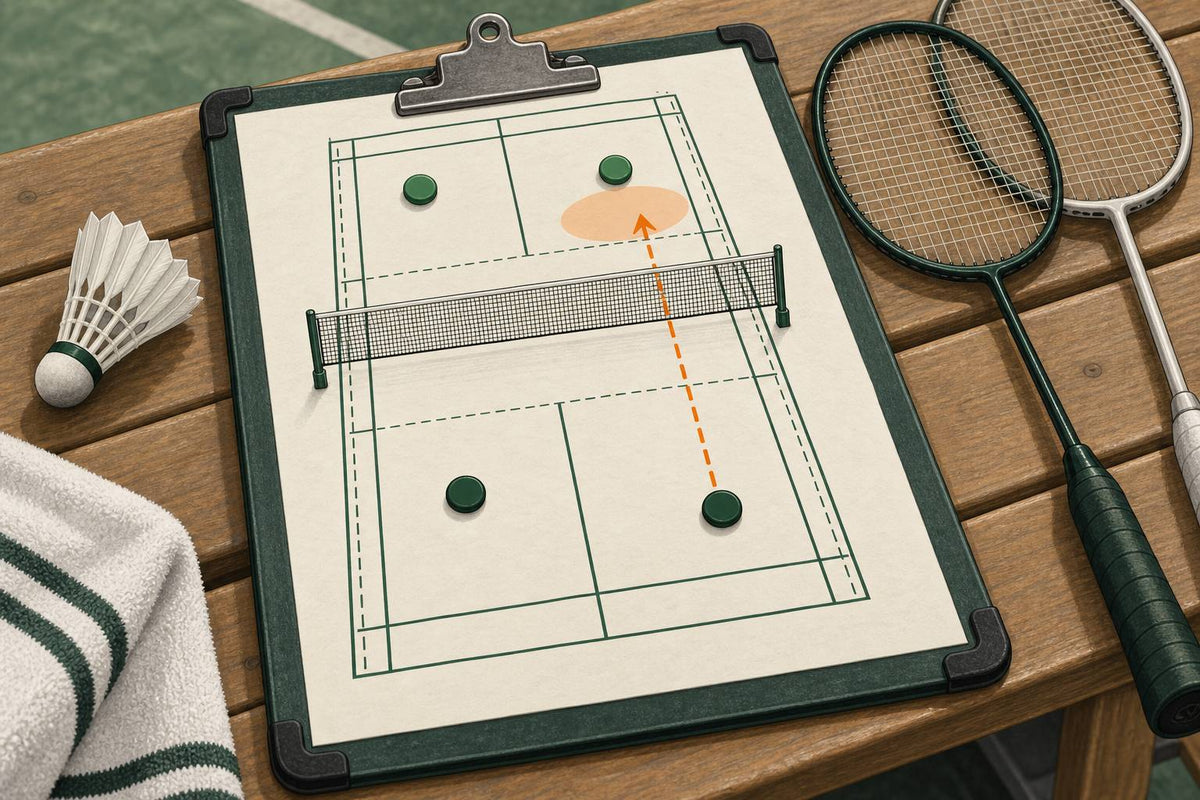
A local version can name roles, an objective, and a finishing point. For example, a coach may keep the same players and area, begin with predictable routes, then change one route; those are local design choices rather than a BWF-tested two-shuttle protocol.
What the cited material cannot say about two shuttles
For anticipation, use a practice that lets players read an opponent’s whole-body cues. BWF’s caution concerns structured multi-feeding; it does not validate or invalidate every two-shuttle variation. Choosing a sequence for a particular group remains a local coaching choice. BWF Level 3 Manual

Use this distinction on court
The useful safeguard in a two-shuttle activity is a shared way to simplify it. Before the first feed, state the players, usable area, sequence, reset, and the local question the extra shuttle is meant to make visible. If anyone can no longer describe that question, or the activity starts to interfere with another court, return to a one-shuttle task. A later version can be redesigned deliberately, but it should name the changed constraint rather than being treated as an automatic progression or a normal rally simulation.
Questions the cited sources do not settle
- A two-shuttle drill dose, safety protocol, or guarantee of anticipation and match transfer.
- A claim that the constraint reproduces official badminton.


Leave a comment
This site is protected by hCaptcha and the hCaptcha Privacy Policy and Terms of Service apply.