
Last checked: August 2026 · Written by the player-led team at Badminton House
Quick Answer: Badminton Cramps
Stop if you cannot control the muscle or move safely, let the spasm settle, and make a conservative decision about the next rally. For repeat episodes, look for a pattern in recent workload, recovery, conditions and symptoms instead of assuming one food or drink is the answer.
Now
Safety first: stop the rally and do not lunge, jump, or chase while the leg will not do what you ask.
Later
Record the setting and change one training variable at a time if the problem repeats.
A cramp during badminton is disruptive, painful and often alarming. It is also easy to over-explain. The useful first response is modest: protect your balance, stop forcing the affected area, and decide whether normal movement returns. The useful longer response is detective work, not a promise that one mineral, stretch, or drink will solve every episode.
Related reading: build a normal session plan with our badminton hydration and sweat-rate guide. Hydration can be part of preparation without being treated as a guaranteed cramp cure.
Why cramps can show up late in a hard badminton session
Exercise-associated cramps do not have one settled, universal cause. A sensible badminton interpretation is that an episode may reflect several inputs at once, including fatigue, unfamiliar work, the day’s conditions and the player’s own history. That uncertainty is why a single-product explanation is rarely helpful.
Badminton can repeatedly load the lower body through split steps, lunges, braking, recovery runs and changes of pace. It is reasonable to ask what changed before the episode: a return after time away, a longer hall day, an extra hard drill, poor recovery, travel, heat, or a different court routine. Those questions do not diagnose the cause. They give you a starting point for a safer next-session adjustment.
The evidence does not support reducing every exercise cramp to dehydration or electrolyte loss. Schwellnus’s review says the cause is still not well understood, notes that four prospective cohort studies did not support those hypotheses, and says evidence was accumulating for altered neuromuscular control while further evidence was still needed. Read the review abstract as a corrective to one-cause claims.
Late-session cramping can still be a useful clue, provided you keep the scope honest. In a large road-running sample, not badminton players, the fourth quarter was the most common reported onset and calves were the most commonly affected. That does not predict your next match. It does show why a late-race pattern should not automatically be treated as a unique badminton problem. The running study abstract gives the exact setting and figures.
What to do when a cramp starts on court
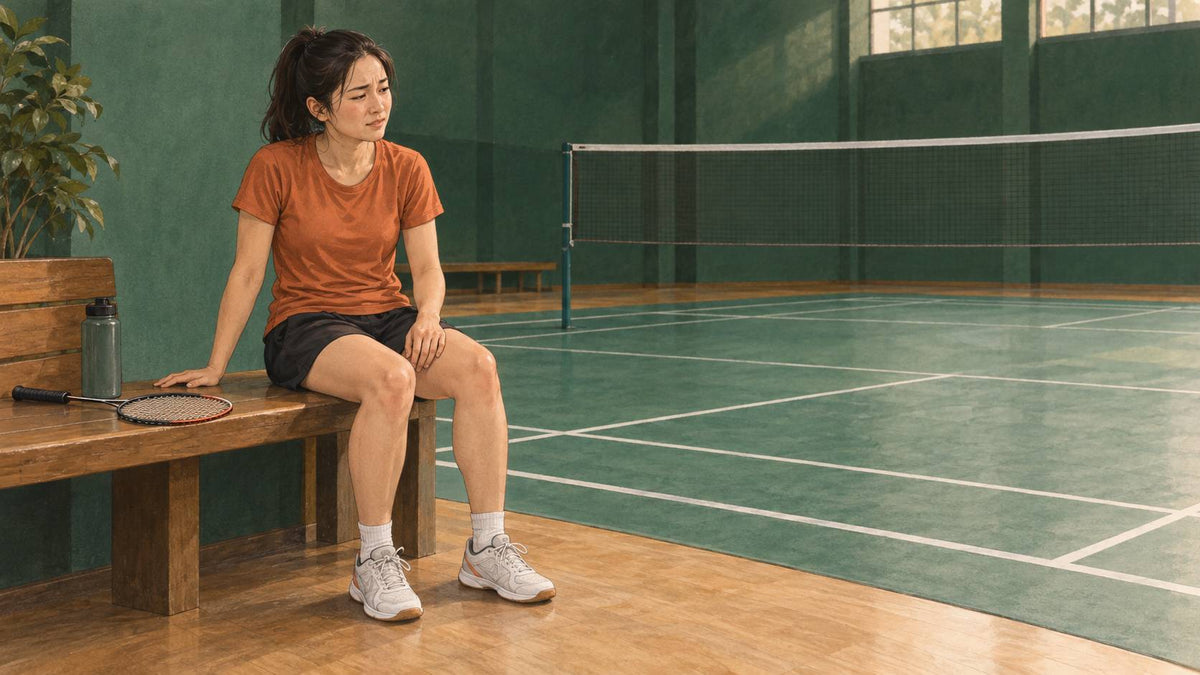
When a cramp interrupts a rally, make the immediate task safe and simple: stop, support yourself, and avoid movements you cannot control. A cautious response protects your balance and gives you information about whether ordinary walking returns before you decide to play again.
- End the point safely. Tell the people on court what happened. Do not keep hopping, lunging, or jumping on a leg that is spasming.
- Move to a stable position. Sit or stand with support. Let the muscle settle rather than forcing a large range of motion through sharp pain.
- Use gentle, comfortable movement. Some players find slowly lengthening the area and then walking a few normal steps more useful than staying completely still. Stop if it worsens pain or you cannot move normally.
- Reassess before returning. If you choose to continue, make the next rally lower demand. Do not use a social game to test repeated jumps or a full-court chase immediately after a spasm.
Drink if you are thirsty and use the normal break you would take between games. Avoid treating fluid as an instant reset button. The review above is precisely why an acute cramp should not be used as proof that you need to chug water, electrolytes, pickle juice, or any other specific remedy on the spot.
There is no prize for returning early. End the session if the spasm returns, walking stays abnormal, pain is significant, or you cannot make a controlled change of direction. Ask a clinician for individual advice for frequent, severe, unexplained, or persistent cramps, and seek urgent care for worrying symptoms such as chest pain, fainting, severe swelling, dark urine, or new numbness or weakness.
Make the next-session decision from a record, not a guess
After a cramp, write down the context while you remember it, then make one conservative change for the next comparable session. A short record cannot prove a cause, but it can show whether the same muscle, workload jump, late-session point, or condition keeps appearing.
Keep the note practical: date, muscle, when the cramp started, how many matches or drills came first, recent changes in court time, sleep, travel, hall conditions, and whether normal walking returned. Do not turn it into a diagnosis spreadsheet. The purpose is to replace “I cramped again” with a description that a coach, physiotherapist, or clinician can use.
For the next session, choose one reduction: fewer hard matches, shorter high-intensity blocks, less jump work, or more recovery between demanding rounds. Keep the rest of the routine familiar. If the episode does not recur, repeat the same manageable session before adding back volume. If it does recur under a similar load, pause the escalation and get individual input rather than piling on new remedies.
This approach is deliberately less exciting than a cure list. It makes the next decision testable. You learn whether a smaller workload, a different spacing of matches, or a return-to-court progression changes the pattern, without claiming that the change prevented cramps for every player.
Prepare for a demanding hall day without chasing a magic fix
Prepare for the work you actually plan to do: arrive with time to warm up, use ordinary food and drink you tolerate, and build demanding court time progressively. These choices support a repeatable routine, yet they should not be sold as guaranteed cramp prevention or as a substitute for medical assessment when symptoms are concerning.
A practical warm-up can move from easy court movement to controlled lunges, calf work, changes of direction and a few rallies before you play hard. The exact exercises matter less than avoiding a cold start followed by maximal movement. On a long club day, plan where your hardest matches sit and leave room to recover rather than treating every warm-up rally as another all-out test.
Build capacity gradually outside the hall too. If you are adding conditioning, strength work, jump drills, or extra matches, change one major demand at a time. The goal is not to exhaust a particular muscle in training. The goal is to give yourself a clear read on what volume you can repeat comfortably, then increase from there.
Keep food and fluid habits ordinary and repeatable. A banana, an electrolyte drink, or a strong-tasting shot may be part of a player’s routine, yet one cramp-free session cannot show which piece mattered. Avoid buying a supplement protocol from a single episode. Record the pattern, make one change, and seek professional advice if cramps keep interrupting sport or daily life.
Use the same restraint with footwear and technique changes. A new shoe, a different insole, or a revised lunge pattern may coincide with an episode, but coincidence is not proof. Keep the change noted, avoid several simultaneous experiments, and give yourself a simple comparison point on another ordinary session. That is more useful than declaring a single item either the culprit or the cure.
If you play several matches in one day, decide in advance what “enough” looks like. You might stop adding hard games after a planned number, or turn the final block into lower-intensity practice. This is a workload-management choice, not a medical treatment. It creates a repeatable boundary while you learn what your body tolerates and whether a clinician’s assessment is needed.
Keep that boundary flexible on the day. A session that feels unusually hard early is useful information, not a challenge to override. Leave with movement you can control, then use the notes to plan a steadier return.
Before your next badminton session
- Choose a realistic number of hard matches and schedule breaks.
- Warm up before the first fast change of direction or jump.
- If a cramp occurs, record the setting and reduce the next comparable demand.
- Get individual medical advice for repeat or concerning symptoms.


Leave a comment
This site is protected by hCaptcha and the hCaptcha Privacy Policy and Terms of Service apply.