
Last checked: August 2026 · Written by the player-led team at Badminton House
Quick Answer: All-Smash Defence Drill
Use a repeatable attacker role, a defender role, a defined return target, and a timed swap. The attacker supplies a challenging but controllable smash; the defender earns quality contacts rather than merely surviving.
Default
One attacker, one defender: run 75 seconds, rest while switching roles, then repeat the other side.
Goal
Count only defended shuttles that pass the service line on the opponent's side. This makes depth and control visible.
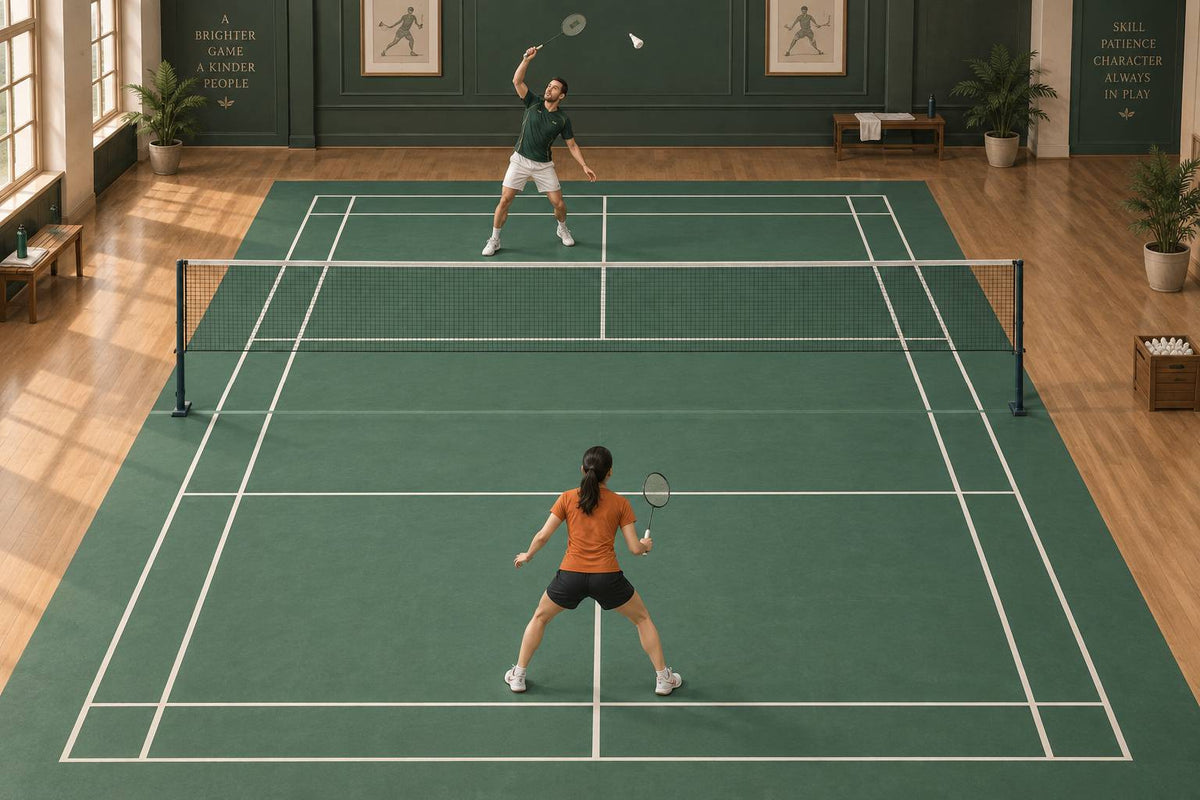
The all-smash badminton defence drill is deliberately narrow. One side keeps attacking; the other side keeps solving the same immediate problem: get a controlled return back while recovering for the next shuttle. That repetition exposes a weak ready position, an over-large swing, or a defender who can make one block but cannot make the second.
The drill is most useful when its rules stop the attacker from turning it into a winner contest. Your training aim is a stream of playable, varied smashes that asks for real decisions. It is not a test of who can hit hardest. For the block, lift, and drive mechanics themselves, start with our badminton smash defence guide.
The non-negotiable rule: the attacker must hit at a pace that gives the defender repeated contacts. If the defender is collecting shuttles instead of returning them, lower the pace before changing the defender's technique.
Set up the all-smash drill so every shuttle has a job
Put the attacker in the rear court with a feeder or a supply of lifted shuttles, put the defender in a realistic defensive base, and decide the permitted return before the timer starts. A fixed job turns fast repetition into feedback instead of a loose rally where nobody knows whether the return was useful.
The BWF Level 1 manual presents a simple linked sequence, “smash – block – block – lift,” and places progressive practice on a path from simple to complex, slow to fast, and predictable to unpredictable. That is a useful map for building this drill rather than jumping straight to full-speed chaos. See the BWF Level 1 coaching manual.
Start with a lift or hand feed that lets the attacker strike from a balanced rear-court position. The attacker smashes only after the feed is high enough to be a real overhead contact. The defender starts side-on enough to cover the body, with the racket in front, then returns to the same base after every shot. If the first feed is poor, reset it. A bad feed makes the attacker improvise and removes the repeatability you are trying to train.
| Role | Job | What counts as success |
|---|---|---|
| Attacker | Deliver a repeatable downward shuttle to the agreed channel. | The defender can contact it, but cannot simply stand still. |
| Defender | Choose the specified block, drive, or lift and recover. | The return crosses the net with intention and the defender is ready again. |
| Feeder or observer | Keep the feed honest and call the agreed score. | No disputed calls and no silent pace creep. |
Use pace and target rules that stretch the defender without ending the drill
Ask the attacker for a repeatable, sub-maximal smash into named lanes, then vary one variable only after the defender can make quality returns. A productive rep makes the defender move, read, and control the racket face; an unplayable ace gives neither player useful practice.
Begin with straight smashes to the defender's forehand or backhand hip. The attacker should aim through a lane, not chase the corners. Once the defender produces a few controlled blocks, add a body target or one wider smash. Do not introduce body, wide, straight, and cross-court targets in the same first set. You will no longer know whether the missed return came from the target, the pace, or the defender's preparation.
Use a simple pace check: after every five shuttles, the attacker should be able to say where the next five are going, and the defender should still be making contact. If either answer is no, reduce pace or narrow the lane. The suggested 70–80% effort is a coaching cue, not a universal measurement. Its purpose is repeatability.
When the attacker begins showing off, make the response immediate and neutral: stop the clock, replay the last five at the agreed pace, and count only returns from those five. Do not argue about effort. The observable standard is whether the attacker is producing a challenging contactable shuttle. A consistent feed is harder to deliver than a single spectacular smash.
Directional choices can become a later layer. The BWF manual uses a cross-court block off a straight smash and a straight block off a cross-court smash as midcourt-defence examples. Add that relationship only after the defender can return the predictable line with balance; the full examples appear in the BWF manual's midcourt-defence section.

Run timed sets and rotations that keep a group moving
Use short timed sets, a visible rotation order, and a rest period while players change jobs. For most club groups, 75 seconds of work followed by a role swap is long enough to reveal fading control and short enough for the attacker to keep delivering a disciplined, useful pace.
This is a proposed club protocol, not a research-mandated interval. Write the order on a shuttle tube or whiteboard before you begin: attacker, defender, feeder, waiting player. At the buzzer, every person moves one place clockwise. With four players, that gives each person a turn at every job before the next round. With five to eight, pair the waiting players as scorekeeper and shuttle collector, then bring them in together on the next rotation.
| Configuration | Use it for | Rotation |
|---|---|---|
| One-versus-one | A focused block, lift, or drive return. | 75 seconds, switch attacker and defender, then take a short reset. |
| One-versus-two | Doubles side-by-side defence with one attacker supplying the pressure. | Defending pair stays for one set, then one defender becomes attacker and the attacker joins defence. |
| Two-versus-two | A constrained doubles sequence after the basic drill is stable. | Attack pair for one set, defence pair for one set, then exchange ends and roles. |
For a one-versus-two version, place the defenders side by side and require the attacker to aim at the space between them, the outside hip, or a straight lane. Keep the defenders' first task simple: block or drive into a safe channel. The BWF doubles guidance explicitly uses blocks and drives into space to turn defence into attack, and its no-lift game is a good later constraint when your group can control the basic version.
Do not run a queue where one player smashes continuously for the whole session. Put the drill beside a lower-demand task such as feeding, observing, net control, or footwork without overhead hitting. The point is a balanced practice layout, not a medical guarantee. Repetitive smash practice has a different workload profile from games: in one 14-player study, repetitive practice showed greater anaerobic contribution and relative Player Load, and the authors suggested appropriate work:rest ratios for such practice. Read the workload comparison study for its measured protocol and limits.
Score the return, then change only one rule for the next set
Score controlled returns rather than winners, record one number per set, and change one drill variable at a time. This keeps progress visible: a defender can see whether better readiness or better target selection created more useful contacts, instead of guessing after a frantic sequence.
A practical score is “returns past the opponent's service line.” Award one point when the defender's block, drive, or lift crosses the net and lands beyond that line in play. Do not award a point for a floating return that lands short and is obviously attackable. The observer calls the score aloud, while the defender uses the score only after the set. During the set, the only cue is the chosen technical focus.
Use two identical sets before progressing. If the defender reaches a similar score with the same compact action, make one change: widen the attacker target, add the body line, permit one direction change, or ask for a different return. If the score collapses, return to the last stable version. This is a drill ladder, not a punishment test.
Run this on your next court session
- Choose one return: straight block, cross-court block, or controlled lift.
- Run 75 seconds with an attacker pace that creates repeated contacts.
- Swap roles, record returns past the service line, and repeat once.
- Change only one target or return rule for the next round.

Leave a comment
This site is protected by hCaptcha and the hCaptcha Privacy Policy and Terms of Service apply.